



 Chat with AI
Exam 8: Corporate Formation, Reorganization, and Liquidation

Exam 1: Business Income, Deductions, and Accounting Methods129 Questions
Exam 2: Property Acquisition and Cost Recovery131 Questions
Exam 3: Property Dispositions132 Questions
Exam 4: Business Entities Overview87 Questions
Exam 5: Corporate Operations126 Questions
Exam 6: Accounting for Income Taxes125 Questions
Exam 7: Corporate Taxation: Non-Liquidating Distributions122 Questions
Exam 8: Corporate Formation, Reorganization, and Liquidation121 Questions
Exam 9: Forming and Operating Partnerships131 Questions
Exam 10: Dispositions of Partnership Interests and Partnership Distributions118 Questions
Exam 11: S Corporations157 Questions
Exam 12: State and Local Taxes139 Questions
Exam 13: The Us Taxation of Multinational Transactions105 Questions
Exam 14: Transfer Taxes and Wealth Planning145 Questions
Select questions type


Maria defers $100 of gain realized in a §351 transaction. The stock she receives in the exchange has a fair market value of $500. Maria's tax basis in the stock will be $400.
(True/False)
4.9/5  (84)
(84) A liquidation of a corporation always is a taxable event for thenon-corporate shareholder(s) of the liquidated corporation.
(True/False)
4.9/5 (76)
(76) Roberta transfers property with a tax basis of $435 and a fair market value of $559 to a corporation in exchange for stock with a fair market value of $372 in a transaction that qualifies for deferral under section 351. The corporation assumed a liability of $187 on the property transferred. What is the amount realized by Roberta in the exchange?
(Multiple Choice)
4.8/5 (77)
(77) Carlos transfers property with a tax basis of $865 and a fair market value of $1,185 to a corporation in exchange for stock with a fair market value of $975 and $71 in cash in a transaction that qualifies for deferral under section 351. The corporation assumed a liability of $139 on the property transferred. What is the corporation's tax basis in the property received in the exchange?
(Multiple Choice)
4.7/5 (64)
(64) Which of the following statements best describes the recognition of loss on property transferred to shareholders in complete liquidation of a corporation?
(Multiple Choice)
4.8/5 (95)
(95) A liquidated corporation will always recognize loss in a complete liquidation where none of the shareholders is a corporation.
(True/False)
4.8/5 (71)
(71) Mike and Michelle decided to liquidate their jointly owned corporation, Pennsylvania Corporation. After liquidating its remaining inventory and paying off its remaining liabilities, Pennsylvania had the following tax accounting balance sheet.
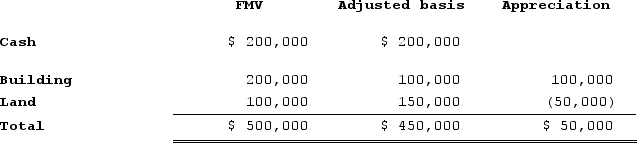 Under the terms of the agreement, Mike will receive the $200,000 cash in exchange for his 40 percent interest in Pennsylvania. Mike's tax basis in his Pennsylvania stock is $50,000. Michelle will receive the building and land in exchange for her 60 percent interest in Pennsylvania. Her tax basis in the Pennsylvania stock is $100,000.
What amount of gain or loss does Michelle recognize in the complete liquidation, and what is her tax basis in the building and land after the complete liquidation?
Under the terms of the agreement, Mike will receive the $200,000 cash in exchange for his 40 percent interest in Pennsylvania. Mike's tax basis in his Pennsylvania stock is $50,000. Michelle will receive the building and land in exchange for her 60 percent interest in Pennsylvania. Her tax basis in the Pennsylvania stock is $100,000.
What amount of gain or loss does Michelle recognize in the complete liquidation, and what is her tax basis in the building and land after the complete liquidation? (Essay)
4.9/5 (73)
(73) Keegan incorporated his sole proprietorship by transferring inventory, a building, and land to the corporation in return for 100 percent of the corporation's stock. The property transferred to the corporation had the following fair market values and tax-adjusted bases.
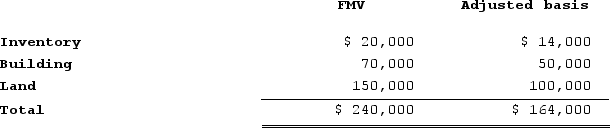 The fair market value of the corporation's stock received in the exchange equaled the fair market value of the assets transferred to the corporation by Keegan.
Assuming the gain or loss realized in this problem is deferred under §351, what is Keegan's basis in the stock he receives in his corporation?
The fair market value of the corporation's stock received in the exchange equaled the fair market value of the assets transferred to the corporation by Keegan.
Assuming the gain or loss realized in this problem is deferred under §351, what is Keegan's basis in the stock he receives in his corporation? (Essay)
4.8/5 (73)
(73) A taxpayer always will have a tax basis in boot received in a §351 transaction equal to its fair market value.
(True/False)
4.8/5 (83)
(83) Which of the following statements best describes the tax consequences of a §338 election?
(Multiple Choice)
4.9/5 (61)
(61) The definition of property as it relates to a §351 transaction includes money.
(True/False)
4.8/5 (81)
(81) Mike and Michelle decided to liquidate their jointly owned corporation, Pennsylvania Corporation. After liquidating its remaining inventory and paying off its remaining liabilities, Pennsylvania had the following tax accounting balance sheet.
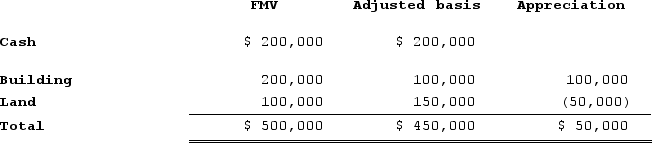 Under the terms of the agreement, Mike will receive the $200,000 cash in exchange for his 40 percent interest in Pennsylvania. Mike's tax basis in his Pennsylvania stock is $50,000. Michelle will receive the building and land in exchange for her 60 percent interest in Pennsylvania. Her tax basis in the Pennsylvania stock is $100,000.
What amount of gain or loss does Pennsylvania recognize in the complete liquidation?
Under the terms of the agreement, Mike will receive the $200,000 cash in exchange for his 40 percent interest in Pennsylvania. Mike's tax basis in his Pennsylvania stock is $50,000. Michelle will receive the building and land in exchange for her 60 percent interest in Pennsylvania. Her tax basis in the Pennsylvania stock is $100,000.
What amount of gain or loss does Pennsylvania recognize in the complete liquidation? (Essay)
4.7/5 (84)
(84) Paladin Corporation transferred its 90 percent interest to Furman Company as part of a complete liquidation of the company. In the exchange, Paladin received land with a fair market value of $1,000,000. The corporation's basis in the Furman Company stock was $400,000. The land had a basis to Furman Company of $200,000. What amount of gain does Paladin recognize in the exchange and what is its basis in the land it receives?
(Multiple Choice)
4.9/5 (86)
(86) In December 2019, Zeb incurred a $100,000 loss on the sale of Pike Corporation stock that he purchased in 2010. The stock satisfied all of the §1244 stock requirements at the time of issue. In addition, Zeb reported a long-term capital gain of $40,000 in 2019. Zeb is single. How much of the loss can Zeb deduct in 2019, and what is the character of the loss?
(Essay)
4.9/5 (78)
(78) Inez transfers property with a tax basis of $200 and a fair market value of $300 to a corporation in exchange for stock with a fair market value of $250 in a transaction that qualifies for deferral under §351. The corporation assumed a liability of $50 on the property transferred. What is the corporation's tax basis in the property received in the exchange?
(Multiple Choice)
4.9/5 (67)
(67) Which of the following statements best describes a §338 transaction?
(Multiple Choice)
4.7/5 (77)
(77) Mandel transferred property to his new corporation in a §351 transaction. Among the several properties transferred by Mandel was land with a fair market value of $200,000 and a tax basis of $250,000. In all cases, the corporation will always take a tax basis in the land of $200,000 to prevent the "built-in loss" from being transferred from Mandel to the corporation.
(True/False)
5.0/5 (96)
(96) Harry and Sally formed Empire Corporation on January 2. Harry contributed cash of $500,000 in return for 50 percent of the corporation's stock. Sally contributed a building and land with the following fair market values and adjusted basis in return for 50 percent of the corporation's stock.
 To equalize the exchange, Empire Corporation paid Sally $100,000 in addition to her stock.
a. What amount of gain or loss does Sally realize on the formation of the corporation?
b. What amount of gain or loss, if any, does she recognize?
c. What is Sally's tax basis in the stock she receives in return for her contribution of property to the corporation?
d. What adjusted basis does Empire Corporation take in the land and building received from Sally?
To equalize the exchange, Empire Corporation paid Sally $100,000 in addition to her stock.
a. What amount of gain or loss does Sally realize on the formation of the corporation?
b. What amount of gain or loss, if any, does she recognize?
c. What is Sally's tax basis in the stock she receives in return for her contribution of property to the corporation?
d. What adjusted basis does Empire Corporation take in the land and building received from Sally? (Essay)
4.9/5 (91)
(91) In December 2019, Zeb incurred a $110,500 loss on the sale of Pike Corporation stock that he purchased in 2010. The stock satisfied all of the §1244 stock requirements at the time of issue. In addition, Zeb reported a long-term capital gain of $47,000 in 2019. Zeb is single. How much of the loss can Zeb deduct in 2019, and what is the character of the loss?
(Essay)
4.8/5 (95)
(95) Julian transferred 100 percent of his stock in Lemon Company to Apricot Corporation in a Type B stock-for-stock exchange. In exchange, he received stock in Apricot with a fair market value of $205,000. Julian's tax basis in the Lemon stock was $410,000. What amount of loss does Julian recognize in the exchange and what is his basis in the Apricot stock he receives?
(Multiple Choice)
4.8/5 (78)
(78) 
Filters
- Essay(0)
- Multiple Choice(0)
- Short Answer(0)
- True False(0)
- Matching(0)