



 Chat with AI
Exam 20: Supplement C Special Inventory Models

Exam 1: Using Operations to Create Value115 Questions
Exam 2: Process Strategy and Analysis239 Questions
Exam 3: Quality and Performance198 Questions
Exam 4: Capacity Planning120 Questions
Exam 5: Constraint Management136 Questions
Exam 6: Lean Systems166 Questions
Exam 7: Project Management139 Questions
Exam 8: Forecasting150 Questions
Exam 9: Inventory Management205 Questions
Exam 10: Operations Planning and Scheduling149 Questions
Exam 11: Resource Planning124 Questions
Exam 12: Supply Chain Design77 Questions
Exam 13: Supply Chain Logistic Networks114 Questions
Exam 14: Supply Chain Integration120 Questions
Exam 15: Supply Chain Sustainability78 Questions
Exam 16: Supplement A Decision Making107 Questions
Exam 17: Supplement J Operations Scheduling123 Questions
Exam 18: Supplement K Layout39 Questions
Exam 19: Supplement B Waiting Lines111 Questions
Exam 20: Supplement C Special Inventory Models53 Questions
Exam 21: Supplement D Linear Programming87 Questions
Exam 22: Supplement E Simulation54 Questions
Exam 23: Supplement F Financial Analysis55 Questions
Exam 24: Supplement G Acceptance Sampling Plans87 Questions
Exam 25: Supplement H Measuring Output Rates108 Questions
Exam 26: Supplement I Learning Curve Analysis50 Questions
Select questions type


A newsstand is trying to determine how many bundles of newspapers to stock. For each bundle, the newsstand makes $20. However, they lose $5 per bundle if they do not sell. The following discrete probability distribution has been estimated for their daily demand. How many bundles should they stock?
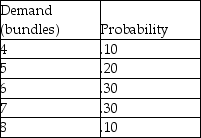
(Essay)
4.9/5  (83)
(83) Warren's Ice Cream makes 4 different flavors of ice cream using their secret process and top-secret recipes. Each of their flavors is equally popular and experiences a demand of 5,000 gallons/year. Warren's process is capable of producing 100 gallons/day once they incur the $25 setup cost. The ice cream holding cost is 10% of the $5 per gallon price. Warren's plant runs 250 days a year and stays busy doing so, but management feels they can add another flavor to their product line and increase their revenue. Which of the following statements is appropriate for this scenario?
(Multiple Choice)
4.9/5 (81)
(81) The ________ is the optimal lot size in situations in which replenishment is not instantaneous.
(Essay)
4.8/5 (83)
(83) Use of the single-period model will maximize profit in every season.
(True/False)
4.9/5 (82)
(82) The need for one-time inventory decisions also can arise in manufacturing plants when ________ items are made to a single order and ________ are high.
(Short Answer)
4.8/5 (81)
(81) A production manager is making a decision on batch size for a product with an annual demand of 25,000 units per year. The setup cost for each batch is $45 and once the setup is complete, the product may be produced at the rate of 650 units per day. There is a holding cost of $2 per unit per year and the plant operates on a 250-day production year. How big should the production batch be and how long (in days) will it take to produce the batch?
(Essay)
4.7/5 (73)
(73) In a one-period inventory model, the higher the after-season sales price, the higher the order placed at the start of the season.
(True/False)
4.7/5 (87)
(87) When faced with a quantity discount situation, the first EOQ should be calculated using the ________ price.
(Short Answer)
4.7/5 (78)
(78) Scenario C.1
Jerry Allison is in charge of production for a small producer of plumbing supplies. The cricket model has an estimated annual demand of 12,000 units and can be produced at a production rate of 90 units per day. The company produces (and sells) the cricket 300 days per year. Setup cost to produce this model averages $22 and the item has a holding cost of $3 per unit per year.
-Use the information in Scenario C.1. How many production runs per year are needed if Jerry chooses to produce at his economic production lot size (ELS)?
(Multiple Choice)
4.7/5 (81)
(81) As an inventory manager, you must decide on the order quantity for an item. Its annual demand is 1,000 units. Ordering costs are $50 each time an order is placed, and the holding cost is 25 percent of the per-unit price. Your supplier provided the following price schedule.
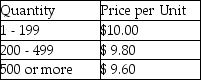 What ordering-quantity policy do you recommend?
 (Essay)
4.8/5 (80)
(80) Why are there discontinuities (areas where the curve jumps up or down and is not smooth) in the total cost curve in the quantity discount model?
(Essay)
4.9/5 (94)
(94) When facing quantity discounts, the EOQ found with the lowest price level is always the lowest total cost plan.
(True/False)
4.9/5 (80)
(80) Scenario C.2
Egan Schranz sells Klammelhoffer skis out of his store in the Alps. The store makes a $75 profit per unit sold during the ski season, but it will take a $25 loss per unit if sold after the season is over. The following discrete probability distribution has been estimated for the season's demand.
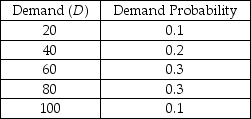 -Use the information in Scenario C.2. What is the best order quantity?
 (Multiple Choice)
4.8/5 (75)
(75) 
Filters
- Essay(0)
- Multiple Choice(0)
- Short Answer(0)
- True False(0)
- Matching(0)