



 Chat with AI
Exam 20: Supplement C Special Inventory Models

Exam 1: Using Operations to Create Value115 Questions
Exam 2: Process Strategy and Analysis239 Questions
Exam 3: Quality and Performance198 Questions
Exam 4: Capacity Planning120 Questions
Exam 5: Constraint Management136 Questions
Exam 6: Lean Systems166 Questions
Exam 7: Project Management139 Questions
Exam 8: Forecasting150 Questions
Exam 9: Inventory Management205 Questions
Exam 10: Operations Planning and Scheduling149 Questions
Exam 11: Resource Planning124 Questions
Exam 12: Supply Chain Design77 Questions
Exam 13: Supply Chain Logistic Networks114 Questions
Exam 14: Supply Chain Integration120 Questions
Exam 15: Supply Chain Sustainability78 Questions
Exam 16: Supplement A Decision Making107 Questions
Exam 17: Supplement J Operations Scheduling123 Questions
Exam 18: Supplement K Layout39 Questions
Exam 19: Supplement B Waiting Lines111 Questions
Exam 20: Supplement C Special Inventory Models53 Questions
Exam 21: Supplement D Linear Programming87 Questions
Exam 22: Supplement E Simulation54 Questions
Exam 23: Supplement F Financial Analysis55 Questions
Exam 24: Supplement G Acceptance Sampling Plans87 Questions
Exam 25: Supplement H Measuring Output Rates108 Questions
Exam 26: Supplement I Learning Curve Analysis50 Questions
Select questions type


For analysis using the economic production lot size (ELS) model to be useful, the producer must be able to produce the item faster than it is consumed.
(True/False)
4.8/5  (79)
(79) If demand exceeds the order quantity in a single period situation, then the payoff is simply the order quantity times the per unit profit.
(True/False)
4.8/5 (82)
(82) Briefly explain why the economic production lot size (ELS) is actually larger than the EOQ when there are noninstantaneous replenishments.
(Essay)
4.9/5 (68)
(68) The closer the in-season and after season sales price are, the lower the order placed at the start of the season.
(True/False)
4.9/5 (86)
(86) In an economic production lot size situation, the producer is producing half the time if the ratio of production rate to demand rate is ________.
(Short Answer)
4.8/5 (78)
(78) The time between orders is given by the formula ELS/D. What is the significance of its inverse, D/ELS?
(Multiple Choice)
5.0/5 (73)
(73) Pick any three products that occupy both extremes and the midpoint of the one-period model continuum. Explain why the products occupy these positions and identify the ideal inventory model for determining the best order quantity or each.
(Essay)
4.9/5 (69)
(69) Scenario C.1
Jerry Allison is in charge of production for a small producer of plumbing supplies. The cricket model has an estimated annual demand of 12,000 units and can be produced at a production rate of 90 units per day. The company produces (and sells) the cricket 300 days per year. Setup cost to produce this model averages $22 and the item has a holding cost of $3 per unit per year.
-Use the information in Scenario C.1. If Jerry chooses to produce batches dictated by the economic production lot size (ELS) model, how many days elapse between the start of consecutive production runs (what is the time between runs or TBO)?
(Multiple Choice)
4.9/5 (82)
(82) In a single period model, if the in-season demand is unexpectedly high, then the profit can be calculated as ________.
(Short Answer)
4.7/5 (69)
(69) Scenario C.1
Jerry Allison is in charge of production for a small producer of plumbing supplies. The cricket model has an estimated annual demand of 12,000 units and can be produced at a production rate of 90 units per day. The company produces (and sells) the cricket 300 days per year. Setup cost to produce this model averages $22 and the item has a holding cost of $3 per unit per year.
-Use the information in Scenario C.1. What is the maximum inventory if Jerry chooses to produce at the economic production lot size (ELS)?
(Multiple Choice)
4.8/5 (79)
(79) As an inventory manager, you must decide on the order quantity for an item. Its annual demand is 679 units. Ordering costs are $7 each time an order is placed, and the holding cost is 10% of the unit cost. Your supplier provided the following price schedule.
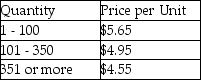 What ordering-quantity policy do you recommend?
 (Essay)
4.9/5 (78)
(78) Consider a manufacturer that uses the economic production lot size (ELS) model. What must be the relationship be between production rate and demand rate for the producer to spend exactly the same time in the production and demand portion of the inventory cycle as they spend in only the demand portion of the inventory cycle?
(Multiple Choice)
4.8/5 (74)
(74) Scenario C.1
Jerry Allison is in charge of production for a small producer of plumbing supplies. The cricket model has an estimated annual demand of 12,000 units and can be produced at a production rate of 90 units per day. The company produces (and sells) the cricket 300 days per year. Setup cost to produce this model averages $22 and the item has a holding cost of $3 per unit per year.
-Use the information in Scenario C.1. What is the economic production lot size (ELS)?
(Multiple Choice)
4.9/5 (91)
(91) Sketch the economic production lot size (ELS) graph of inventory level as a function of time and label all elements of the graph.
(Essay)
4.7/5 (76)
(76) The economic production lot size represents the maximum quantity of on-hand inventory for a manufacturer.
(True/False)
4.9/5 (86)
(86) Scenario C.2
Egan Schranz sells Klammelhoffer skis out of his store in the Alps. The store makes a $75 profit per unit sold during the ski season, but it will take a $25 loss per unit if sold after the season is over. The following discrete probability distribution has been estimated for the season's demand.
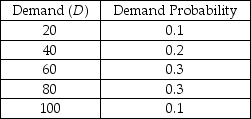 -Use the information in Scenario C.2. What is the payoff with an order quantity (Q) of 80 units if the demand (D) is 60 units?
 (Multiple Choice)
4.8/5 (67)
(67) Scenario C.3
Consider an item with the following discrete demand distribution for a one-period inventory decision.
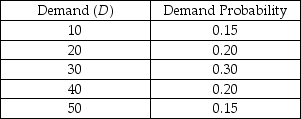 This item experiences a seasonal demand pattern. A profit of $15 per unit is made if the item is sold in season, but a loss of $10 per unit is incurred if the item is sold after the season is over.
-Use the information in Scenario C.3. What is the order quantity with the highest expected payoff?
This item experiences a seasonal demand pattern. A profit of $15 per unit is made if the item is sold in season, but a loss of $10 per unit is incurred if the item is sold after the season is over.
-Use the information in Scenario C.3. What is the order quantity with the highest expected payoff? (Multiple Choice)
4.9/5 (87)
(87) Walter White must satisfy an annual demand of 50,000 pounds per year. The setup cost for each batch is $6,500 and once the setup is complete, the product may be produced at the rate of 1800 pounds per day. There is a holding cost of $15 per unit per year and the plant operates on a 350-day production year. How big should the production batch be and how long (in days) will it take to produce the batch?
(Essay)
5.0/5 (81)
(81) Consider a manufacturer that uses the economic production lot size (ELS) model. What must the relationship be between production rate and demand rate for the producer to realize a maximum inventory that is exactly two-thirds of their lot size?
(Multiple Choice)
4.9/5 (92)
(92) A production manager uses the economic lot size approach to determine the batch size for a product with an annual demand of 20,000 units per year. The setup cost for each batch is $50 and once the setup is complete, the product may be produced at the rate of 800 units per day. There is a holding cost of $2 per unit per year and the plant operates on a 250-day production year. If the machine used to produce this product is needed for another item and it takes one day to set up regardless of product, how many production days are available for production of the new item?
(Essay)
4.9/5 (77)
(77) 
Filters
- Essay(0)
- Multiple Choice(0)
- Short Answer(0)
- True False(0)
- Matching(0)