



 Chat with AI
Exam 14: Periodic Motion

Exam 2: Motion Along a Straight Line55 Questions
Exam 3: Motion in Two or Three Dimensions59 Questions
Exam 4: Newtons Laws of Motion50 Questions
Exam 5: Applying Newtons Laws139 Questions
Exam 6: Work and Kinetic Energy109 Questions
Exam 7: Potential Energy and Energy Conservation50 Questions
Exam 8: Momentum, Impulse, and Collisions99 Questions
Exam 9: Rotation of Rigid Bodies26 Questions
Exam 10: Dynamics of Rotational Motion49 Questions
Exam 11: Equilibrium and Elasticity50 Questions
Exam 12: Fluid Mechanics54 Questions
Exam 13: Gravitation52 Questions
Exam 14: Periodic Motion109 Questions
Exam 15: Mechanical Waves50 Questions
Exam 16: Sound and Hearing121 Questions
Exam 17: Temperature and Heat60 Questions
Exam 18: Thermal Properties of Matter41 Questions
Exam 19: The First Law of Thermodynamics55 Questions
Exam 20: The Second Law of Thermodynamics52 Questions
Exam 21: Electric Charge and Electric Field54 Questions
Exam 22: Gausss Law54 Questions
Exam 23: Electric Potential88 Questions
Exam 24: Capacitance and Dielectrics70 Questions
Exam 25: Current, Resistance, and Electromotive Force44 Questions
Exam 26: Direct-Current Circuits51 Questions
Exam 27: Magnetic Field and Magnetic Forces105 Questions
Exam 28: Sources of Magnetic Field82 Questions
Exam 29: Electromagnetic Induction51 Questions
Exam 30: Inductance88 Questions
Exam 31: Alternating Current51 Questions
Exam 32: Electromagnetic Waves Optics53 Questions
Exam 33: The Nature and Propagation of Light31 Questions
Exam 34: Geometric Optics89 Questions
Exam 35: Interference59 Questions
Select questions type


Standing waves on a string: A thin taut string is fixed at both ends and stretched along the horizontal x-axis with its left end at x = 0. It is vibrating in its third OVERTONE, and the equation for the vertical displacement of any point on the string is y(x,t) = (1.22 cm) sin[(14.4 m-1)x] cos[(166 rad/s)t].
(a) What are the frequency and wavelength of the fundamental mode of this string?
(b) How long is the string?
(c) How fast do waves travel on this string?
(Essay)
4.9/5  (91)
(91) Beats: Two pure tones are sounded together and a particular beat frequency is heard. What happens to the beat frequency if the frequency of one of the tones is increased?
(Multiple Choice)
4.8/5 (95)
(95) Beats: A person is hearing two sound waves simultaneously. One has a period of 1.50 ms and the other one a period of 1.54 ms. What is the period of the beat due to these two waves?
(Multiple Choice)
4.9/5 (62)
(62) Mathematics of traveling waves: For the wave shown in the figure, the wavelength is 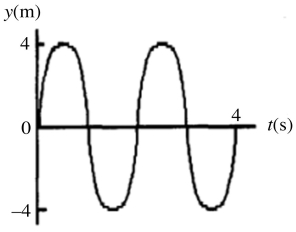
(Multiple Choice)
4.9/5 (80)
(80) Doppler effect: A bat emits a sound at a frequency of 30.0 kHz as it approaches a wall. The bat detects beats such that the frequency of the echo is 900 Hz higher than the frequency the bat is emitting. The speed of sound in air is 340 m/s. The speed of the bat is closest to
(Multiple Choice)
4.8/5 (78)
(78) Interference: The sound from a single source can reach point O by two different paths. One path is 20.0 m long and the second path is 21.0 m long. The sound destructively interferes at point O. What is the minimum frequency of the source if the speed of sound is 340 m/s?
(Multiple Choice)
4.7/5 (71)
(71) Sound level: The howler monkey is the loudest land animal and, under some circumstances, can be heard up to a distance of 8.9 km. Assume the acoustic output of a howler to be uniform in all directions and that the threshold of hearing is 1.0 × 10⁻¹² W/m2. A juvenile howler monkey has an acoustic output of  What is the ratio of the acoustic intensity produced by the juvenile howler to the reference intensity I0, at a distance of 210 m?
 (Multiple Choice)
4.9/5 (79)
(79) Sound level: A sound source emits 20.0 W of acoustical power spread equally in all directions. The threshold of hearing is 1.0 × 10⁻¹² W/m2. What is the sound intensity level 30.0 m from the source?
(Multiple Choice)
4.8/5 (80)
(80) Standing sound waves: A violin with string length 32 cm and string density  resonates with the first overtone from a 2.0-m long organ pipe with one end closed and the other end open. What is the tension in the string?
 (Multiple Choice)
4.9/5 (78)
(78) Doppler effect: A policeman in a stationary car measures the speed of approaching cars by means of an ultrasonic device that emits a sound with a frequency of 41.2 kHz. A car is approaching him at a speed of 33.0 m/s. The wave is reflected by the car and interferes with the emitted sound producing beats. What is the frequency of the beats? The speed of sound in air is 330 m/s.
(Multiple Choice)
4.8/5 (85)
(85) Sound level: A howler monkey is the loudest land animal and, under some circumstances, can be heard up to a distance of 5.0 km. Assume the acoustic output of a howler to be uniform in all directions and that the threshold of hearing is 1.0 × 10⁻¹² W/m2. The acoustic power emitted by the howler is closest to
(Multiple Choice)
4.9/5 (74)
(74) Shock waves: A jet aircraft, in level flight at constant speed, is observed directly overhead. A sonic boom is heard  later, at which time the line of sight to the aircraft forms a 56° angle with respect to the horizontal. The speed of sound is 325 m/s. What is the Mach number (the ratio of the speed of the jet to the speed of sound) for the aircraft?
 (Multiple Choice)
4.8/5 (84)
(84) Interference: Two loudspeakers placed 6.0 m apart are driven in phase by an audio oscillator whose frequency range is  to
 A point P is located
 from one loudspeaker and 3.6 m from the other. The speed of sound is 344 m/s. The frequency produced by the oscillator, for which constructive interference of sound occurs at point P, is closest to
to A point P is located from one loudspeaker and 3.6 m from the other. The speed of sound is 344 m/s. The frequency produced by the oscillator, for which constructive interference of sound occurs at point P, is closest to (Multiple Choice)
5.0/5 (78)
(78) Doppler effect: When a rocket is traveling toward a mountain at 100 m/s, the sound waves from this rocket's engine approach the mountain at speed V. If the rocket doubles its speed to 200 m/s, the sound waves from the engine will now approach the mountain at speed
(Multiple Choice)
4.8/5 (77)
(77) Beats: Two harmonic sound waves reach an observer simultaneously. The observer hears the sound intensity rise and fall with a time of 0.200 s between the maximum intensity and the succeeding minimum intensity. What is the difference in frequency of the two sound waves?
(Multiple Choice)
4.8/5 (75)
(75) Sound level: An enclosed chamber with sound absorbing walls has a 2.0 m × 1.0 m opening for an outside window. A loudspeaker is located outdoors, 78 m away and facing the window. The intensity level of the sound entering the window space from the loudspeaker is 79 dB. Assume the acoustic output of the loudspeaker is uniform in all directions and that the acoustic energy incident upon the ground is completely absorbed and therefore is not reflected into the window. The threshold of hearing is 1.0 × 10⁻¹² W/m2. The acoustic power entering through the window space is closest to
(Multiple Choice)
4.7/5 (81)
(81) Intensity: The intensity of sunlight falling on the earth is about 1.4 kW/m2 (before any gets absorbed by our atmosphere). At what rate does the sun emit light energy? (The earth-sun distance = 1.5 × 10⁸ km and the earth's radius = 6.4 × 10³ km.)
(Multiple Choice)
4.9/5 (95)
(95) Standing waves of frequency 57 Hz are produced on a string that has mass per unit length 0.0160 kg/m. With what tension must the string be stretched between two supports if adjacent nodes in the standing wave are to be 0.71 meters apart?
(Short Answer)
4.8/5 (74)
(74) Waves on a string: Waves travel along a 100-m length of string which has a mass of 55 g and is held taut with a tension of 75 N. What is the speed of the waves?
(Multiple Choice)
4.9/5 (79)
(79) Standing sound waves: A string, 0.28 m long and vibrating in its third harmonic, excites an open pipe that is 0.82 m long into its second overtone resonance. The speed of sound in air is 345 m/s. The speed of transverse waves on the string is closest to
(Multiple Choice)
4.8/5 (83)
(83) 
Filters
- Essay(0)
- Multiple Choice(0)
- Short Answer(0)
- True False(0)
- Matching(0)