
Exam 2: Motion Along a Straight Line

arrow
  • Select Tags
search iconSearch Question
  • Select Tags

Scalar (dot) product: Determine the angle between the directions of vector Scalar (dot) product: Determine the angle between the directions of vector   = 3.00   + 1.00   and vector   = -3.00   + 3.00   . = 3.00 Scalar (dot) product: Determine the angle between the directions of vector   = 3.00   + 1.00   and vector   = -3.00   + 3.00   . + 1.00 Scalar (dot) product: Determine the angle between the directions of vector   = 3.00   + 1.00   and vector   = -3.00   + 3.00   . and vector Scalar (dot) product: Determine the angle between the directions of vector   = 3.00   + 1.00   and vector   = -3.00   + 3.00   . = -3.00 Scalar (dot) product: Determine the angle between the directions of vector   = 3.00   + 1.00   and vector   = -3.00   + 3.00   . + 3.00 Scalar (dot) product: Determine the angle between the directions of vector   = 3.00   + 1.00   and vector   = -3.00   + 3.00   . .

(Multiple Choice)
4.9/5
(84)

Vector (cross) product: If two vectors point in opposite directions, their cross product must be zero.

(True/False)
4.9/5
(86)

Scalar (dot) product: If the dot product of two nonzero vectors is zero, the vectors must be perpendicular to each other.

(True/False)
4.7/5
(87)

Scalar (dot) product: For the vectors shown in the figure, assume numbers are accurate to two significant figures. The scalar product Scalar (dot) product: For the vectors shown in the figure, assume numbers are accurate to two significant figures. The scalar product   ×   is closest to  × Scalar (dot) product: For the vectors shown in the figure, assume numbers are accurate to two significant figures. The scalar product   ×   is closest to  is closest to Scalar (dot) product: For the vectors shown in the figure, assume numbers are accurate to two significant figures. The scalar product   ×   is closest to
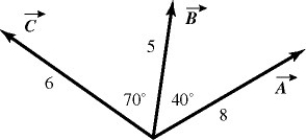
(Multiple Choice)
4.9/5
(81)

Unit vectors: If all the components of a vector are equal to 1, then that vector is a unit vector.

(True/False)
4.8/5
(85)

Unit vectors: Vectors Unit vectors: Vectors   and   are shown in the figure. What is |-5.00   + 4.00   |  and Unit vectors: Vectors   and   are shown in the figure. What is |-5.00   + 4.00   |  are shown in the figure. What is |-5.00 Unit vectors: Vectors   and   are shown in the figure. What is |-5.00   + 4.00   |  + 4.00 Unit vectors: Vectors   and   are shown in the figure. What is |-5.00   + 4.00   |  | Unit vectors: Vectors   and   are shown in the figure. What is |-5.00   + 4.00   |
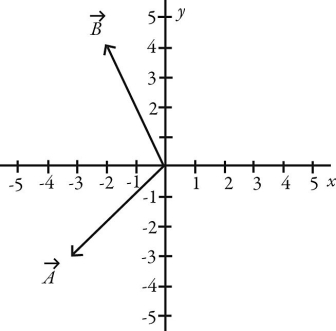
(Multiple Choice)
5.0/5
(56)

Addition and subtraction: If A > B, under what condition is | Addition and subtraction: If A > B, under what condition is |   -   | = A - B? - Addition and subtraction: If A > B, under what condition is |   -   | = A - B? | = A - B?

(Multiple Choice)
4.8/5
(76)

Unit vectors: Vector Unit vectors: Vector   = -3.00   + 3.00   and vector   = 3.00   + 4.00   . What is vector   =   +   ? = -3.00 Unit vectors: Vector   = -3.00   + 3.00   and vector   = 3.00   + 4.00   . What is vector   =   +   ? + 3.00 Unit vectors: Vector   = -3.00   + 3.00   and vector   = 3.00   + 4.00   . What is vector   =   +   ? and vector Unit vectors: Vector   = -3.00   + 3.00   and vector   = 3.00   + 4.00   . What is vector   =   +   ? = 3.00 Unit vectors: Vector   = -3.00   + 3.00   and vector   = 3.00   + 4.00   . What is vector   =   +   ? + 4.00 Unit vectors: Vector   = -3.00   + 3.00   and vector   = 3.00   + 4.00   . What is vector   =   +   ? . What is vector Unit vectors: Vector   = -3.00   + 3.00   and vector   = 3.00   + 4.00   . What is vector   =   +   ? = Unit vectors: Vector   = -3.00   + 3.00   and vector   = 3.00   + 4.00   . What is vector   =   +   ? + Unit vectors: Vector   = -3.00   + 3.00   and vector   = 3.00   + 4.00   . What is vector   =   +   ? ?

(Multiple Choice)
4.8/5
(81)

Components: In the figure, the magnitude of vector Components: In the figure, the magnitude of vector   is 18.0 units, and the magnitude of vector   is 12.0 units. What vector   must be added to the vectors   and   so that the resultant of these three vectors points in the -x direction and has a magnitude of 7.50 units? Use vector components to find your answer, and express vector   by giving its magnitude and the angle it makes with the +x-axis taking counterclockwise to be positive.  is 18.0 units, and the magnitude of vector Components: In the figure, the magnitude of vector   is 18.0 units, and the magnitude of vector   is 12.0 units. What vector   must be added to the vectors   and   so that the resultant of these three vectors points in the -x direction and has a magnitude of 7.50 units? Use vector components to find your answer, and express vector   by giving its magnitude and the angle it makes with the +x-axis taking counterclockwise to be positive.  is 12.0 units. What vector Components: In the figure, the magnitude of vector   is 18.0 units, and the magnitude of vector   is 12.0 units. What vector   must be added to the vectors   and   so that the resultant of these three vectors points in the -x direction and has a magnitude of 7.50 units? Use vector components to find your answer, and express vector   by giving its magnitude and the angle it makes with the +x-axis taking counterclockwise to be positive.  must be added to the vectors Components: In the figure, the magnitude of vector   is 18.0 units, and the magnitude of vector   is 12.0 units. What vector   must be added to the vectors   and   so that the resultant of these three vectors points in the -x direction and has a magnitude of 7.50 units? Use vector components to find your answer, and express vector   by giving its magnitude and the angle it makes with the +x-axis taking counterclockwise to be positive.  and Components: In the figure, the magnitude of vector   is 18.0 units, and the magnitude of vector   is 12.0 units. What vector   must be added to the vectors   and   so that the resultant of these three vectors points in the -x direction and has a magnitude of 7.50 units? Use vector components to find your answer, and express vector   by giving its magnitude and the angle it makes with the +x-axis taking counterclockwise to be positive.  so that the resultant of these three vectors points in the -x direction and has a magnitude of 7.50 units? Use vector components to find your answer, and express vector Components: In the figure, the magnitude of vector   is 18.0 units, and the magnitude of vector   is 12.0 units. What vector   must be added to the vectors   and   so that the resultant of these three vectors points in the -x direction and has a magnitude of 7.50 units? Use vector components to find your answer, and express vector   by giving its magnitude and the angle it makes with the +x-axis taking counterclockwise to be positive.  by giving its magnitude and the angle it makes with the +x-axis taking counterclockwise to be positive. Components: In the figure, the magnitude of vector   is 18.0 units, and the magnitude of vector   is 12.0 units. What vector   must be added to the vectors   and   so that the resultant of these three vectors points in the -x direction and has a magnitude of 7.50 units? Use vector components to find your answer, and express vector   by giving its magnitude and the angle it makes with the +x-axis taking counterclockwise to be positive.
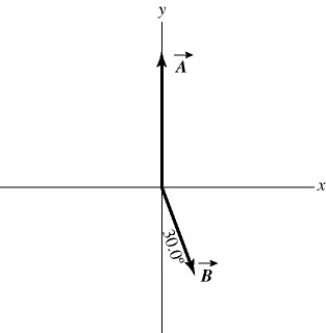
(Short Answer)
4.7/5
(84)

Vector (cross) product: If Vector (cross) product: If   = -2   - 6   + 2   and   = - 2   -2   - 3   , which of the following numbers is closest to the magnitude of   ×   ? = -2 Vector (cross) product: If   = -2   - 6   + 2   and   = - 2   -2   - 3   , which of the following numbers is closest to the magnitude of   ×   ? - 6 Vector (cross) product: If   = -2   - 6   + 2   and   = - 2   -2   - 3   , which of the following numbers is closest to the magnitude of   ×   ? + 2 Vector (cross) product: If   = -2   - 6   + 2   and   = - 2   -2   - 3   , which of the following numbers is closest to the magnitude of   ×   ? and Vector (cross) product: If   = -2   - 6   + 2   and   = - 2   -2   - 3   , which of the following numbers is closest to the magnitude of   ×   ? = - 2 Vector (cross) product: If   = -2   - 6   + 2   and   = - 2   -2   - 3   , which of the following numbers is closest to the magnitude of   ×   ? -2 Vector (cross) product: If   = -2   - 6   + 2   and   = - 2   -2   - 3   , which of the following numbers is closest to the magnitude of   ×   ? - 3 Vector (cross) product: If   = -2   - 6   + 2   and   = - 2   -2   - 3   , which of the following numbers is closest to the magnitude of   ×   ? , which of the following numbers is closest to the magnitude of Vector (cross) product: If   = -2   - 6   + 2   and   = - 2   -2   - 3   , which of the following numbers is closest to the magnitude of   ×   ? × Vector (cross) product: If   = -2   - 6   + 2   and   = - 2   -2   - 3   , which of the following numbers is closest to the magnitude of   ×   ? ?

(Multiple Choice)
4.9/5
(84)

Addition and subtraction: You walk Addition and subtraction: You walk   to the north, then turn 60° to your right and walk another   How far are you from where you originally started? to the north, then turn 60° to your right and walk another Addition and subtraction: You walk   to the north, then turn 60° to your right and walk another   How far are you from where you originally started? How far are you from where you originally started?

(Multiple Choice)
4.9/5
(83)

Components: The magnitude of a vector can never be less than the magnitude of one of its components.

(True/False)
4.9/5
(83)

Components: The components of vector Components: The components of vector   are A<sub>x</sub> = + 3.90 and A<sub>y</sub> = -4.00. What is the angle measured counterclockwise from the +x-axis to vector   ? are Ax = + 3.90 and Ay = -4.00. What is the angle measured counterclockwise from the +x-axis to vector Components: The components of vector   are A<sub>x</sub> = + 3.90 and A<sub>y</sub> = -4.00. What is the angle measured counterclockwise from the +x-axis to vector   ? ?

(Multiple Choice)
4.7/5
(84)

Unit vectors: Vector Unit vectors: Vector   = 1.00   + -2.00   and vector   = 3.00   + 4.00   What are the magnitude and direction of vector   =   +   ? = 1.00 Unit vectors: Vector   = 1.00   + -2.00   and vector   = 3.00   + 4.00   What are the magnitude and direction of vector   =   +   ? + -2.00 Unit vectors: Vector   = 1.00   + -2.00   and vector   = 3.00   + 4.00   What are the magnitude and direction of vector   =   +   ? and vector Unit vectors: Vector   = 1.00   + -2.00   and vector   = 3.00   + 4.00   What are the magnitude and direction of vector   =   +   ? = 3.00 Unit vectors: Vector   = 1.00   + -2.00   and vector   = 3.00   + 4.00   What are the magnitude and direction of vector   =   +   ? + 4.00 Unit vectors: Vector   = 1.00   + -2.00   and vector   = 3.00   + 4.00   What are the magnitude and direction of vector   =   +   ? What are the magnitude and direction of vector Unit vectors: Vector   = 1.00   + -2.00   and vector   = 3.00   + 4.00   What are the magnitude and direction of vector   =   +   ? = Unit vectors: Vector   = 1.00   + -2.00   and vector   = 3.00   + 4.00   What are the magnitude and direction of vector   =   +   ? + Unit vectors: Vector   = 1.00   + -2.00   and vector   = 3.00   + 4.00   What are the magnitude and direction of vector   =   +   ? ?

(Multiple Choice)
4.9/5
(71)

Scalar (dot) product: The value of the dot product of two vectors depends on the particular coordinate system being used.

(True/False)
4.9/5
(68)

Unit vectors: If Unit vectors: If   = + 4   - 2   - 3   and   = - 4   -2   - 3   , which of the following numbers is closest to the magnitude of   -   ? = + 4 Unit vectors: If   = + 4   - 2   - 3   and   = - 4   -2   - 3   , which of the following numbers is closest to the magnitude of   -   ? - 2 Unit vectors: If   = + 4   - 2   - 3   and   = - 4   -2   - 3   , which of the following numbers is closest to the magnitude of   -   ? - 3 Unit vectors: If   = + 4   - 2   - 3   and   = - 4   -2   - 3   , which of the following numbers is closest to the magnitude of   -   ? and Unit vectors: If   = + 4   - 2   - 3   and   = - 4   -2   - 3   , which of the following numbers is closest to the magnitude of   -   ? = - 4 Unit vectors: If   = + 4   - 2   - 3   and   = - 4   -2   - 3   , which of the following numbers is closest to the magnitude of   -   ? -2 Unit vectors: If   = + 4   - 2   - 3   and   = - 4   -2   - 3   , which of the following numbers is closest to the magnitude of   -   ? - 3 Unit vectors: If   = + 4   - 2   - 3   and   = - 4   -2   - 3   , which of the following numbers is closest to the magnitude of   -   ? , which of the following numbers is closest to the magnitude of Unit vectors: If   = + 4   - 2   - 3   and   = - 4   -2   - 3   , which of the following numbers is closest to the magnitude of   -   ? - Unit vectors: If   = + 4   - 2   - 3   and   = - 4   -2   - 3   , which of the following numbers is closest to the magnitude of   -   ? ?

(Multiple Choice)
4.8/5
(76)

Scalar (dot) product: Determine the scalar product of Scalar (dot) product: Determine the scalar product of   = 6.0   + 4.0   - 2.0   and   = 5.0   - 6.0   - 3.0   . = 6.0 Scalar (dot) product: Determine the scalar product of   = 6.0   + 4.0   - 2.0   and   = 5.0   - 6.0   - 3.0   . + 4.0 Scalar (dot) product: Determine the scalar product of   = 6.0   + 4.0   - 2.0   and   = 5.0   - 6.0   - 3.0   . - 2.0 Scalar (dot) product: Determine the scalar product of   = 6.0   + 4.0   - 2.0   and   = 5.0   - 6.0   - 3.0   . and Scalar (dot) product: Determine the scalar product of   = 6.0   + 4.0   - 2.0   and   = 5.0   - 6.0   - 3.0   . = 5.0 Scalar (dot) product: Determine the scalar product of   = 6.0   + 4.0   - 2.0   and   = 5.0   - 6.0   - 3.0   . - 6.0 Scalar (dot) product: Determine the scalar product of   = 6.0   + 4.0   - 2.0   and   = 5.0   - 6.0   - 3.0   . - 3.0 Scalar (dot) product: Determine the scalar product of   = 6.0   + 4.0   - 2.0   and   = 5.0   - 6.0   - 3.0   . .

(Multiple Choice)
4.9/5
(83)

Scalar (dot) product: If two nonzero vectors point in the same direction, their dot product must be zero.

(True/False)
4.8/5
(79)

Components: As shown in the figure, three force vectors act on an object. The magnitudes of the forces as shown in the figure are F1 = 80.0 N, F2 = 60.0 N, and F3 = 40.0 N, where N is the standard SI unit of force. The resultant force acting on the object is given by Components: As shown in the figure, three force vectors act on an object. The magnitudes of the forces as shown in the figure are F<sub>1</sub> = 80.0 N, F<sub>2</sub> = 60.0 N, and F<sub>3</sub> = 40.0 N, where N is the standard SI unit of force. The resultant force acting on the object is given by
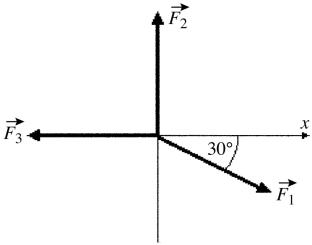
(Multiple Choice)
5.0/5
(75)

Vector (cross) product: What is the vector product of Vector (cross) product: What is the vector product of   = 2.00   + 3.00   + 1.00   and   = 1.00   - 3.00   - 2.00   ? = 2.00 Vector (cross) product: What is the vector product of   = 2.00   + 3.00   + 1.00   and   = 1.00   - 3.00   - 2.00   ? + 3.00 Vector (cross) product: What is the vector product of   = 2.00   + 3.00   + 1.00   and   = 1.00   - 3.00   - 2.00   ? + 1.00 Vector (cross) product: What is the vector product of   = 2.00   + 3.00   + 1.00   and   = 1.00   - 3.00   - 2.00   ? and Vector (cross) product: What is the vector product of   = 2.00   + 3.00   + 1.00   and   = 1.00   - 3.00   - 2.00   ? = 1.00 Vector (cross) product: What is the vector product of   = 2.00   + 3.00   + 1.00   and   = 1.00   - 3.00   - 2.00   ? - 3.00 Vector (cross) product: What is the vector product of   = 2.00   + 3.00   + 1.00   and   = 1.00   - 3.00   - 2.00   ? - 2.00 Vector (cross) product: What is the vector product of   = 2.00   + 3.00   + 1.00   and   = 1.00   - 3.00   - 2.00   ? ?

(Multiple Choice)
4.7/5
(77)
Showing 21 - 40 of 55
close modal

Filters

  • Essay(0)
  • Multiple Choice(0)
  • Short Answer(0)
  • True False(0)
  • Matching(0)