



 Chat with AI
Exam 20: The Second Law of Thermodynamics

Exam 2: Motion Along a Straight Line55 Questions
Exam 3: Motion in Two or Three Dimensions59 Questions
Exam 4: Newtons Laws of Motion50 Questions
Exam 5: Applying Newtons Laws139 Questions
Exam 6: Work and Kinetic Energy109 Questions
Exam 7: Potential Energy and Energy Conservation50 Questions
Exam 8: Momentum, Impulse, and Collisions99 Questions
Exam 9: Rotation of Rigid Bodies26 Questions
Exam 10: Dynamics of Rotational Motion49 Questions
Exam 11: Equilibrium and Elasticity50 Questions
Exam 12: Fluid Mechanics54 Questions
Exam 13: Gravitation52 Questions
Exam 14: Periodic Motion109 Questions
Exam 15: Mechanical Waves50 Questions
Exam 16: Sound and Hearing121 Questions
Exam 17: Temperature and Heat60 Questions
Exam 18: Thermal Properties of Matter41 Questions
Exam 19: The First Law of Thermodynamics55 Questions
Exam 20: The Second Law of Thermodynamics52 Questions
Exam 21: Electric Charge and Electric Field54 Questions
Exam 22: Gausss Law54 Questions
Exam 23: Electric Potential88 Questions
Exam 24: Capacitance and Dielectrics70 Questions
Exam 25: Current, Resistance, and Electromotive Force44 Questions
Exam 26: Direct-Current Circuits51 Questions
Exam 27: Magnetic Field and Magnetic Forces105 Questions
Exam 28: Sources of Magnetic Field82 Questions
Exam 29: Electromagnetic Induction51 Questions
Exam 30: Inductance88 Questions
Exam 31: Alternating Current51 Questions
Exam 32: Electromagnetic Waves Optics53 Questions
Exam 33: The Nature and Propagation of Light31 Questions
Exam 34: Geometric Optics89 Questions
Exam 35: Interference59 Questions
Select questions type


Energy in capacitors: The capacitive network shown in the figure is assembled with initially uncharged capacitors. A potential difference, Vab = +100V, is applied across the network. The switch S in the network is kept open. Assume that all the capacitances shown are accurate to two significant figures. What is the total energy stored in the seven capacitors? 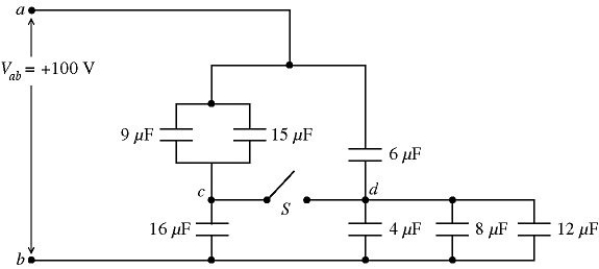
(Multiple Choice)
4.9/5  (85)
(85) Dielectrics: A 15-μF air-filled capacitor is connected to a 50-V voltage source and becomes fully charged. The voltage source is then removed and a slab of dielectric that completely fills the space between the plates is inserted. The dielectric has a dielectric constant of 5.0.
(a) What is the capacitance of the capacitor after the slab has been inserted?
(b) What is the potential difference across the plates of the capacitor after the slab has been inserted?
(Essay)
4.7/5 (77)
(77) Capacitors in combination: Three capacitors, with capacitances  = 4.0 μF,
 = 3.0 μF, and
 = 2.0 μF, are connected to a 12 -V voltage source, as shown in the figure. What is the charge on capacitor
 ?
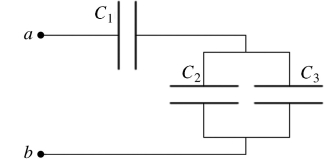
= 4.0 μF, = 3.0 μF, and = 2.0 μF, are connected to a 12 -V voltage source, as shown in the figure. What is the charge on capacitor ? (Multiple Choice)
4.9/5 (77)
(77) Dielectrics: A 6.0-μF air-filled capacitor is connected across a 100-V voltage source. After the source fully charges the capacitor, the capacitor is immersed in transformer oil (of dielectric constant 4.5). How much ADDITIONAL charge flows from the voltage source, which remained connected during the process?
(Multiple Choice)
4.9/5 (70)
(70) Energy density: Each plate of an air-filled parallel-plate air capacitor has an area of 0.0040 m2, and the separation of the plates is 0.080 mm. An electric field of 5.3 × 10⁶ V/m is present between the plates. What is the energy density between the plates? (ε0 = 8.85 × 10⁻¹² C2/N ∙ m2)
(Multiple Choice)
4.9/5 (79)
(79) Cylindrical capacitors: An air-filled capacitor is formed from two long conducting cylindrical shells that are coaxial and have radii of  and
 The electric potential of the inner conductor with respect to the outer conductor is
 (k = 1/4πε0 = 8.99 × 10⁹ N ∙ m2/C2) The energy stored in a 1.0-m length of this capacitor is closest to
and The electric potential of the inner conductor with respect to the outer conductor is (k = 1/4πε0 = 8.99 × 10⁹ N ∙ m2/C2) The energy stored in a 1.0-m length of this capacitor is closest to (Multiple Choice)
4.9/5 (82)
(82) Cylindrical capacitors: The capacitance per unit length of a very long coaxial cable, made of two concentric cylinders, is 50 pF/m. What is the radius of the outer cylinder if the radius of the inner one is 1.0 mm? (k = 1/4πε0 = 8.99 × 10⁹ N ∙ m2/C2)
(Multiple Choice)
4.7/5 (97)
(97) Dielectrics: A parallel-plate capacitor, with air between the plates, is connected across a voltage source. This source establishes a potential difference between the plates by placing charge of magnitude  on each plate. The space between the plates is then filled with a dielectric material, with a dielectric constant of 7.74. What must the magnitude of the charge on each capacitor plate now be, to produce the same potential difference between the plates as before?
 (Short Answer)
4.9/5 (77)
(77) Capacitors in combination: The network shown in the figure is assembled with uncharged capacitors X, Y, and Z, with 
 , and
 and open switches, S1 and S2. A potential difference Vab = +120 V is applied between points a and b. After the network is assembled, switch S1 is closed for a long time, but switch S2 is kept open. Then switch S1 is opened and switch S2 is closed. What is the final voltage across capacitor X?
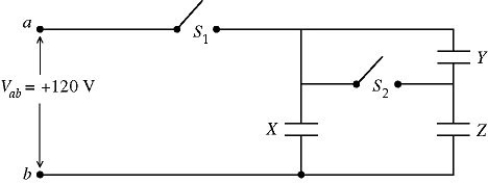
, and and open switches, S1 and S2. A potential difference Vab = +120 V is applied between points a and b. After the network is assembled, switch S1 is closed for a long time, but switch S2 is kept open. Then switch S1 is opened and switch S2 is closed. What is the final voltage across capacitor X? (Multiple Choice)
4.9/5 (79)
(79) Parallel-plate capacitors: The electric field between square the plates of a parallel-plate capacitor has magnitude E. The potential across the plates is maintained with constant voltage by a battery as they are pulled apart to twice their original separation, which is small compared to the dimensions of the plates. The magnitude of the electric field between the plates is now equal to
(Multiple Choice)
4.8/5 (74)
(74) Cylindrical capacitors: An air-filled capacitor is formed from two long conducting cylindrical shells that are coaxial and have radii of  and
 The electric potential of the inner conductor with respect to the outer conductor is
 (k = 1/4πε0 = 8.99 × 10⁹ N ∙ m2/C2) The maximum energy density of the capacitor is closest to
and The electric potential of the inner conductor with respect to the outer conductor is (k = 1/4πε0 = 8.99 × 10⁹ N ∙ m2/C2) The maximum energy density of the capacitor is closest to (Multiple Choice)
4.9/5 (79)
(79) Dielectrics: A charged capacitor stores energy U. Without connecting this capacitor to anything, dielectric having dielectric constant K is now inserted between the plates of the capacitor, completely filling the space between them. How much energy does the capacitor now store?
(Multiple Choice)
4.8/5 (83)
(83) 
Filters
- Essay(0)
- Multiple Choice(0)
- Short Answer(0)
- True False(0)
- Matching(0)