



 Chat with AI
Exam 23: Electric Potential

Exam 2: Motion Along a Straight Line55 Questions
Exam 3: Motion in Two or Three Dimensions59 Questions
Exam 4: Newtons Laws of Motion50 Questions
Exam 5: Applying Newtons Laws139 Questions
Exam 6: Work and Kinetic Energy109 Questions
Exam 7: Potential Energy and Energy Conservation50 Questions
Exam 8: Momentum, Impulse, and Collisions99 Questions
Exam 9: Rotation of Rigid Bodies26 Questions
Exam 10: Dynamics of Rotational Motion49 Questions
Exam 11: Equilibrium and Elasticity50 Questions
Exam 12: Fluid Mechanics54 Questions
Exam 13: Gravitation52 Questions
Exam 14: Periodic Motion109 Questions
Exam 15: Mechanical Waves50 Questions
Exam 16: Sound and Hearing121 Questions
Exam 17: Temperature and Heat60 Questions
Exam 18: Thermal Properties of Matter41 Questions
Exam 19: The First Law of Thermodynamics55 Questions
Exam 20: The Second Law of Thermodynamics52 Questions
Exam 21: Electric Charge and Electric Field54 Questions
Exam 22: Gausss Law54 Questions
Exam 23: Electric Potential88 Questions
Exam 24: Capacitance and Dielectrics70 Questions
Exam 25: Current, Resistance, and Electromotive Force44 Questions
Exam 26: Direct-Current Circuits51 Questions
Exam 27: Magnetic Field and Magnetic Forces105 Questions
Exam 28: Sources of Magnetic Field82 Questions
Exam 29: Electromagnetic Induction51 Questions
Exam 30: Inductance88 Questions
Exam 31: Alternating Current51 Questions
Exam 32: Electromagnetic Waves Optics53 Questions
Exam 33: The Nature and Propagation of Light31 Questions
Exam 34: Geometric Optics89 Questions
Exam 35: Interference59 Questions
Select questions type


Force on parallel wires: A very long straight wire carries a 12-A current eastward and a second very long straight wire carries a 14-A current westward. The wires are parallel to each other and are 42 cm apart. Calculate the force on a 6.4 m length of one of the wires. (μ0 = 4π × 10-7 T ∙ m/A)
(Multiple Choice)
4.8/5  (67)
(67) Field of a long wire: The magnetic field at a distance of 2 cm from a current carrying wire is 4 μT. What is the magnetic field at a distance of 4 cm from the wire?
(Multiple Choice)
4.9/5 (76)
(76) Field due to a long wire: Two very long parallel wires in the xy-plane, a distance 2a apart, are parallel to the y-axis and carry equal currents I as shown in the figure. The +z direction points perpendicular to the xy-plane in a right-handed coordinate system. If both currents flow in the +y direction, which one of the graphs shown in the figure below best represents the z component of the net magnetic field, in the xy-plane, as a function of x? (Caution: These graphs are not magnetic field lines.) 

(Multiple Choice)
4.9/5 (95)
(95) Velocity selector: An electron moving with a velocity  = 5.0 × 10⁷ m/s enters a region of space where perpendicular electric and a magnetic fields are present. The electric field is
 =
 . What magnetic field will allow the electron to go through the region without being deflected?
= 5.0 × 10⁷ m/s enters a region of space where perpendicular electric and a magnetic fields are present. The electric field is = . What magnetic field will allow the electron to go through the region without being deflected? (Multiple Choice)
4.8/5 (83)
(83) Circular motion of charges: A proton is first accelerated from rest through a potential difference V and then enters a uniform 0.750-T magnetic field oriented perpendicular to its path. In this field, the proton follows a circular arc having a radius of curvature of 1.84 cm. What was the potential difference V? (mproton = 1.67 × 10⁻²⁷ kg, e = 1.60 × 10⁻¹⁹C)
(Short Answer)
4.8/5 (75)
(75) Direction of magnetic fields: A vertical wire carries a current straight down. To the east of this wire, the magnetic field points
(Multiple Choice)
4.9/5 (77)
(77) Velocity selector: The figure shows a velocity selector that can be used to measure the speed of a charged particle. A beam of particles is directed along the axis of the instrument. A parallel plate capacitor sets up an electric field E, which is oriented perpendicular to a uniform magnetic field B. If the plates are separated by 2.0 mm and the value of the magnetic field is 0.60 T, what voltage between the plates will allow particles of speed 5.0 × 10⁵ m/s to pass straight through without deflection? 
(Multiple Choice)
4.8/5 (82)
(82) Force on moving charges: Ions having equal charges but masses of M and 2M are accelerated through the same potential difference and then enter a uniform magnetic field perpendicular to their path. If the heavier ions follow a circular arc of radius R, what is the radius of the arc followed by the lighter?
(Multiple Choice)
4.9/5 (76)
(76) Solenoids: A solenoid is wound with 970 turns on a form 4.0 cm in diameter and 50 cm long. The windings carry a current I in the sense that is shown in the figure. The current produces a magnetic field, of magnitude  near the center of the solenoid. Find the current in the solenoid windings. (μ0 = 4π × 10-7 T ∙ m/A)
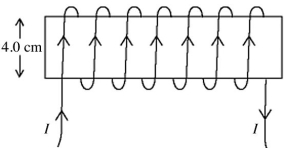
near the center of the solenoid. Find the current in the solenoid windings. (μ0 = 4π × 10-7 T ∙ m/A) (Multiple Choice)
4.8/5 (73)
(73) Field due to circular loop: A ring with a clockwise current (as seen from above the ring) is situated with its center directly above another ring, which has a counter-clockwise current, as shown in the figure. In what direction is the net magnetic force exerted on the top ring? 
(Multiple Choice)
4.9/5 (86)
(86) Solenoids: A solenoid of length 18 cm consists of closely spaced coils of wire wrapped tightly around a wooden core. The magnetic field strength is 2.0 mT inside the solenoid near its center when a certain current flows through the coils. If the coils of the solenoid are now pulled apart slightly, stretching it to 21 cm without appreciably changing the size of the coils, what does the magnetic field become near the center of the solenoid when the same current flows through the coils? (μ0 = 4π × 10-7 T ∙ m/A)
(Multiple Choice)
4.9/5 (79)
(79) Field due to a long wire: A negatively charged particle is moving to the right, directly above a wire having a current flowing to the right, as shown in the figure. In which direction is the magnetic force exerted on the particle? 
(Multiple Choice)
4.9/5 (62)
(62) Biot-Savart law: A point charge Q moves on the x-axis in the positive direction with a speed of  A point P is on the y-axis at
 The magnetic field produced at the point P, as the charge moves through the origin, is equal to
 What is the charge Q? (μ0 = 4π × 10-7 T ∙ m/A)
A point P is on the y-axis at The magnetic field produced at the point P, as the charge moves through the origin, is equal to What is the charge Q? (μ0 = 4π × 10-7 T ∙ m/A) (Multiple Choice)
4.8/5 (87)
(87) Circular motion of charges: An alpha particle is moving at a speed of 5.0 × 10⁵ m/s in a direction perpendicular to a uniform magnetic field of strength 0.040 T. The charge on an alpha particle is 3.2 × 10⁻¹⁹ C and its mass is 6.6 × 10⁻²⁷ kg.
(a) What is the radius of the path of the alpha particle?
(b) How long does it take the alpha particle to make one complete revolution around its path?
(Essay)
4.9/5 (79)
(79) Field of a long wire: As shown in the figure, two long straight wires are separated by a distance of  The currents are
 to the right in the upper wire and
 to the left in the lower wire. What are the magnitude and direction of the magnetic field at point P, which is a distance
 below the lower wire?


The currents are to the right in the upper wire and to the left in the lower wire. What are the magnitude and direction of the magnetic field at point P, which is a distance below the lower wire? (Essay)
4.8/5 (85)
(85) Circular motion of charges: A proton starting from rest travels through a potential of 1.0 kV and then moves into a uniform 0.040-T magnetic field. What is the radius of the proton's resulting orbit? (mproton = 1.67 × 10⁻²⁷ kg, e = 1.60 × 10⁻¹⁹C)
(Multiple Choice)
4.9/5 (82)
(82) Toroids: A toroidal solenoid has a central radius of 0.50 m and a cross-sectional diameter of 10 cm. When a current passes through the coil of the solenoid, the magnetic field inside the solenoid at its CENTER has a magnitude of 2.0 μT. What is the largest value of the magnetic field inside the solenoid when this current is flowing? (μ0 = 4π × 10-7 T ∙ m/A)
(Multiple Choice)
4.9/5 (77)
(77) Field of a circular loop: A wire carrying a current is shaped in the form of a circular loop of radius  If the magnetic field strength that this current produces at the center of the loop is
 what is the magnitude of the current that flows through the wire? (μ0 = 4π × 10-7 T ∙ m/A)
If the magnetic field strength that this current produces at the center of the loop is what is the magnitude of the current that flows through the wire? (μ0 = 4π × 10-7 T ∙ m/A) (Multiple Choice)
4.9/5 (73)
(73) Solenoids: A solenoid with 400 turns has a radius of 0.040 m and is 40 cm long. If this solenoid carries a current of  what is the magnitude of the magnetic field near the center of the solenoid? (μ0 = 4π × 10-7 T ∙ m/A)
 (Multiple Choice)
4.8/5 (94)
(94) Ampere's law: The figure shows the cross-section of a hollow cylinder of inner radius a = 5.0 cm and outer radius b = 7.0 cm. A uniform current density of 1.0 A/ cm2 flows through the cylinder parallel to its axis. Calculate the magnitude of the magnetic field at a distance of d = 10 cm from the axis of the cylinder. (μ0 = 4π × 10-7 T ∙ m/A) 
(Multiple Choice)
4.8/5 (77)
(77) 
Filters
- Essay(0)
- Multiple Choice(0)
- Short Answer(0)
- True False(0)
- Matching(0)