



 Chat with AI
Exam 3: Motion in Two or Three Dimensions

Exam 2: Motion Along a Straight Line55 Questions
Exam 3: Motion in Two or Three Dimensions59 Questions
Exam 4: Newtons Laws of Motion50 Questions
Exam 5: Applying Newtons Laws139 Questions
Exam 6: Work and Kinetic Energy109 Questions
Exam 7: Potential Energy and Energy Conservation50 Questions
Exam 8: Momentum, Impulse, and Collisions99 Questions
Exam 9: Rotation of Rigid Bodies26 Questions
Exam 10: Dynamics of Rotational Motion49 Questions
Exam 11: Equilibrium and Elasticity50 Questions
Exam 12: Fluid Mechanics54 Questions
Exam 13: Gravitation52 Questions
Exam 14: Periodic Motion109 Questions
Exam 15: Mechanical Waves50 Questions
Exam 16: Sound and Hearing121 Questions
Exam 17: Temperature and Heat60 Questions
Exam 18: Thermal Properties of Matter41 Questions
Exam 19: The First Law of Thermodynamics55 Questions
Exam 20: The Second Law of Thermodynamics52 Questions
Exam 21: Electric Charge and Electric Field54 Questions
Exam 22: Gausss Law54 Questions
Exam 23: Electric Potential88 Questions
Exam 24: Capacitance and Dielectrics70 Questions
Exam 25: Current, Resistance, and Electromotive Force44 Questions
Exam 26: Direct-Current Circuits51 Questions
Exam 27: Magnetic Field and Magnetic Forces105 Questions
Exam 28: Sources of Magnetic Field82 Questions
Exam 29: Electromagnetic Induction51 Questions
Exam 30: Inductance88 Questions
Exam 31: Alternating Current51 Questions
Exam 32: Electromagnetic Waves Optics53 Questions
Exam 33: The Nature and Propagation of Light31 Questions
Exam 34: Geometric Optics89 Questions
Exam 35: Interference59 Questions
Select questions type


Basic kinematics variables: The figure shows a graph of the velocity as a function of time for a basketball player traveling up and down the court in a straight-line path. For the 10 s shown on the graph, find
(a) the net displacement of the player.
(b) the total distance run by the player. 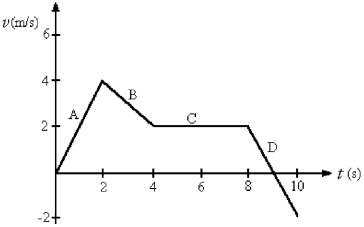
(Essay)
4.8/5  (83)
(83) Constant acceleration: A runner maintains constant acceleration after starting from rest as she runs a distance of 60.0 m. The runner's speed at the end of the 60.0 m is 9.00 m/s. How much time did it take the runner to complete the 60.0 m distance?
(Multiple Choice)
4.8/5 (82)
(82) Basic kinematics variables using calculus: The velocity of an object is given by the expression v(t) = 3.00 m/s + ( 4.00 m/s3)t2, where t is in seconds. Determine the position of the object as a function of time if it is located at x = 1.00 m at time t = 0.000 s.
(Multiple Choice)
4.9/5 (72)
(72) Free fall: A toy rocket is launched vertically from ground level (y = 0.00 m), at time t = 0.00 s. The rocket engine provides constant upward acceleration during the burn phase. At the instant of engine burnout, the rocket has risen to 72 m and acquired a velocity of  The rocket continues to rise in unpowered flight, reaches maximum height, and falls back to the ground with negligible air resistance. The speed of the rocket upon impact on the ground is closest to
 (Multiple Choice)
4.8/5 (77)
(77) Basic kinematics variables: A cat runs along a straight line (the x-axis) from point A to point B to point C, as shown in the figure. The distance between points A and C is 5.00 m, the distance between points B and C is 10.0 m, and the positive direction of the x-axis points to the right. The time to run from A to B is 20.0 s, and the time from B to C is 8.00 s. As the cat runs along the x-axis between points A and C
(a) what is the magnitude of its average velocity?
(b) what is its average speed? 
(Essay)
4.8/5 (86)
(86) Constant acceleration: A speeding car is traveling at a constant 30.0 m/s when it passes a stationary police car. If the police car delays for 1.00 s before starting, what must be the magnitude of the constant acceleration of the police car to catch the speeding car after the police car travels a distance of 300 m?
(Multiple Choice)
4.8/5 (77)
(77) Free fall: A rock is dropped from the top of a vertical cliff and takes 3.00 s to reach the ground below the cliff. A second rock is thrown vertically from the cliff, and it takes this rock 2.00 s to reach the ground below the cliff from the time it is released. With what velocity was the second rock thrown, assuming no air resistance?
(Multiple Choice)
4.9/5 (74)
(74) Basic kinematics variables: The figure shows the velocity of a particle as it travels along the x-axis. What is the direction of the acceleration at t = 0.5 s? 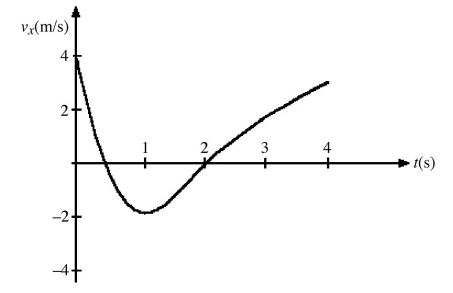
(Multiple Choice)
4.8/5 (98)
(98) Basic kinematics variables using calculus: The position of an object as a function of time is given by x(t) = at3 - bt2 + ct - d, where a = 3.6 m/s3, b = 4.0 m/s2, c = 60 m/s and d = 7.0 m.
(a) Find the instantaneous acceleration at t =2.4 s.
(b) Find the average acceleration over the first 2.4 seconds.
(Essay)
4.9/5 (77)
(77) Constant acceleration: An airplane that is flying level needs to accelerate from a speed of 2.00 × 10² m/s to a speed of 2.40 × 10² m/s while it flies a distance of 1.20 km. What must be the acceleration of the plane?
(Multiple Choice)
4.7/5 (87)
(87) Free fall: Two objects are dropped from a bridge, an interval of 1.0 s apart, and experience no appreciable air resistance. As time progresses, the DIFFERENCE in their speeds
(Multiple Choice)
4.9/5 (83)
(83) Basic kinematics variables: An object starts its motion with a constant velocity of 2.0 m/s toward the east. After 3.0 s, the object stops for 1.0 s. The object then moves toward the west a distance of 2.0 m in 3.0 s. The object continues traveling in the same direction, but increases its speed by 1.0 m/s for the next 2.0 s. Which graph below could represent the motion of this object?
(Multiple Choice)
4.8/5 (81)
(81) Basic kinematics variables using calculus: The position of an object as a function of time is given by x =  - ct, where b = 2.0 m/
 and
 and x and t are in SI units. What is the instantaneous velocity of the object when

- ct, where b = 2.0 m/ and and x and t are in SI units. What is the instantaneous velocity of the object when (Multiple Choice)
4.8/5 (83)
(83) Basic kinematics variables: A racing car accelerates uniformly from rest along a straight track. This track has markers spaced at equal distances along it from the start, as shown in the figure. The car reaches a speed of 140 km/h as it passes marker 2. Where on the track was the car when it was traveling at 70 km/h? 
(Multiple Choice)
4.9/5 (87)
(87) Basic kinematics variables: The figure represents the velocity of a particle as it travels along the x-axis. At what value (or values) of t is the instantaneous acceleration equal to zero? 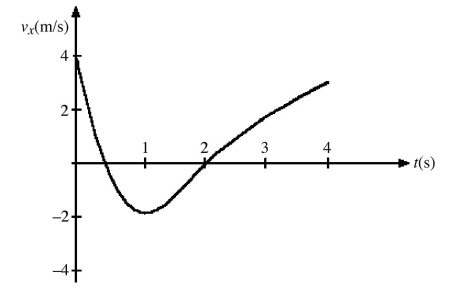
(Multiple Choice)
4.9/5 (58)
(58) Constant acceleration: A soccer ball is released from rest at the top of a grassy incline. After 8.6 seconds, the ball travels 87 meters and 1.0 s after this, the ball reaches the bottom of the incline.
(a) What was the magnitude of the ball's acceleration, assume it to be constant?
(b) How long was the incline?
(Essay)
4.8/5 (73)
(73) Free fall: A foul ball is hit straight up into the air with a speed of 30.0 m/s.
(a) Calculate the time required for the ball to rise to its maximum height.
(b) Calculate the maximum height reached by the ball.
(c) Determine the time at which the ball pass a point 25.0 m above the point of contact between the bat and ball.
(d) Explain why there are two answers to part (c).
(Essay)
4.8/5 (74)
(74) Basic kinematics variables: The figure shows the position of an object as a function of time. During the time interval from time t = 0.0 s and time t = 9.0 s
(a) what is the length of the path the object followed?
(b) what is the displacement of the object? 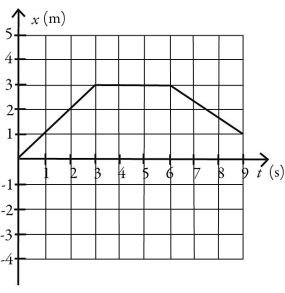
(Essay)
4.8/5 (77)
(77) Basic kinematics variables: The graph in the figure shows the position of an object as a function of time. The letters H-L represent particular moments of time. At which moments shown (H, I, etc.) is the speed of the object
(a) the greatest?
(b) the smallest? 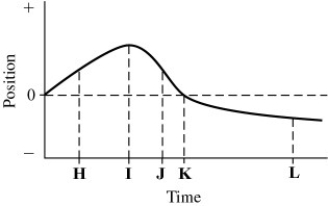
(Essay)
4.7/5 (71)
(71) 
Filters
- Essay(0)
- Multiple Choice(0)
- Short Answer(0)
- True False(0)
- Matching(0)