



 Chat with AI
Exam 7: Potential Energy and Energy Conservation

Exam 2: Motion Along a Straight Line55 Questions
Exam 3: Motion in Two or Three Dimensions59 Questions
Exam 4: Newtons Laws of Motion50 Questions
Exam 5: Applying Newtons Laws139 Questions
Exam 6: Work and Kinetic Energy109 Questions
Exam 7: Potential Energy and Energy Conservation50 Questions
Exam 8: Momentum, Impulse, and Collisions99 Questions
Exam 9: Rotation of Rigid Bodies26 Questions
Exam 10: Dynamics of Rotational Motion49 Questions
Exam 11: Equilibrium and Elasticity50 Questions
Exam 12: Fluid Mechanics54 Questions
Exam 13: Gravitation52 Questions
Exam 14: Periodic Motion109 Questions
Exam 15: Mechanical Waves50 Questions
Exam 16: Sound and Hearing121 Questions
Exam 17: Temperature and Heat60 Questions
Exam 18: Thermal Properties of Matter41 Questions
Exam 19: The First Law of Thermodynamics55 Questions
Exam 20: The Second Law of Thermodynamics52 Questions
Exam 21: Electric Charge and Electric Field54 Questions
Exam 22: Gausss Law54 Questions
Exam 23: Electric Potential88 Questions
Exam 24: Capacitance and Dielectrics70 Questions
Exam 25: Current, Resistance, and Electromotive Force44 Questions
Exam 26: Direct-Current Circuits51 Questions
Exam 27: Magnetic Field and Magnetic Forces105 Questions
Exam 28: Sources of Magnetic Field82 Questions
Exam 29: Electromagnetic Induction51 Questions
Exam 30: Inductance88 Questions
Exam 31: Alternating Current51 Questions
Exam 32: Electromagnetic Waves Optics53 Questions
Exam 33: The Nature and Propagation of Light31 Questions
Exam 34: Geometric Optics89 Questions
Exam 35: Interference59 Questions
Select questions type


Impulse: A time-varying horizontal force F(t) = At4 + Bt2 acts for 0.500 s on a 12.25-kg object, starting at time t = 1.00 s. In the SI system, A has the numerical value 4.50 and B has the numerical value 8.75.
(a) What are the SI units of A and B?
(b) What impulse does this force impart to the object?
(Essay)
4.9/5  (74)
(74) Explosions in one dimension: Jacques and George meet in the middle of a lake while paddling in their canoes. They come to a complete stop and talk for a while. When they are ready to leave, Jacques pushes George's canoe with a force  to separate the two canoes. If we can neglect any resistance due to the water, what is correct to say about the final momentum and kinetic energy of the system consisting of the two canoes and the two men inside?
 (Multiple Choice)
4.9/5 (80)
(80) Inelastic collisions in one dimension: A 2.00-kg object traveling east at 20.0 m/s collides with a 3.00-kg object traveling west at 10.0 m/s. After the collision, the 2.00-kg object has a velocity 5.00 m/s to the west. How much kinetic energy was lost during the collision?
(Multiple Choice)
4.8/5 (72)
(72) Explosions in one dimension: A shell explodes into two fragments, one fragment 25 times heavier than the other. If any gas from the explosion has negligible mass, then
(Multiple Choice)
4.9/5 (87)
(87) Inelastic collisions in one dimension: A 480-kg car moving at 14.4 m/s hits from behind a 570-kg car moving at 13.3 m/s in the same direction. If the new speed of the heavier car is 14.0 m/s, what is the speed of the lighter car after the collision, assuming that any unbalanced forces on the system are negligibly small?
(Multiple Choice)
4.8/5 (77)
(77) Inelastic collisions in two dimensions: A 1000-kg car approaches an intersection traveling north at 20.0 m/s. A 1200-kg car approaches the same intersection traveling east at 22.0 m/s. The two cars collide at the intersection and lock together. Ignoring any external forces that act on the cars during the collision, what is the velocity of the cars immediately after the collision?
(Multiple Choice)
4.7/5 (88)
(88) Explosions in one dimension: A 10.0-kg shell is traveling horizontally to the right at 25.0 m/s relative to the ground when it explodes into two fragments, one of mass 3.00 kg and the other of mass 7.00 kg. The lighter fragment goes directly forward, and the explosion releases 1.50 × 10³ J of mechanical energy to the fragments. Find the magnitude and direction of the velocity of the heavier fragment relative to the ground just after the explosion. Ignore the effect of any ejected gases.
(Short Answer)
4.8/5 (85)
(85) Center of mass: A long thin rod of length L has a linear density λ(x) = Ax where x is the distance from the left end of the rod.
(a) How far is the center of mass of the rod from the left end of the rod?
(b) What is the mass of the rod?
(Essay)
4.8/5 (80)
(80) Collisions: A small car has a head-on collision with a large truck. Which of the following statements concerning the magnitude of the average force due to the collision is correct?
(Multiple Choice)
4.8/5 (63)
(63) Impulse-momentum: Consider two less-than-desirable options. In the first you are driving 50 km/h and crash head-on into an identical car also going 50km/h. In the second option you are driving 50 km/h and crash head-on into a stationary brick wall. In neither case does your car bounce off the thing it hits, and the collision time is the same in both cases. Which of these two situations would result in the greatest impact force?
(Multiple Choice)
4.8/5 (84)
(84) Center of mass: There must be equal amounts of mass on both side of the center of mass of an object.
(True/False)
4.9/5 (72)
(72) Conservation of momentum: A baseball is thrown vertically upward and feels no air resistance. As it is rising
(Multiple Choice)
4.8/5 (95)
(95) Inelastic collisions in two dimensions: A 900-kg car traveling east at 15.0 m/s collides with a 750-kg car traveling north at 20.0 m/s. The cars stick together. Assume that any other unbalanced forces are negligible.
(a) What is the speed of the wreckage just after the collision?
(b) In what direction does the wreckage move just after the collision?
(Essay)
4.8/5 (71)
(71) Elastic collisions in two dimensions: A billiard ball traveling at 3.00 m/s collides perfectly elastically with an identical billiard ball initially at rest on the level table. The initially moving billiard ball deflects 30.0° from its original direction. What is the speed of the initially stationary billiard ball after the collision?
(Multiple Choice)
4.9/5 (73)
(73) Elastic collisions in one dimension: A car of mass 1689 kg collides head-on with a parked truck of mass 2000 kg. Spring mounted bumpers ensure that the collision is essentially elastic. If the velocity of the truck is 17 km/h (in the same direction as the car's initial velocity) after the collision, what was the initial speed of the car?
(Multiple Choice)
4.8/5 (90)
(90) Inelastic collisions in one dimension: In the figure, determine the character of the collision. The masses of the blocks, and the velocities before and after are given. The collision is 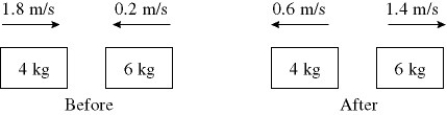
(Multiple Choice)
4.9/5 (86)
(86) Conservation of momentum: You are standing on a skateboard, initially at rest. A friend throws a very heavy ball towards you. You can either catch the object or deflect the object back towards your friend (such that it moves away from you with the same speed as it was originally thrown). What should you do in order to MINIMIZE your speed on the skateboard?
(Multiple Choice)
4.9/5 (81)
(81) Center of mass: A 310-g air track cart is traveling at 1.25 m/s and a 260-g cart traveling in the opposite direction at 1.33 m/s. What is the speed of the center of mass of the two carts?
(Multiple Choice)
5.0/5 (87)
(87) Elastic collisions in two dimensions: A pool player is attempting a fancy shot. He hits the cue ball giving it a speed of 5.57 m/s and directs its center on a path tangent to the surface of the target ball having the same mass as the cue ball. After the collision (on a frictionless table) the initially-stationary ball moves with a speed of 4.82 m/s. After the collision, the new speed of the cue ball and the relative direction of the balls are closest to
(Multiple Choice)
4.9/5 (73)
(73) 
Filters
- Essay(0)
- Multiple Choice(0)
- Short Answer(0)
- True False(0)
- Matching(0)