



 Chat with AI
Exam 18: Corporate Taxation: Nonliquidating Distributions

Exam 1: An Introduction to Tax134 Questions
Exam 2: Tax Compliance, the Irs, and Tax Authorities109 Questions
Exam 3: Tax Planning Strategies and Related Limitations137 Questions
Exam 4: Individual Income Tax Overview, Dependents, and Filing Status130 Questions
Exam 5: Gross Income and Exclusions152 Questions
Exam 6: Individual Deductions117 Questions
Exam 7: Investments93 Questions
Exam 8: Individual Income Tax Computation and Tax Credits179 Questions
Exam 9: Business Income, Deductions, and Accounting Methods129 Questions
Exam 10: Property Acquisition and Cost Recovery131 Questions
Exam 11: Property Dispositions132 Questions
Exam 12: Compensation122 Questions
Exam 13: Retirement Savings and Deferred Compensation157 Questions
Exam 14: Tax Consequences of Home Ownership126 Questions
Exam 15: Entities Overview87 Questions
Exam 16: Corporate Operations126 Questions
Exam 17: Accounting for Income Taxes125 Questions
Exam 18: Corporate Taxation: Nonliquidating Distributions122 Questions
Exam 19: Corporate Formation, Reorganization, and Liquidation121 Questions
Exam 20: Forming and Operating Partnerships131 Questions
Exam 21: Dispositions of Partnership Interests and Partnership Distributions118 Questions
Exam 22: S Corporations157 Questions
Exam 23: State and Local Taxes139 Questions
Exam 24: The Us Taxation of Multinational Transactions105 Questions
Exam 25: Transfer Taxes and Wealth Planning145 Questions
Select questions type


Catamount Company had current and accumulated E&P of $510,000 at December 31, 20X3. On December 31, the company made a distribution of land to its sole shareholder, Caroline West. The land's fair market value was $210,000 and its tax and E&P basis to Catamount was $255,000. The tax consequences of the distribution to Catamount in 20X3 would be:
(Multiple Choice)
4.7/5  (80)
(80) Elk Company reports a deficit in current E&P of ($215,000)and positive accumulated E&P of $330,000. Elk distributed $230,000 to its sole shareholder, Barney Rubble, on December 31, 20X3. Barney's tax basis in his Elk stock is $86,250. What is the tax treatment of the distribution to Barney, and what is his tax basis in Elk stock after the distribution?
(Essay)
4.8/5 (77)
(77) A stock redemption is always treated as a sale or exchange for tax purposes.
(True/False)
5.0/5 (79)
(79) Orchard, Incorporated reported taxable income of $800,000 in 20X3 and paid federal income taxes of $272,000. Included in the company's computation of taxable income is gain from sale of a depreciable asset of $200,000. The income tax basis of the asset was $50,000. The E&P basis of the asset using the alternative depreciation system was $75,000. Compute the company's current E&P for 20X3.
(Essay)
4.8/5 (81)
(81) Austin Company reports positive current E&P of $200,000 and a deficit in accumulated E&P of ($300,000). Austin distributed $250,000 to its sole shareholder, Betsy Bevo, on December 31, 20X3. Betsy's tax basis in her stock is $125,000. How much of the $250,000 distribution is treated as a dividend to Betsy, and what is her tax basis in Austin stock after the distribution?
(Essay)
4.9/5 (70)
(70) Madison Corporation reported taxable income of $400,000 in 20X3 and accrued federal income taxes of $136,000. Included in the computation of taxable income was regular depreciation of $200,000 (E&P depreciation is $60,000)and a net capital loss carryover of $20,000 from 20X2 utilized in 20X3. The corporation's current E&P for 20X3 would be:
(Multiple Choice)
4.8/5 (78)
(78) Sweetwater Corporation declared a stock distribution to all common stock shareholders of record on December 31, 20X3. Shareholders will receive one share of Sweetwater common stock for each five shares of common stock they already own. Pierre Dorgan owns 500 shares of Sweetwater common stock, with a tax basis of $150 per share. The fair market value of the Sweetwater common stock was $90 per share on December 31. What is Pierre's income tax basis per share in his new and existing common stock in Sweetwater, assuming the distribution is nontaxable?
(Essay)
4.8/5 (55)
(55) Tappan declared a 100 percent stock distribution to all shareholders of record on May 2 of this year. Prior to the distribution, Tappan reported current E&P of $60,000 and accumulated E&P of $30,000. Prior to the split, Barb owned 100 shares of Tappan stock, with a market value of $150 per share and a tax basis of $100 per share. After the distribution, Barb owned 200 shares of Tappan, with a market value of $80 per share. What is the per-share tax basis of Barb's additional 100 shares?
(Essay)
4.9/5 (77)
(77) Elk Company reports a deficit in current E&P of ($200,000)and positive accumulated E&P of $300,000. Elk distributed $200,000 to its sole shareholder, Barney Rubble, on December 31, 20X3. Barney's tax basis in his Elk stock is $75,000. What is the tax treatment of the distribution to Barney, and what is his tax basis in Elk stock after the distribution?
(Essay)
4.7/5 (82)
(82) A distribution from a corporation to a shareholder will only be treated as a dividend for tax purposes if the distribution is paid out of current or accumulated E&P.
(True/False)
4.9/5 (67)
(67) Evergreen Corporation distributes land with a fair market value of $200,000 to its sole shareholder. Evergreen's tax basis in the land is $50,000. Assuming sufficient E&P, the amount of dividend reported by the shareholder is $200,000.
(True/False)
4.9/5 (85)
(85) Crescent Corporation is owned equally by George and his daughter Olympia, each of whom owns 100 shares in the company. George wants to retire from the company, and it was decided that the company will redeem all 100 of his shares for $10,000 per share on December 31, 20X3. George's income tax basis in each share is $2,000. Crescent has current E&P of $1,000,000 and accumulated E&P of $5,000,000. What must George do to ensure that the redemption will be treated as an exchange?
(Essay)
4.9/5 (85)
(85) Husker Corporation reportsa deficit in current E&P of ($200,000)in 20X3 and accumulated E&P at the beginning of the year of $300,000. Husker distributed $200,000 to its sole shareholder on December 31, 20X3. The shareholder's tax basis in her stock in Husker is $50,000. How is the distribution treated by the shareholder in 20X3?
(Multiple Choice)
4.9/5 (72)
(72) Tammy owns 60 percent of the stock of Huron Corporation. Unrelated individuals own the remaining 40 percent. For a stock redemption of a portion of Tammy's shares to be treated as an exchange under the "substantially disproportionate" rule, the redemption must reduce Tammy's stock ownership in Huron Corporation below 48 percent.
(True/False)
4.9/5 (89)
(89) Tiger Corporation, a privately held company, has one class of voting common stock, of which 2,700 shares are issued and outstanding. The shares are owned as follows:
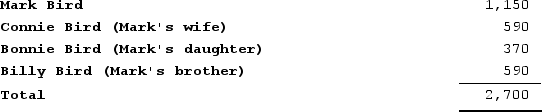 How many shares of stock is Mark deemed to own under the family attribution rules in a stock redemption?
 (Essay)
4.8/5 (76)
(76) Sam owns 70 percent of the stock of Club Corporation. Unrelated individuals own the remaining 30 percent. For a stock redemption of Sam's stock to be treated as an exchange under the "substantially disproportionate" test, what percentage of Club stock must Sam own after the redemption?
(Multiple Choice)
4.8/5 (95)
(95) Packard Corporation reported taxable income of $1,000,000 in 20X3 and paid federal income taxes of $340,000. Included in the taxable income computation was a dividends received deduction of $5,000, a net capital loss carryover from 20X2 of $10,000 utilized in 20X3, and gain of $50,000 recognized on the collection of cash from an installment sale that took place in 20X1. The corporation's current E&P for 20X3 would be:
(Multiple Choice)
4.9/5 (92)
(92) Longhorn Company reports current E&P of $195,000 in 20X3 and a deficit of ($390,000)in accumulated E&P at the beginning of the year. Longhorn distributed $585,000 to its sole shareholder on January 1, 20X3. The shareholder's tax basis in his stock in Longhorn is $195,000. How is the distribution treated by the shareholder in 20X3?
(Multiple Choice)
4.9/5 (86)
(86) Which of these items is not an adjustment to taxable income or net loss to compute current E&P?
(Multiple Choice)
4.9/5 (77)
(77) Greenwich Corporation reported a net operating loss of $800,000 in 20X3, which the corporation elected to carry forward to 20X4. The computation of the loss did not include a disallowed fine of $50,000, life insurance proceeds of $500,000, and a current-year charitable contribution of $10,000 that will be carried forward to 20X4. The corporation's current E&P for 20X3 would be:
(Multiple Choice)
4.8/5 (86)
(86) 
Filters
- Essay(0)
- Multiple Choice(0)
- Short Answer(0)
- True False(0)
- Matching(0)