



 Chat with AI
Exam 19: Corporate Formation, Reorganization, and Liquidation

Exam 1: An Introduction to Tax134 Questions
Exam 2: Tax Compliance, the Irs, and Tax Authorities109 Questions
Exam 3: Tax Planning Strategies and Related Limitations137 Questions
Exam 4: Individual Income Tax Overview, Dependents, and Filing Status130 Questions
Exam 5: Gross Income and Exclusions152 Questions
Exam 6: Individual Deductions117 Questions
Exam 7: Investments93 Questions
Exam 8: Individual Income Tax Computation and Tax Credits179 Questions
Exam 9: Business Income, Deductions, and Accounting Methods129 Questions
Exam 10: Property Acquisition and Cost Recovery131 Questions
Exam 11: Property Dispositions132 Questions
Exam 12: Compensation122 Questions
Exam 13: Retirement Savings and Deferred Compensation157 Questions
Exam 14: Tax Consequences of Home Ownership126 Questions
Exam 15: Entities Overview87 Questions
Exam 16: Corporate Operations126 Questions
Exam 17: Accounting for Income Taxes125 Questions
Exam 18: Corporate Taxation: Nonliquidating Distributions122 Questions
Exam 19: Corporate Formation, Reorganization, and Liquidation121 Questions
Exam 20: Forming and Operating Partnerships131 Questions
Exam 21: Dispositions of Partnership Interests and Partnership Distributions118 Questions
Exam 22: S Corporations157 Questions
Exam 23: State and Local Taxes139 Questions
Exam 24: The Us Taxation of Multinational Transactions105 Questions
Exam 25: Transfer Taxes and Wealth Planning145 Questions
Select questions type


To meet the control test under §351, taxpayers transferring property to a corporation must in aggregate own 80 percent or more of the corporation's voting stock and 80 percent of each class of nonvoting stock after the transfer.
(True/False)
4.9/5  (89)
(89) Inez transfers property with a tax basis of $200 and a fair market value of $300 to a corporation in exchange for stock with a fair market value of $250 in a transaction that qualifies for deferral under §351. The corporation assumed a liability of $50 on the property transferred. What is the corporation's tax basis in the property received in the exchange?
(Multiple Choice)
4.8/5 (88)
(88) Red Blossom Corporation transferred its 40 percent interest to Tea Company as part of a complete liquidation of the company. In the exchange, Red Blossom received land with a fair market value of $500,000. The corporation's basis in the Tea Company stock was $300,000. The land had a basis to Tea Company of $600,000. What amount of gain does Red Blossom recognize in the exchange and what is its basis in the land it receives?
(Multiple Choice)
4.8/5 (92)
(92) Phillip incorporated his sole proprietorship by transferring inventory, a building, and land to the corporation in return for 100 percent of the corporation's stock. The property transferred to the corporation had the following fair market values and tax-adjusted bases.
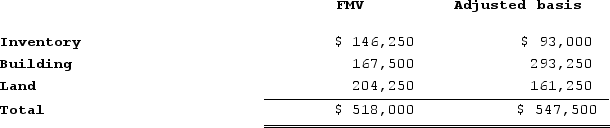 The fair market value of the corporation's stock received in the exchange was $518,000. The transaction met the requirements to be tax-deferred under §351.
a. What amount of net gain or loss does Phillip realize on the transfer of the property to his corporation?
b. What amount of gain or loss does Phillip recognize on the transfer of the property to his corporation?
c. What is the corporation's adjusted basis in each of the assets received in the exchange?
The fair market value of the corporation's stock received in the exchange was $518,000. The transaction met the requirements to be tax-deferred under §351.
a. What amount of net gain or loss does Phillip realize on the transfer of the property to his corporation?
b. What amount of gain or loss does Phillip recognize on the transfer of the property to his corporation?
c. What is the corporation's adjusted basis in each of the assets received in the exchange? (Essay)
4.8/5 (67)
(67) Mike and Michelle decided to liquidate their jointly owned corporation, Pennsylvania Corporation. After liquidating its remaining inventory and paying off its remaining liabilities, Pennsylvania had the following tax accounting balance sheet.
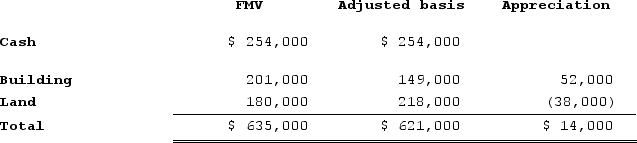 Under the terms of the agreement, Mike will receive the $254,000 cash in exchange for his 40 percent interest in Pennsylvania. Mike's tax basis in his Pennsylvania stock is $68,000. Michelle will receive the building and land in exchange for her 60 percent interest in Pennsylvania. Her tax basis in the Pennsylvania stock is $136,000.What amount of gain or loss does Michelle recognize in the complete liquidation, and what is her tax basis in the building and land after the complete liquidation?
 (Essay)
4.8/5 (92)
(92) Billie transferred her 20 percent interest to Jean Company as part of a complete liquidation of the company. In the exchange, she received land with a fair market value of $200,000. Billie's basis in the Jean stock was $100,000. The land had a basis to Jean Company of $400,000. What amount of loss does Jean recognize in the exchange and what is Billie's basis in the land she receives? Billie is not considered a related party to Jean Company.
(Multiple Choice)
5.0/5 (82)
(82) Which of the following classes of stock is not allowed to be used in a §351 transaction?
(Multiple Choice)
4.7/5 (75)
(75) Red Blossom Corporation transferred its 40 percent interest to Tea Company as part of a complete liquidation of the company. In the exchange, Red Blossom received land with a fair market value of $555,000. The corporation's basis in the Tea Company stock was $422,500. The land had a basis to Tea Company of $815,000. What amount of gain does Red Blossom recognize in the exchange and what is its basis in the land it receives?
(Multiple Choice)
4.8/5 (78)
(78) April transferred 100 percent of her stock in June Company to March Corporation in a taxable merger. In exchange she received stock in March with a fair market value of $462,500 plus $1,237,500 in cash. April's tax basis in the June stock was $2,106,500. What amount of loss does April recognize in the exchange and what is her basis in the March stock she receives?
(Essay)
4.7/5 (84)
(84) Julian transferred 100 percent of his stock in Lemon Company to Apricot Corporation in a Type B stock-for-stock exchange. In exchange, he received stock in Apricot with a fair market value of $200,000. Julian's tax basis in the Lemon stock was $400,000. What amount of loss does Julian recognize in the exchange and what is his basis in the Apricot stock he receives?
(Multiple Choice)
4.8/5 (77)
(77) Camille transfers property with a tax basis of $800 and a fair market value of $1,200 to a corporation in exchange for stock with a fair market value of $850 and $350 in cash in a transaction that qualifies for deferral under section 351. Camille also incurred selling expenses of $100. What is the amount realized by Camille in the exchange?
(Multiple Choice)
4.9/5 (93)
(93) Celeste transferred 100 percent of her stock in Supply Chain Company to Marketing Corporation in a Type A merger. In exchange, she received stock in Marketing with a fair market value of $574,500 plus $574,500 in cash. Celeste's tax basis in the Supply Chain stock was $1,410,000. What amount of loss does Celeste recognize in the exchange and what is her basis in the Marketing stock she receives?
(Multiple Choice)
4.7/5 (72)
(72) Gain and loss realized in a §351 transaction will be recognized if the taxpayer receives boot in the exchange.
(True/False)
4.8/5 (75)
(75) Casey transfers property with a tax basis of $2,640 and a fair market value of $7,000 to a corporation in exchange for stock with a fair market value of $5,100 and $835 in cash in a transaction that qualifies for deferral under section 351. The corporation assumed a liability of $1,065 on the property transferred. Casey also incurred selling expenses of $547. What is the amount realized by Casey in the exchange?
(Multiple Choice)
4.9/5 (81)
(81) Simone transferred 100 percent of her stock in Purple Company to Plum Corporation in a Type A merger. In exchange, she received stock in Plum with a fair market value of $720,000 plus $720,000 in cash. Simone's tax basis in the Purple stock was $277,000. What amount of gain does Simone recognize in the exchange and what is her basis in the Plum stock she receives?
(Multiple Choice)
4.8/5 (85)
(85) Rachelle transfers property with a tax basis of $825 and a fair market value of $1,300 to a corporation in exchange for stock with a fair market value of $700 and $214 incash in a transaction that qualifies for deferral under section 351. The corporation assumed a liability of $386 on the property transferred. What is the corporation's tax basis in the property received in the exchange?
(Multiple Choice)
4.8/5 (73)
(73) The requirements for tax deferral in a forward triangular merger and a reverse triangular merger are the same.
(True/False)
4.7/5 (85)
(85) Which of the following statements best describes the recognition of loss on property transferred to shareholders in complete liquidation of a corporation?
(Multiple Choice)
4.9/5 (68)
(68) Tristan transfers property with a tax basis of $900 and a fair market value of $1,200 to a corporation in exchange for stock with a fair market value of $900 and $200 in cash in a transaction that qualifies for deferral under section 351. The corporation assumed a liability of $100 on the property transferred. What is the corporation's tax basis in the property received in the exchange?
(Multiple Choice)
4.7/5 (90)
(90) Which of the following statements does not describe a requirement that must be met in a tax-deferred forward triangular merger?
(Multiple Choice)
4.9/5 (62)
(62) 
Filters
- Essay(0)
- Multiple Choice(0)
- Short Answer(0)
- True False(0)
- Matching(0)