



 Chat with AI
Exam 7: Investments

Exam 1: An Introduction to Tax134 Questions
Exam 2: Tax Compliance, the Irs, and Tax Authorities109 Questions
Exam 3: Tax Planning Strategies and Related Limitations137 Questions
Exam 4: Individual Income Tax Overview, Dependents, and Filing Status130 Questions
Exam 5: Gross Income and Exclusions152 Questions
Exam 6: Individual Deductions117 Questions
Exam 7: Investments93 Questions
Exam 8: Individual Income Tax Computation and Tax Credits179 Questions
Exam 9: Business Income, Deductions, and Accounting Methods129 Questions
Exam 10: Property Acquisition and Cost Recovery131 Questions
Exam 11: Property Dispositions132 Questions
Exam 12: Compensation122 Questions
Exam 13: Retirement Savings and Deferred Compensation157 Questions
Exam 14: Tax Consequences of Home Ownership126 Questions
Exam 15: Entities Overview87 Questions
Exam 16: Corporate Operations126 Questions
Exam 17: Accounting for Income Taxes125 Questions
Exam 18: Corporate Taxation: Nonliquidating Distributions122 Questions
Exam 19: Corporate Formation, Reorganization, and Liquidation121 Questions
Exam 20: Forming and Operating Partnerships131 Questions
Exam 21: Dispositions of Partnership Interests and Partnership Distributions118 Questions
Exam 22: S Corporations157 Questions
Exam 23: State and Local Taxes139 Questions
Exam 24: The Us Taxation of Multinational Transactions105 Questions
Exam 25: Transfer Taxes and Wealth Planning145 Questions
Select questions type


On January 1, 20X1, Fred purchased a corporate bond with a face value of $105,000 from the secondary market at a premium. The bond has a coupon rate of 8 percent and matures in five years. The market rate of the bond is a 6 percent annual before-tax return compounded semiannually. If Fred is trying to minimize interest income, what is the least amount of interest income Fred may report on his 20X1 tax return? Present value of $1, Present value of annuity $1. (Do not round intermediate calculations. Round your final answer to two decimal places.)
(Essay)
4.9/5  (76)
(76) Sue invested $8,000 in the ABC Limited Partnership and received a 10 percent interest in the partnership. The partnership had $26,000 of qualified nonrecourse debt and $26,000 of debt Sue is not responsible to repay because she is a limited partner. Sue is allocated a 10 percent share of both types of debt, resulting in a tax basis of $13,200 and an at-risk amount of $10,600. During the year, ABC LP generated a ($132,000)loss. How much of Sue's loss is disallowed due to her tax basis or at-risk amount?
(Multiple Choice)
4.8/5 (75)
(75) Assume thatJoe (single)has a marginal tax rate of 37 percent and decides to make the election to include preferentially taxed capital gains and qualified dividends as investment income. What rate must Joe use when calculating the tax on these two items?
(Multiple Choice)
4.7/5 (76)
(76) Roy, a resident of Michigan, owns 25 percent of a fourplex in the nearby college town of Ann Arbor with three other friends. The fourplex is rented to students who attend the University of Michigan. Roy's responsibility is to approve new tenants each year and take care of any maintenance issues. During the year, the rental property generated a $35,500 loss, which was split equally among Roy and his three friends. Assuming Roy's only source of income was $140,500 of salary, how much of the rental loss can Roy deduct this year and what amount must be carried forward?
(Essay)
4.9/5 (84)
(84) On January 1, 20X1, Fred purchased a corporate bond with a face value of $50,000 from the secondary market at a premium. The bond has a coupon rate of 8 percent and matures in five years. The market rate of the bond is a 6 percent annual before-tax return compounded semiannually. If Fred is trying to minimize interest income, what is the least amount of interest income Fred may report on his 20X1 tax return? Present value of $1, Present value of Annuity $1 (Do not round intermediate calculations. Round your final answer to two decimal places.)
(Essay)
4.9/5 (70)
(70) A loss from a passive activity is fully deductible as long as the taxpayer has sufficient tax basis in the activity.
(True/False)
4.8/5 (82)
(82) When selling stocks, which method of calculating basis provides the greatest opportunity for minimizing gains or increasing losses?
(Multiple Choice)
4.9/5 (76)
(76) When electing to include preferentially taxed capital gains and qualified dividends in net investment income, taxpayers must include all preferentially taxed capital gains and qualified dividends recognized for that year.
(True/False)
4.7/5 (78)
(78) The amount of interest income a taxpayer recognizes when he redeems a U.S. savings bond is:
(Multiple Choice)
4.9/5 (90)
(90) On December 1, 20X7, George Jimenez needed a little extra cash for the upcoming holiday season, and sold 250 shares of Microsoft stock for $57 per share less a broker's fee of $200 for the entire sale transaction. Prior to the sale, George held the following blocks of Microsoft stock (associated broker's fee paid at the time of purchase). (Round your intermediate calculations to 2 decimal places)
 If his goal is to minimize his current capital gain, how much capital gain will George report from the sale?
 (Essay)
4.9/5 (72)
(72) On January 1, 20X8, Jill contributed $18,000 of cash to the XYZ limited partnership for a 25 percent limited partnership interest. On April 6, 20X8, XYZ limited partnership distributed $2,000 to Jill. For the year ended December 31, 20X8, Jill received the following income/loss allocations from her partnership investments: (1)XYZ limited partnership allocated a $5,000 loss to Jill and (2)ABC limited partnership allocated $2,300 of income to Jill. How much of the $5,000 loss from XYZ limited partnership can Jill deduct in 20X8?
(Essay)
4.9/5 (90)
(90) Henry, a single taxpayer with a marginal tax rate of 35 percent(taxable income is $317,000 before considering any of the items below), sold the following assets during the year:
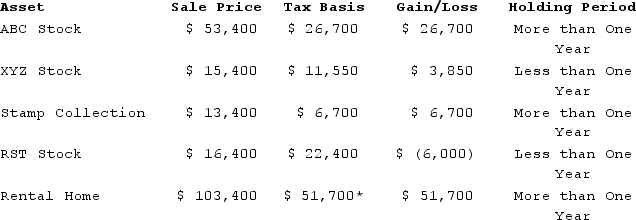 *$25,850 of the gain is a 25 percent gain. The remaining gain is 0/15/20 percent gain.
What tax rate(s)will apply to Henry's capital gains or losses?
*$25,850 of the gain is a 25 percent gain. The remaining gain is 0/15/20 percent gain.
What tax rate(s)will apply to Henry's capital gains or losses? (Essay)
4.8/5 (94)
(94) Taxpayers may make an election to include preferentially taxed capital gains and qualified dividends in investment income and deduct more investment interest expense currently if they are willing to subject this income to ordinary tax rates.
(True/False)
4.9/5 (64)
(64) Two advantages of investing in capital assets are (1)gains are generally deferred and (2)gains are generally taxed at preferential rates.
(True/False)
4.8/5 (82)
(82) Doug and Sue Click file a joint tax return and decide to itemize their deductions. The Clicks' income for the year consists of $90,600 in salary, $2,300 interest income,and $860 long-term capital loss. The Clicks' expenses for the year consist of $1,200 investment interest expense. Assuming that the Clicks' marginal tax rate is 35 percent, what is the amount of their investment interest expense deduction for the year?
(Multiple Choice)
4.9/5 (79)
(79) What are the rules limiting the amount of capital losses a taxpayer may deduct in a given year? Name at least three.
(Essay)
4.9/5 (91)
(91) Losses associated with personal-use assets, sales to related parties, and wash sales are not currently deductible.
(True/False)
4.9/5 (78)
(78) Describe the three main loss limitations that taxpayers must overcome before deducting losses allocated to them from a specific activity.
(Essay)
4.8/5 (83)
(83) 
Filters
- Essay(0)
- Multiple Choice(0)
- Short Answer(0)
- True False(0)
- Matching(0)