



 Chat with AI
Exam 56: Conservation Biology and Global Change

Exam 1: Introduction: Themes in the Study of Life64 Questions
Exam 2: The Chemical Context of Life83 Questions
Exam 3: Water and Life70 Questions
Exam 4: Carbon and the Molecular Diversity of Life71 Questions
Exam 5: The Structure and Function of Large Biological Molecules109 Questions
Exam 6: A Tour of the Cell80 Questions
Exam 7: Membrane Structure and Function80 Questions
Exam 8: An Introduction to Metabolism80 Questions
Exam 9: Cellular Respiration and Fermentation107 Questions
Exam 10: Photosynthesis81 Questions
Exam 11: Cell Communication69 Questions
Exam 12: The Cell Cycle79 Questions
Exam 13: Meiosis and Sexual Life Cycles70 Questions
Exam 14: Mendel and the Gene Idea73 Questions
Exam 15: The Chromosomal Basis of Inheritance61 Questions
Exam 16: The Molecular Basis of Inheritance57 Questions
Exam 17: From Gene to Protein83 Questions
Exam 18: Regulation of Gene Expression99 Questions
Exam 19: Viruses47 Questions
Exam 20: Biotechnology72 Questions
Exam 21: Genomes and Their Evolution42 Questions
Exam 22: Descent with Modification: A Darwinian View of Life55 Questions
Exam 23: The Evolution of Populations78 Questions
Exam 24: The Origin of Species63 Questions
Exam 25: The History of Life on Earth75 Questions
Exam 26: Phylogeny and the Tree of Life73 Questions
Exam 27: Bacteria and Archaea78 Questions
Exam 28: Protists76 Questions
Exam 29: Plant Diversity I: How Plants Colonized Land74 Questions
Exam 30: Plant Diversity II: The Evolution of Seed Plants102 Questions
Exam 31: Fungi89 Questions
Exam 32: An Overview of Animal Diversity74 Questions
Exam 33: An Introduction to Invertebrates93 Questions
Exam 34: The Origin and Evolution of Vertebrates109 Questions
Exam 35: Plant Structure, Growth, and Development67 Questions
Exam 36: Resource Acquisition and Transport in Vascular Plants82 Questions
Exam 37: Soil and Plant Nutrition83 Questions
Exam 38: Angiosperm Reproduction and Biotechnology86 Questions
Exam 39: Plant Responses to Internal and External Signals108 Questions
Exam 40: Basic Principles of Animal Form and Function77 Questions
Exam 41: Animal Nutrition64 Questions
Exam 42: Circulation and Gas Exchange90 Questions
Exam 43: The Immune System100 Questions
Exam 44: Osmoregulation and Excretion69 Questions
Exam 45: Hormones and the Endocrine System72 Questions
Exam 46: Animal Reproduction94 Questions
Exam 47: Animal Development92 Questions
Exam 48: Neurons, Synapses, and Signaling73 Questions
Exam 49: Nervous Systems65 Questions
Exam 50: Sensory and Motor Mechanisms82 Questions
Exam 51: Animal Behavior69 Questions
Exam 52: An Introduction to Ecology and the Biosphere73 Questions
Exam 53: Population Ecology79 Questions
Exam 54: Community Ecology77 Questions
Exam 55: Ecosystems and Restoration Ecology81 Questions
Exam 56: Conservation Biology and Global Change67 Questions
Select questions type


The biggest challenge that Costa Rica will likely face in its dedication to conservation and restoration in the future is
(Multiple Choice)
4.9/5  (75)
(75) Although extinction is a natural process, current extinctions are of concern to environmentalists because
(Multiple Choice)
4.9/5 (78)
(78) According to the U.S. Endangered Species Act (ESA), the difference between an endangered species and a threatened one is that
(Multiple Choice)
4.9/5 (72)
(72) The main cause of the increase in the amount of CO₂ in Earth's atmosphere over the past 150 years is
(Multiple Choice)
4.8/5 (100)
(100) How are movement corridors potentially harmful to certain species?
(Multiple Choice)
4.8/5 (82)
(82) How might the extinction of some Pacific Island bats called "flying foxes" threaten the survival of over 75% of the tree species in those islands?
(Multiple Choice)
4.9/5 (78)
(78) Relatively small geographic areas with high concentrations of endemic species and a large number of endangered and threatened species are known as
(Multiple Choice)
4.8/5 (79)
(79) Suppose you attend a town meeting at which some experts tell the audience that they have performed a cost-benefit analysis of a proposed transit system that would probably reduce overall air pollution and fossil fuel consumption. The analysis, however, reveals that ticket prices will not cover the cost of operating the system when fuel, wages, and equipment are taken into account. As a biologist, you know that if ecosystem services had been included in the analysis the experts might have arrived at a different answer. Why are ecosystem services rarely included in economic analyses?
(Multiple Choice)
4.8/5 (81)
(81) The greatest cause of the biodiversity crisis, the one which includes all of the others, is
(Multiple Choice)
4.9/5 (71)
(71) For the following questions, match the statement with the appropriate term/phrase.
-This is caused by excessive nutrient runoff into aquatic ecosystems.
(Multiple Choice)
4.8/5 (79)
(79) Which of the following conditions is the most likely indicator of a population in an extinction vortex?
(Multiple Choice)
4.8/5 (82)
(82) Use the graph and information provided in the paragraph below to answer the following questions.
Flycatcher birds that migrate from Africa to Europe feed their nestlings a diet that is almost exclusively moth caterpillars. The graph below shows the mean dates of arrival, bird hatching, and peak caterpillar season for the years 1980 and 2000.
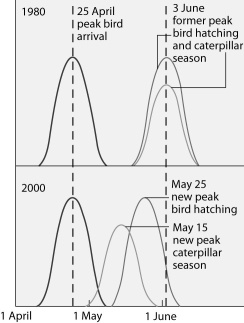 -The shift in the peak of caterpillar season is most likely due to
 (Multiple Choice)
4.9/5 (69)
(69) Of the following statements about protected areas that have been established to preserve biodiversity, which one is not correct?
(Multiple Choice)
4.7/5 (90)
(90) For the following questions, match the statement with the appropriate term/phrase.
-This term refers to the reflecting and absorption of infrared radiation by atmospheric methane, carbon dioxide, and water.
(Multiple Choice)
4.7/5 (94)
(94) Which of the following life history traits can potentially influence effective population size (Ne)?
(Multiple Choice)
4.9/5 (69)
(69) 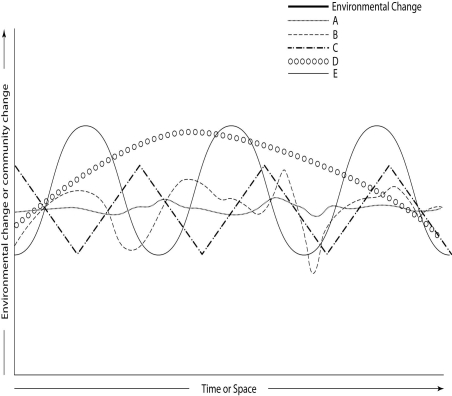 -Based on what you know about ecosystem stability and the information provided in the graph, which community (A-E)would likely support the most biodiversity?
 (Multiple Choice)
4.8/5 (63)
(63) 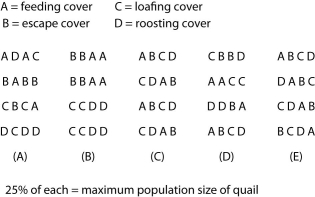 -Study the information above about quail habitats. Assuming that only one quail can occupy a habitat where all cover requirements are met, what is the maximum number of quail that could inhabit any of the hypothetical plots shown?
 (Multiple Choice)
4.9/5 (85)
(85) 
Filters
- Essay(0)
- Multiple Choice(0)
- Short Answer(0)
- True False(0)
- Matching(0)