



 Chat with AI
Exam 55: Ecosystems and Restoration Ecology

Exam 1: Introduction: Themes in the Study of Life64 Questions
Exam 2: The Chemical Context of Life83 Questions
Exam 3: Water and Life70 Questions
Exam 4: Carbon and the Molecular Diversity of Life71 Questions
Exam 5: The Structure and Function of Large Biological Molecules109 Questions
Exam 6: A Tour of the Cell80 Questions
Exam 7: Membrane Structure and Function80 Questions
Exam 8: An Introduction to Metabolism80 Questions
Exam 9: Cellular Respiration and Fermentation107 Questions
Exam 10: Photosynthesis81 Questions
Exam 11: Cell Communication69 Questions
Exam 12: The Cell Cycle79 Questions
Exam 13: Meiosis and Sexual Life Cycles70 Questions
Exam 14: Mendel and the Gene Idea73 Questions
Exam 15: The Chromosomal Basis of Inheritance61 Questions
Exam 16: The Molecular Basis of Inheritance57 Questions
Exam 17: From Gene to Protein83 Questions
Exam 18: Regulation of Gene Expression99 Questions
Exam 19: Viruses47 Questions
Exam 20: Biotechnology72 Questions
Exam 21: Genomes and Their Evolution42 Questions
Exam 22: Descent with Modification: A Darwinian View of Life55 Questions
Exam 23: The Evolution of Populations78 Questions
Exam 24: The Origin of Species63 Questions
Exam 25: The History of Life on Earth75 Questions
Exam 26: Phylogeny and the Tree of Life73 Questions
Exam 27: Bacteria and Archaea78 Questions
Exam 28: Protists76 Questions
Exam 29: Plant Diversity I: How Plants Colonized Land74 Questions
Exam 30: Plant Diversity II: The Evolution of Seed Plants102 Questions
Exam 31: Fungi89 Questions
Exam 32: An Overview of Animal Diversity74 Questions
Exam 33: An Introduction to Invertebrates93 Questions
Exam 34: The Origin and Evolution of Vertebrates109 Questions
Exam 35: Plant Structure, Growth, and Development67 Questions
Exam 36: Resource Acquisition and Transport in Vascular Plants82 Questions
Exam 37: Soil and Plant Nutrition83 Questions
Exam 38: Angiosperm Reproduction and Biotechnology86 Questions
Exam 39: Plant Responses to Internal and External Signals108 Questions
Exam 40: Basic Principles of Animal Form and Function77 Questions
Exam 41: Animal Nutrition64 Questions
Exam 42: Circulation and Gas Exchange90 Questions
Exam 43: The Immune System100 Questions
Exam 44: Osmoregulation and Excretion69 Questions
Exam 45: Hormones and the Endocrine System72 Questions
Exam 46: Animal Reproduction94 Questions
Exam 47: Animal Development92 Questions
Exam 48: Neurons, Synapses, and Signaling73 Questions
Exam 49: Nervous Systems65 Questions
Exam 50: Sensory and Motor Mechanisms82 Questions
Exam 51: Animal Behavior69 Questions
Exam 52: An Introduction to Ecology and the Biosphere73 Questions
Exam 53: Population Ecology79 Questions
Exam 54: Community Ecology77 Questions
Exam 55: Ecosystems and Restoration Ecology81 Questions
Exam 56: Conservation Biology and Global Change67 Questions
Select questions type


What is the primary limiting factor for aquatic productivity?
(Multiple Choice)
4.8/5  (79)
(79) When levels of CO₂ are experimentally increased in a typical grassland community, C₃ plants generally respond with a greater increase in productivity than C₄ plants. This is because
(Multiple Choice)
4.9/5 (75)
(75) If you applied a fungicide to a cornfield, what would you expect to happen to the rate of decomposition and net ecosystem production (NEP)?
(Multiple Choice)
4.7/5 (78)
(78) Many homeowners mow their lawns during the summer and collect the clippings, which are then hauled to the local landfill. Which of the following actions would most benefit the suburban ecosystem?
(Multiple Choice)
4.9/5 (78)
(78) Why is net primary production (NPP)a more useful measurement to an ecosystem ecologist than gross primary production (GPP)?
(Multiple Choice)
4.8/5 (69)
(69) Which of these ecosystems accounts for the largest amount of Earth's net primary productivity?
(Multiple Choice)
4.9/5 (76)
(76) Consider the food chain grass → grasshopper → mouse → snake → hawk. How much of the chemical energy fixed by photosynthesis of the grass (100%)is available to the hawk?
(Multiple Choice)
4.7/5 (80)
(80) In terms of nutrient cycling, why does timber harvesting in a temperate forest cause less ecological devastation than timber harvesting in tropical rain forests?
(Multiple Choice)
4.9/5 (87)
(87) A 3-hectare lake in the American Midwest suddenly has succumbed to an algal bloom. What is the likely cause of eutrophication in freshwater ecosystems, such as this one?
(Multiple Choice)
4.9/5 (79)
(79) Which of the following is an example of a local biogeochemical cycle?
(Multiple Choice)
4.7/5 (66)
(66) 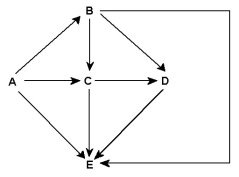 Food web for a particular terrestrial ecosystem (arrows represent energy flow and letters represent species)
-Examine this food web for a particular terrestrial ecosystem. Which pair of species could be omnivores?
Food web for a particular terrestrial ecosystem (arrows represent energy flow and letters represent species)
-Examine this food web for a particular terrestrial ecosystem. Which pair of species could be omnivores? (Multiple Choice)
4.9/5 (76)
(76) How is it that satellites can detect differences in primary productivity on Earth?
(Multiple Choice)
4.8/5 (74)
(74) The amount of chemical energy in consumers' food that is converted to their own new biomass during a given time period is known as which of the following?
(Multiple Choice)
4.8/5 (92)
(92) If the flow of energy in an arctic ecosystem goes through a simple food chain, perhaps involving humans, starting from phytoplankton to zooplankton to fish to seals to polar bears, then which of the following could be true?
(Multiple Choice)
4.9/5 (83)
(83) What percentage of solar radiation striking a plant is converted into chemical energy?
(Multiple Choice)
4.9/5 (95)
(95) 
Filters
- Essay(0)
- Multiple Choice(0)
- Short Answer(0)
- True False(0)
- Matching(0)