



 Chat with AI
Exam 54: Community Ecology

Exam 1: Introduction: Themes in the Study of Life64 Questions
Exam 2: The Chemical Context of Life83 Questions
Exam 3: Water and Life70 Questions
Exam 4: Carbon and the Molecular Diversity of Life71 Questions
Exam 5: The Structure and Function of Large Biological Molecules109 Questions
Exam 6: A Tour of the Cell80 Questions
Exam 7: Membrane Structure and Function80 Questions
Exam 8: An Introduction to Metabolism80 Questions
Exam 9: Cellular Respiration and Fermentation107 Questions
Exam 10: Photosynthesis81 Questions
Exam 11: Cell Communication69 Questions
Exam 12: The Cell Cycle79 Questions
Exam 13: Meiosis and Sexual Life Cycles70 Questions
Exam 14: Mendel and the Gene Idea73 Questions
Exam 15: The Chromosomal Basis of Inheritance61 Questions
Exam 16: The Molecular Basis of Inheritance57 Questions
Exam 17: From Gene to Protein83 Questions
Exam 18: Regulation of Gene Expression99 Questions
Exam 19: Viruses47 Questions
Exam 20: Biotechnology72 Questions
Exam 21: Genomes and Their Evolution42 Questions
Exam 22: Descent with Modification: A Darwinian View of Life55 Questions
Exam 23: The Evolution of Populations78 Questions
Exam 24: The Origin of Species63 Questions
Exam 25: The History of Life on Earth75 Questions
Exam 26: Phylogeny and the Tree of Life73 Questions
Exam 27: Bacteria and Archaea78 Questions
Exam 28: Protists76 Questions
Exam 29: Plant Diversity I: How Plants Colonized Land74 Questions
Exam 30: Plant Diversity II: The Evolution of Seed Plants102 Questions
Exam 31: Fungi89 Questions
Exam 32: An Overview of Animal Diversity74 Questions
Exam 33: An Introduction to Invertebrates93 Questions
Exam 34: The Origin and Evolution of Vertebrates109 Questions
Exam 35: Plant Structure, Growth, and Development67 Questions
Exam 36: Resource Acquisition and Transport in Vascular Plants82 Questions
Exam 37: Soil and Plant Nutrition83 Questions
Exam 38: Angiosperm Reproduction and Biotechnology86 Questions
Exam 39: Plant Responses to Internal and External Signals108 Questions
Exam 40: Basic Principles of Animal Form and Function77 Questions
Exam 41: Animal Nutrition64 Questions
Exam 42: Circulation and Gas Exchange90 Questions
Exam 43: The Immune System100 Questions
Exam 44: Osmoregulation and Excretion69 Questions
Exam 45: Hormones and the Endocrine System72 Questions
Exam 46: Animal Reproduction94 Questions
Exam 47: Animal Development92 Questions
Exam 48: Neurons, Synapses, and Signaling73 Questions
Exam 49: Nervous Systems65 Questions
Exam 50: Sensory and Motor Mechanisms82 Questions
Exam 51: Animal Behavior69 Questions
Exam 52: An Introduction to Ecology and the Biosphere73 Questions
Exam 53: Population Ecology79 Questions
Exam 54: Community Ecology77 Questions
Exam 55: Ecosystems and Restoration Ecology81 Questions
Exam 56: Conservation Biology and Global Change67 Questions
Select questions type


Which of the following would be most significant in understanding the structure of an ecological community?
(Multiple Choice)
4.8/5  (77)
(77) According to the equilibrium model of island biogeography, species richness would be greatest on an island that is
(Multiple Choice)
4.9/5 (77)
(77) Use the following diagram of five islands formed at around the same time near a particular mainland, as well as MacArthur and Wilson's island biogeography principles, to answer the following questions.
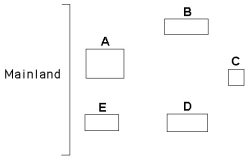 Figure 54.4
-Which island would likely exhibit the most impoverished species diversity?
Figure 54.4
-Which island would likely exhibit the most impoverished species diversity? (Multiple Choice)
4.8/5 (79)
(79) Use the following diagram to answer the next question
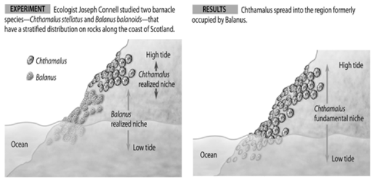 -Connell conducted this experiment to learn more about
 (Multiple Choice)
4.7/5 (71)
(71) The next series of questions presumes that you have at least once visited and have some knowledge of the fast-food restaurant McDonald's. Use your knowledge of McDonald's and your understanding of community ecology to answer the following questions about an ecological community, McDonaldland.
-Which of the following would be considered a keystone species in McDonaldland?
(Multiple Choice)
4.8/5 (84)
(84) Resource partitioning would be most likely to occur between
(Multiple Choice)
4.9/5 (75)
(75) The oak tree pathogen, Phytophthora ramorum, has migrated 650 km in 10 years. West Nile virus spread from New York State to 46 other states in 5 years. The difference in the rate of spread is probably related to
(Multiple Choice)
4.8/5 (77)
(77) The symbols +, -, and o are to be used to show the results of interactions between individuals and groups of individuals in the examples that follow. The symbol + denotes a positive interaction, - denotes a negative interaction, and o denotes where individuals are not affected by interacting. The first symbol refers to the first organism mentioned.
-The feeding relationships among the species in a community determine the community's
(Multiple Choice)
4.8/5 (98)
(98) Evidence shows that some grasses benefit from being grazed. Which of the following terms would best describe this plant-herbivore interaction?
(Multiple Choice)
4.7/5 (85)
(85) According to bottom-up and top-down control models of community organization, which of the following expressions would imply that an increase in the size of a carnivore (C)population would negatively impact on its prey (P)population, but not vice versa?
(Multiple Choice)
4.9/5 (77)
(77) Use the following diagram of a hypothetical food web to answer the following questions. The arrows represent the transfer of food energy between the various trophic levels.
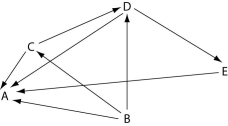 Figure 54.3
-Which letter represents an organism that could be a producer?
Figure 54.3
-Which letter represents an organism that could be a producer? (Multiple Choice)
4.9/5 (83)
(83) Dwarf mistletoes are flowering plants that grow on certain forest trees. They obtain nutrients and water from the vascular tissues of the trees. The trees derive no known benefits from the dwarf mistletoes. Which of the following best describes the interactions between dwarf mistletoes and trees?
(Multiple Choice)
4.7/5 (68)
(68) The 1988 Yellowstone National Park lodgepole pine forest fires were likely the result of
(Multiple Choice)
4.8/5 (80)
(80) As you study two closely related predatory insect species, the two-spot and the three-spot avenger beetles, you notice that each species seeks prey at dawn in areas without the other species. However, where their ranges overlap, the two-spot avenger beetle hunts at night and the three-spot hunts in the morning. When you bring them into the laboratory and isolate the two different species, you discover that the offspring of both species are found to be nocturnal. You have discovered an example of
(Multiple Choice)
4.7/5 (73)
(73) The most plausible hypothesis to explain why species richness is higher in tropical than in temperate regions is that
(Multiple Choice)
4.7/5 (62)
(62) The next series of questions presumes that you have at least once visited and have some knowledge of the fast-food restaurant McDonald's. Use your knowledge of McDonald's and your understanding of community ecology to answer the following questions about an ecological community, McDonaldland.
-Which two "species" are likely to compete for the same ecological niche?
(Multiple Choice)
4.8/5 (83)
(83) The symbols +, -, and o are to be used to show the results of interactions between individuals and groups of individuals in the examples that follow. The symbol + denotes a positive interaction, - denotes a negative interaction, and o denotes where individuals are not affected by interacting. The first symbol refers to the first organism mentioned.
-What interactions exist between a bee and a flower?
(Multiple Choice)
4.9/5 (73)
(73) Which of the following best describes resource partitioning?
(Multiple Choice)
4.8/5 (78)
(78) The symbols +, -, and o are to be used to show the results of interactions between individuals and groups of individuals in the examples that follow. The symbol + denotes a positive interaction, - denotes a negative interaction, and o denotes where individuals are not affected by interacting. The first symbol refers to the first organism mentioned.
-What interactions exist between a lion pride and a hyena pack?
(Multiple Choice)
4.9/5 (70)
(70) How might an ecologist test whether a species is occupying its realized or its fundamental niche?
(Multiple Choice)
4.8/5 (87)
(87) 
Filters
- Essay(0)
- Multiple Choice(0)
- Short Answer(0)
- True False(0)
- Matching(0)