



 Chat with AI
Exam 48: Neurons, Synapses, and Signaling

Exam 1: Introduction: Themes in the Study of Life64 Questions
Exam 2: The Chemical Context of Life83 Questions
Exam 3: Water and Life70 Questions
Exam 4: Carbon and the Molecular Diversity of Life71 Questions
Exam 5: The Structure and Function of Large Biological Molecules109 Questions
Exam 6: A Tour of the Cell80 Questions
Exam 7: Membrane Structure and Function80 Questions
Exam 8: An Introduction to Metabolism80 Questions
Exam 9: Cellular Respiration and Fermentation107 Questions
Exam 10: Photosynthesis81 Questions
Exam 11: Cell Communication69 Questions
Exam 12: The Cell Cycle79 Questions
Exam 13: Meiosis and Sexual Life Cycles70 Questions
Exam 14: Mendel and the Gene Idea73 Questions
Exam 15: The Chromosomal Basis of Inheritance61 Questions
Exam 16: The Molecular Basis of Inheritance57 Questions
Exam 17: From Gene to Protein83 Questions
Exam 18: Regulation of Gene Expression99 Questions
Exam 19: Viruses47 Questions
Exam 20: Biotechnology72 Questions
Exam 21: Genomes and Their Evolution42 Questions
Exam 22: Descent with Modification: A Darwinian View of Life55 Questions
Exam 23: The Evolution of Populations78 Questions
Exam 24: The Origin of Species63 Questions
Exam 25: The History of Life on Earth75 Questions
Exam 26: Phylogeny and the Tree of Life73 Questions
Exam 27: Bacteria and Archaea78 Questions
Exam 28: Protists76 Questions
Exam 29: Plant Diversity I: How Plants Colonized Land74 Questions
Exam 30: Plant Diversity II: The Evolution of Seed Plants102 Questions
Exam 31: Fungi89 Questions
Exam 32: An Overview of Animal Diversity74 Questions
Exam 33: An Introduction to Invertebrates93 Questions
Exam 34: The Origin and Evolution of Vertebrates109 Questions
Exam 35: Plant Structure, Growth, and Development67 Questions
Exam 36: Resource Acquisition and Transport in Vascular Plants82 Questions
Exam 37: Soil and Plant Nutrition83 Questions
Exam 38: Angiosperm Reproduction and Biotechnology86 Questions
Exam 39: Plant Responses to Internal and External Signals108 Questions
Exam 40: Basic Principles of Animal Form and Function77 Questions
Exam 41: Animal Nutrition64 Questions
Exam 42: Circulation and Gas Exchange90 Questions
Exam 43: The Immune System100 Questions
Exam 44: Osmoregulation and Excretion69 Questions
Exam 45: Hormones and the Endocrine System72 Questions
Exam 46: Animal Reproduction94 Questions
Exam 47: Animal Development92 Questions
Exam 48: Neurons, Synapses, and Signaling73 Questions
Exam 49: Nervous Systems65 Questions
Exam 50: Sensory and Motor Mechanisms82 Questions
Exam 51: Animal Behavior69 Questions
Exam 52: An Introduction to Ecology and the Biosphere73 Questions
Exam 53: Population Ecology79 Questions
Exam 54: Community Ecology77 Questions
Exam 55: Ecosystems and Restoration Ecology81 Questions
Exam 56: Conservation Biology and Global Change67 Questions
Select questions type


The surface on a neuron that discharges the contents of synaptic vesicles is the
(Multiple Choice)
4.7/5  (78)
(78) For the following questions, refer to the graph of an action potential.
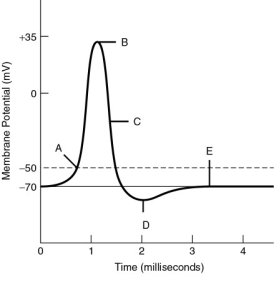 -Action potentials are normally carried in only one direction: from the axon hillock toward the axon terminals. If you experimentally depolarize the middle of the axon to threshold, using an electronic probe, then
 (Multiple Choice)
4.8/5 (71)
(71) Although the membrane of a "resting" neuron is highly permeable to potassium ions, its membrane potential does not exactly match the equilibrium potential for potassium because the neuronal membrane is also
(Multiple Choice)
4.9/5 (81)
(81) A toxin that binds specifically to voltage-gated sodium channels in axons would be expected to
(Multiple Choice)
4.9/5 (81)
(81) The primary means by which a neuron can communicate to a second neuron is by
(Multiple Choice)
4.9/5 (65)
(65) Immediately after an action potential passes along an axon, it is not possible to generate a second action potential; thus, we state that the membrane is briefly
(Multiple Choice)
4.8/5 (61)
(61) For the following questions, refer to the graph of an action potential.
-The neuronal membrane is at its resting potential at label
-The neuronal membrane is at its resting potential at label (Multiple Choice)
4.9/5 (79)
(79) In a simple synapse, neurotransmitter chemicals are received by
(Multiple Choice)
4.9/5 (91)
(91) When several EPSPs arrive at the axon hillock from different dendritic locations, depolarizing the postsynaptic cell to threshold for an action potential, this is an example of
(Multiple Choice)
4.9/5 (80)
(80) The observation that the acetylcholine released into the junction between a motor neuron and a skeletal muscle binds to a sodium channel and opens it is an example of
(Multiple Choice)
4.9/5 (78)
(78) A neuropeptide that might function as a natural analgesic is
(Multiple Choice)
4.7/5 (64)
(64) In certain large animals, this type of neuron can extend beyond 1 meter in length.
(Multiple Choice)
4.9/5 (75)
(75) In the sequence of permeability changes for a complete action potential, the first of these events that occurs is
(Multiple Choice)
4.9/5 (76)
(76) The activity of acetylcholine in a synapse is terminated by
(Multiple Choice)
4.8/5 (74)
(74) An amino acid that operates at inhibitory synapses in the brain is
(Multiple Choice)
4.7/5 (70)
(70) Two fundamental concepts about the ion channels of a "resting" neuron are that the channels
(Multiple Choice)
4.9/5 (72)
(72) An action potential can start in the middle of an axon and proceed in both opposite directions when
(Multiple Choice)
4.7/5 (90)
(90) A cation that is more abundant as a solute in the cytosol of a neuron than it is in the interstitial fluid outside the neuron is
(Multiple Choice)
5.0/5 (81)
(81) 
Filters
- Essay(0)
- Multiple Choice(0)
- Short Answer(0)
- True False(0)
- Matching(0)