



 Chat with AI
Exam 41: Animal Nutrition

Exam 1: Introduction: Themes in the Study of Life64 Questions
Exam 2: The Chemical Context of Life83 Questions
Exam 3: Water and Life70 Questions
Exam 4: Carbon and the Molecular Diversity of Life71 Questions
Exam 5: The Structure and Function of Large Biological Molecules109 Questions
Exam 6: A Tour of the Cell80 Questions
Exam 7: Membrane Structure and Function80 Questions
Exam 8: An Introduction to Metabolism80 Questions
Exam 9: Cellular Respiration and Fermentation107 Questions
Exam 10: Photosynthesis81 Questions
Exam 11: Cell Communication69 Questions
Exam 12: The Cell Cycle79 Questions
Exam 13: Meiosis and Sexual Life Cycles70 Questions
Exam 14: Mendel and the Gene Idea73 Questions
Exam 15: The Chromosomal Basis of Inheritance61 Questions
Exam 16: The Molecular Basis of Inheritance57 Questions
Exam 17: From Gene to Protein83 Questions
Exam 18: Regulation of Gene Expression99 Questions
Exam 19: Viruses47 Questions
Exam 20: Biotechnology72 Questions
Exam 21: Genomes and Their Evolution42 Questions
Exam 22: Descent with Modification: A Darwinian View of Life55 Questions
Exam 23: The Evolution of Populations78 Questions
Exam 24: The Origin of Species63 Questions
Exam 25: The History of Life on Earth75 Questions
Exam 26: Phylogeny and the Tree of Life73 Questions
Exam 27: Bacteria and Archaea78 Questions
Exam 28: Protists76 Questions
Exam 29: Plant Diversity I: How Plants Colonized Land74 Questions
Exam 30: Plant Diversity II: The Evolution of Seed Plants102 Questions
Exam 31: Fungi89 Questions
Exam 32: An Overview of Animal Diversity74 Questions
Exam 33: An Introduction to Invertebrates93 Questions
Exam 34: The Origin and Evolution of Vertebrates109 Questions
Exam 35: Plant Structure, Growth, and Development67 Questions
Exam 36: Resource Acquisition and Transport in Vascular Plants82 Questions
Exam 37: Soil and Plant Nutrition83 Questions
Exam 38: Angiosperm Reproduction and Biotechnology86 Questions
Exam 39: Plant Responses to Internal and External Signals108 Questions
Exam 40: Basic Principles of Animal Form and Function77 Questions
Exam 41: Animal Nutrition64 Questions
Exam 42: Circulation and Gas Exchange90 Questions
Exam 43: The Immune System100 Questions
Exam 44: Osmoregulation and Excretion69 Questions
Exam 45: Hormones and the Endocrine System72 Questions
Exam 46: Animal Reproduction94 Questions
Exam 47: Animal Development92 Questions
Exam 48: Neurons, Synapses, and Signaling73 Questions
Exam 49: Nervous Systems65 Questions
Exam 50: Sensory and Motor Mechanisms82 Questions
Exam 51: Animal Behavior69 Questions
Exam 52: An Introduction to Ecology and the Biosphere73 Questions
Exam 53: Population Ecology79 Questions
Exam 54: Community Ecology77 Questions
Exam 55: Ecosystems and Restoration Ecology81 Questions
Exam 56: Conservation Biology and Global Change67 Questions
Select questions type


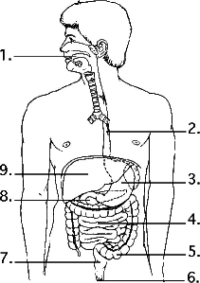 -Examine the digestive system structures in the figure above. The agents that help emulsify fats are produced in
 (Multiple Choice)
4.9/5  (84)
(84) To maintain adequate nutrition, animals require dietary access to certain amino acids. An amino acid that is referred to as "nonessential" would be best described as one that
(Multiple Choice)
4.9/5 (72)
(72) Upon activation by stomach acidity, the secretions of the parietal cells
(Multiple Choice)
4.9/5 (76)
(76) Ingested dietary substances must cross cell membranes to be used by the body, a process known as
(Multiple Choice)
4.9/5 (76)
(76) Certain nutrients are considered "essential" in the diets of some animals because
(Multiple Choice)
4.8/5 (84)
(84) A nutritional monomer that can be transported in the blood after a typical meal is
(Multiple Choice)
4.8/5 (78)
(78) In marine sponges, intracellular digestion of peptides is usually immediately preceded by
(Multiple Choice)
4.8/5 (80)
(80) Historically inaccurate diagnosis of acid reflux disorders and gastric ulcers has been improved by
(Multiple Choice)
4.8/5 (87)
(87) A hiatal hernia that disrupts the functional relationship between the smooth muscle in the esophagus and that in the stomach would be most likely to increase the frequency of
(Multiple Choice)
5.0/5 (94)
(94) A fasting animal whose energy needs exceed those provided in its diet draws on its stored resources in which order?
(Multiple Choice)
4.7/5 (69)
(69) The molar teeth of herbivorous mammals are especially effective at
(Multiple Choice)
4.9/5 (82)
(82) A general rule relating the capacity of a specific animal's digestive system to provide adequate access to substrates for biosynthesis of cellular components, as well as fuel molecules needed for ATP production, is that the animal should have access to
(Multiple Choice)
4.8/5 (82)
(82)
-Examine the digestive system structures in the figure above. Bacteria that produce vitamins as products are residents of location
-Examine the digestive system structures in the figure above. Bacteria that produce vitamins as products are residents of location (Multiple Choice)
4.9/5 (96)
(96) Which of the following organs is incorrectly paired with its function?
(Multiple Choice)
4.8/5 (78)
(78) Animals that migrate great distances would obtain the greatest energetic benefit of storing chemical energy as
(Multiple Choice)
4.8/5 (74)
(74) If you were to jog 1 km a few hours after lunch, which stored fuel would you probably tap?
(Multiple Choice)
4.9/5 (83)
(83) Digestive secretions with a pH of 2 are characteristic of the
(Multiple Choice)
5.0/5 (65)
(65) 
Filters
- Essay(0)
- Multiple Choice(0)
- Short Answer(0)
- True False(0)
- Matching(0)