



 Chat with AI
Exam 28: Protists

Exam 1: Introduction: Themes in the Study of Life64 Questions
Exam 2: The Chemical Context of Life83 Questions
Exam 3: Water and Life70 Questions
Exam 4: Carbon and the Molecular Diversity of Life71 Questions
Exam 5: The Structure and Function of Large Biological Molecules109 Questions
Exam 6: A Tour of the Cell80 Questions
Exam 7: Membrane Structure and Function80 Questions
Exam 8: An Introduction to Metabolism80 Questions
Exam 9: Cellular Respiration and Fermentation107 Questions
Exam 10: Photosynthesis81 Questions
Exam 11: Cell Communication69 Questions
Exam 12: The Cell Cycle79 Questions
Exam 13: Meiosis and Sexual Life Cycles70 Questions
Exam 14: Mendel and the Gene Idea73 Questions
Exam 15: The Chromosomal Basis of Inheritance61 Questions
Exam 16: The Molecular Basis of Inheritance57 Questions
Exam 17: From Gene to Protein83 Questions
Exam 18: Regulation of Gene Expression99 Questions
Exam 19: Viruses47 Questions
Exam 20: Biotechnology72 Questions
Exam 21: Genomes and Their Evolution42 Questions
Exam 22: Descent with Modification: A Darwinian View of Life55 Questions
Exam 23: The Evolution of Populations78 Questions
Exam 24: The Origin of Species63 Questions
Exam 25: The History of Life on Earth75 Questions
Exam 26: Phylogeny and the Tree of Life73 Questions
Exam 27: Bacteria and Archaea78 Questions
Exam 28: Protists76 Questions
Exam 29: Plant Diversity I: How Plants Colonized Land74 Questions
Exam 30: Plant Diversity II: The Evolution of Seed Plants102 Questions
Exam 31: Fungi89 Questions
Exam 32: An Overview of Animal Diversity74 Questions
Exam 33: An Introduction to Invertebrates93 Questions
Exam 34: The Origin and Evolution of Vertebrates109 Questions
Exam 35: Plant Structure, Growth, and Development67 Questions
Exam 36: Resource Acquisition and Transport in Vascular Plants82 Questions
Exam 37: Soil and Plant Nutrition83 Questions
Exam 38: Angiosperm Reproduction and Biotechnology86 Questions
Exam 39: Plant Responses to Internal and External Signals108 Questions
Exam 40: Basic Principles of Animal Form and Function77 Questions
Exam 41: Animal Nutrition64 Questions
Exam 42: Circulation and Gas Exchange90 Questions
Exam 43: The Immune System100 Questions
Exam 44: Osmoregulation and Excretion69 Questions
Exam 45: Hormones and the Endocrine System72 Questions
Exam 46: Animal Reproduction94 Questions
Exam 47: Animal Development92 Questions
Exam 48: Neurons, Synapses, and Signaling73 Questions
Exam 49: Nervous Systems65 Questions
Exam 50: Sensory and Motor Mechanisms82 Questions
Exam 51: Animal Behavior69 Questions
Exam 52: An Introduction to Ecology and the Biosphere73 Questions
Exam 53: Population Ecology79 Questions
Exam 54: Community Ecology77 Questions
Exam 55: Ecosystems and Restoration Ecology81 Questions
Exam 56: Conservation Biology and Global Change67 Questions
Select questions type


A P. bursaria cell that has lost its zoochlorellae is aposymbiotic. If aposymbiotic cells have population growth rates the same as those of healthy, zoochlorella-containing P. bursaria in well-lit environments with plenty of prey items, then such an observation would be consistent with which type of relationship?
(Multiple Choice)
4.8/5  (85)
(85) You are given five test tubes, each containing an unknown protist, and your task is to read the following description and match these five protists to the correct test tube.
In test tube 1, you observe an organism feeding. Your sketch of the organism looks very similar to Figure 28.1. When light, especially red and blue light, is shone on the tubes, oxygen bubbles accumulate on the inside of test tubes 2 and 3. Chemical analysis of test tube 3 indicates the presence of substantial amounts of silica. Chemical analysis of test tube 2 indicates the presence of a chemical that is toxic to fish and humans. Microscopic analysis of organisms in test tubes 2, 4, and 5 reveals the presence of permanent, membrane-bounded sacs just under the plasma membrane. Microscopic analysis of organisms in test tube 4 reveals the presence of an apicoplast in each. Microscopic analysis of the contents in test tube 5 reveals the presence of one large nucleus and several small nuclei in each organism.
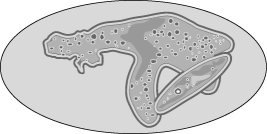 Figure 28.1
-Test tube 5 contains
Figure 28.1
-Test tube 5 contains (Multiple Choice)
4.8/5 (79)
(79) The next few questions refer to the following description and Table 28.1.
Diatoms are encased in Petri-platelike cases (valves) made of translucent hydrated silica whose thickness can be varied. The material used to store excess calories can also be varied. At certain times, diatoms store excess calories in the form of the liquid polysaccharide, laminarin, and at other times as oil. The following are data concerning the density (specific gravity) of various components of diatoms, and of their environment.
Table 28.1 Specific Gravities of Materials Relevant to Diatoms
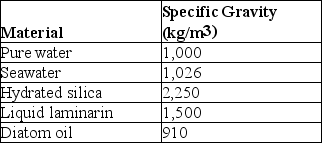 -Water's density and, consequently, its buoyancy decrease at warmer temperatures. Based on this consideration and using data from Table 28.1, at which time of year should one expect diatoms to be storing excess calories mostly as oil?
 (Multiple Choice)
4.8/5 (83)
(83) Paulinella chromatophora is one of the few cercozoans that is autotrophic, carrying out aerobic photosynthesis with its two elongated "cyanelles." The cyanelles are contained within vesicles of the host cell, and each is derived from a cyanobacterium, though not the same type of cyanobacterium that gave rise to the chloroplasts of algae and plants.
-The closest living relative of P. chromatophora is the heterotroph, P. ovalis. What type of evidence permits biologists to make this claim about relatedness?
(Multiple Choice)
4.7/5 (86)
(86) You are given five test tubes, each containing an unknown protist, and your task is to read the following description and match these five protists to the correct test tube.
In test tube 1, you observe an organism feeding. Your sketch of the organism looks very similar to Figure 28.1. When light, especially red and blue light, is shone on the tubes, oxygen bubbles accumulate on the inside of test tubes 2 and 3. Chemical analysis of test tube 3 indicates the presence of substantial amounts of silica. Chemical analysis of test tube 2 indicates the presence of a chemical that is toxic to fish and humans. Microscopic analysis of organisms in test tubes 2, 4, and 5 reveals the presence of permanent, membrane-bounded sacs just under the plasma membrane. Microscopic analysis of organisms in test tube 4 reveals the presence of an apicoplast in each. Microscopic analysis of the contents in test tube 5 reveals the presence of one large nucleus and several small nuclei in each organism.
Figure 28.1
-Test tube 3 contains
Figure 28.1
-Test tube 3 contains (Multiple Choice)
4.8/5 (85)
(85) The next few questions refer to the following description.
Healthy individuals of Paramecium bursaria contain photosynthetic algal endosymbionts of the genus Chlorella. When within their hosts, the algae are referred to as zoochlorellae. In aquaria with light coming from only one side, P. bursaria gathers at the well-lit side, whereas other species of Paramecium gather at the opposite side. The zoochlorellae provide their hosts with glucose and oxygen, and P. bursaria provides its zoochlorellae with protection and motility. P. bursaria can lose its zoochlorellae in two ways: (1) if kept in darkness, the algae will die; and (2) if prey items (mostly bacteria) are absent from its habitat, P. bursaria will digest its zoochlorellae.
-Which term best describes the symbiotic relationship of well-fed P. bursaria to their zoochlorellae?
(Multiple Choice)
4.9/5 (94)
(94) Paulinella chromatophora is one of the few cercozoans that is autotrophic, carrying out aerobic photosynthesis with its two elongated "cyanelles." The cyanelles are contained within vesicles of the host cell, and each is derived from a cyanobacterium, though not the same type of cyanobacterium that gave rise to the chloroplasts of algae and plants.
-The closest living relative of P. chromatophora is the heterotroph, P. ovalis. P. ovalis uses threadlike pseudopods to capture its prey, which it digests internally. Which of the following, if observed, would be the best reason for relabeling P. chromatophora as a mixotroph?
(Multiple Choice)
4.9/5 (72)
(72) The motility that permits P. bursaria to move toward a light source is provided by
(Multiple Choice)
4.7/5 (83)
(83) Giardia's mitosome can be said to be "doubly degenerate," because it is a degenerate form of ________, an organelle that is itself a degenerate form of ________.
(Multiple Choice)
4.7/5 (68)
(68) Which two genera have members that can evade the human immune system by frequently changing their surface proteins?
1)Plasmodium
2)Trichomonas
3)Paramecium
4)Trypanosoma
5)Entamoeba
(Multiple Choice)
4.7/5 (81)
(81) The chloroplasts of land plants are thought to have been derived according to which evolutionary sequence?
(Multiple Choice)
4.8/5 (81)
(81) Plastids that are surrounded by more than two membranes are evidence of
(Multiple Choice)
4.8/5 (81)
(81) The primary treatment for giardiasis (infection with Giardia), as well as for trichomoniasis (infection with Trichomonas vaginalis)and for amoebic dysentery (infection with Entamoeba histolytica), is a drug marketed as Flagyl (generic name is metronidazole). The drug also kills anaerobic gut bacteria. Consequently, which of these are cues that Flagyl's mode of action has nothing to do with attacking or disabling the parasites' flagella, as the drug's name might imply?
1)It would also harm the flagellated lining of the human intestine.
2)Entamoeba possesses pseudopods, not flagella, yet it is killed by Flagyl.
3)Prokaryotic flagella and eukaryotic flagella are radically different from each other and unlikely to be harmed by the same chemical.
4)Not all anaerobic gut bacteria possess flagella, yet it kills these bacteria.
(Multiple Choice)
4.9/5 (83)
(83) The next few questions refer to the following description.
Healthy individuals of Paramecium bursaria contain photosynthetic algal endosymbionts of the genus Chlorella. When within their hosts, the algae are referred to as zoochlorellae. In aquaria with light coming from only one side, P. bursaria gathers at the well-lit side, whereas other species of Paramecium gather at the opposite side. The zoochlorellae provide their hosts with glucose and oxygen, and P. bursaria provides its zoochlorellae with protection and motility. P. bursaria can lose its zoochlorellae in two ways: (1) if kept in darkness, the algae will die; and (2) if prey items (mostly bacteria) are absent from its habitat, P. bursaria will digest its zoochlorellae.
-Which term accurately describes the behavior of Paramecium species that lack zoochlorellae in an aquarium with light coming from one side only?
(Multiple Choice)
4.9/5 (73)
(73) P. chromatophora secretes around itself a test, or case, of plates made of silica. Which of the following is another rhizarian that would be in competition with P. chromatophora for the silica needed to make these plates, assuming limited quantities of silica in the environment?
(Multiple Choice)
4.8/5 (67)
(67) Given the putative ancestry of Giardia's mitosome, what should we predict is true of the mitosome?
(Multiple Choice)
4.8/5 (81)
(81) If true, which of the following is the best evidence that the cyanelles are providing nutrition (in other words, calories)to the surrounding cercozoan?
(Multiple Choice)
4.9/5 (82)
(82) The next few questions refer to the following description and Table 28.1.
Diatoms are encased in Petri-platelike cases (valves) made of translucent hydrated silica whose thickness can be varied. The material used to store excess calories can also be varied. At certain times, diatoms store excess calories in the form of the liquid polysaccharide, laminarin, and at other times as oil. The following are data concerning the density (specific gravity) of various components of diatoms, and of their environment.
Table 28.1 Specific Gravities of Materials Relevant to Diatoms
-Judging from Table 28.1 and given that water's density and, consequently, its buoyancy decrease at warmer temperatures, in which environment should diatoms (and other suspended particles)sink most slowly?
-Judging from Table 28.1 and given that water's density and, consequently, its buoyancy decrease at warmer temperatures, in which environment should diatoms (and other suspended particles)sink most slowly? (Multiple Choice)
4.7/5 (71)
(71) 
Filters
- Essay(0)
- Multiple Choice(0)
- Short Answer(0)
- True False(0)
- Matching(0)