



 Chat with AI
Exam 23: The Evolution of Populations

Exam 1: Introduction: Themes in the Study of Life64 Questions
Exam 2: The Chemical Context of Life83 Questions
Exam 3: Water and Life70 Questions
Exam 4: Carbon and the Molecular Diversity of Life71 Questions
Exam 5: The Structure and Function of Large Biological Molecules109 Questions
Exam 6: A Tour of the Cell80 Questions
Exam 7: Membrane Structure and Function80 Questions
Exam 8: An Introduction to Metabolism80 Questions
Exam 9: Cellular Respiration and Fermentation107 Questions
Exam 10: Photosynthesis81 Questions
Exam 11: Cell Communication69 Questions
Exam 12: The Cell Cycle79 Questions
Exam 13: Meiosis and Sexual Life Cycles70 Questions
Exam 14: Mendel and the Gene Idea73 Questions
Exam 15: The Chromosomal Basis of Inheritance61 Questions
Exam 16: The Molecular Basis of Inheritance57 Questions
Exam 17: From Gene to Protein83 Questions
Exam 18: Regulation of Gene Expression99 Questions
Exam 19: Viruses47 Questions
Exam 20: Biotechnology72 Questions
Exam 21: Genomes and Their Evolution42 Questions
Exam 22: Descent with Modification: A Darwinian View of Life55 Questions
Exam 23: The Evolution of Populations78 Questions
Exam 24: The Origin of Species63 Questions
Exam 25: The History of Life on Earth75 Questions
Exam 26: Phylogeny and the Tree of Life73 Questions
Exam 27: Bacteria and Archaea78 Questions
Exam 28: Protists76 Questions
Exam 29: Plant Diversity I: How Plants Colonized Land74 Questions
Exam 30: Plant Diversity II: The Evolution of Seed Plants102 Questions
Exam 31: Fungi89 Questions
Exam 32: An Overview of Animal Diversity74 Questions
Exam 33: An Introduction to Invertebrates93 Questions
Exam 34: The Origin and Evolution of Vertebrates109 Questions
Exam 35: Plant Structure, Growth, and Development67 Questions
Exam 36: Resource Acquisition and Transport in Vascular Plants82 Questions
Exam 37: Soil and Plant Nutrition83 Questions
Exam 38: Angiosperm Reproduction and Biotechnology86 Questions
Exam 39: Plant Responses to Internal and External Signals108 Questions
Exam 40: Basic Principles of Animal Form and Function77 Questions
Exam 41: Animal Nutrition64 Questions
Exam 42: Circulation and Gas Exchange90 Questions
Exam 43: The Immune System100 Questions
Exam 44: Osmoregulation and Excretion69 Questions
Exam 45: Hormones and the Endocrine System72 Questions
Exam 46: Animal Reproduction94 Questions
Exam 47: Animal Development92 Questions
Exam 48: Neurons, Synapses, and Signaling73 Questions
Exam 49: Nervous Systems65 Questions
Exam 50: Sensory and Motor Mechanisms82 Questions
Exam 51: Animal Behavior69 Questions
Exam 52: An Introduction to Ecology and the Biosphere73 Questions
Exam 53: Population Ecology79 Questions
Exam 54: Community Ecology77 Questions
Exam 55: Ecosystems and Restoration Ecology81 Questions
Exam 56: Conservation Biology and Global Change67 Questions
Select questions type


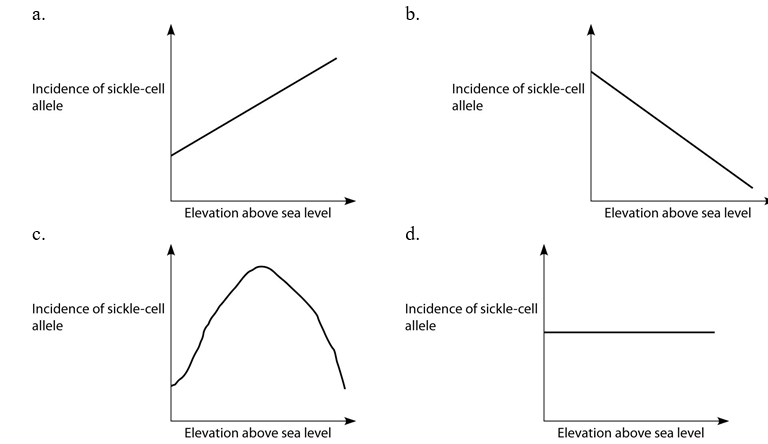
If global warming permits mosquitoes to live at higher altitudes than they currently do, then in which direction should the entire plot in the correct distribution below be shifted?
(Multiple Choice)
4.8/5  (82)
(82) The sickle-cell allele is pleiotropic (i.e., it affects more than one phenotypic trait). Specifically, this allele affects oxygen delivery to tissues and affects one's susceptibility to malaria. Under conditions of low atmospheric oxygen availability, individuals heterozygous for this allele can experience life-threatening sickle-cell "crises." Such individuals remain less susceptible to malaria. Thus, pleiotropic genes/alleles such as this can help explain why
(Multiple Choice)
4.9/5 (82)
(82) The restriction enzymes of bacteria protect the bacteria from successful attack by bacteriophages, whose genomes can be degraded by the restriction enzymes. The bacterial genomes are not vulnerable to these restriction enzymes because bacterial DNA is methylated. This situation selects for bacteriophages whose genomes are also methylated. As new strains of resistant bacteriophages become more prevalent, this in turn selects for bacteria whose genomes are not methylated and whose restriction enzymes instead degrade methylated DNA. Over the course of evolutionary time, what should occur?
(Multiple Choice)
4.8/5 (73)
(73) In a very large population, a quantitative trait has the following distribution pattern:
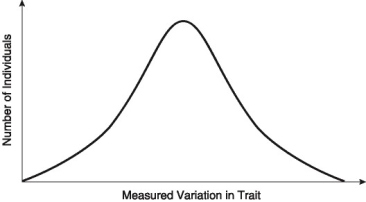 -If the curve in the previous figure shifts to the left or to the right, there is no gene flow, and the population size consequently increases over successive generations. Which of the following is (are)probably occurring?
1)immigration or emigration
2)directional selection
3)adaptation
4)genetic drift
5)disruptive selection
-If the curve in the previous figure shifts to the left or to the right, there is no gene flow, and the population size consequently increases over successive generations. Which of the following is (are)probably occurring?
1)immigration or emigration
2)directional selection
3)adaptation
4)genetic drift
5)disruptive selection (Multiple Choice)
4.7/5 (85)
(85) The same gene that causes various coat patterns in wild and domesticated cats also causes the cross-eyed condition in these cats, the cross-eyed condition being slightly maladaptive. In a hypothetical environment, the coat pattern that is associated with crossed eyes is highly adaptive, with the result that both the coat pattern and the cross-eyed condition increase in a feline population over time. Which statement is supported by these observations?
(Multiple Choice)
4.8/5 (78)
(78) Which of the following statements best summarizes evolution as it is viewed today?
(Multiple Choice)
4.9/5 (91)
(91) Which of the following is most likely to produce an African butterfly species in the wild whose members have one of two strikingly different color patterns?
(Multiple Choice)
4.9/5 (87)
(87) With respect to the sickle-cell allele, what should be true of the β hemoglobin locus in U.S. populations of African-Americans whose ancestors were from equatorial Africa?
1)The average heterozygosity at this locus should be decreasing over time.
2)There is an increasing heterozygote advantage at this locus.
3)Diploidy is helping to preserve the sickle-cell allele at this locus.
4)Frequency-dependent selection is helping to preserve the sickle-cell allele at this locus.
(Multiple Choice)
4.9/5 (73)
(73) Adult male humans generally have deeper voices than do adult female humans, which is the direct result of higher levels of testosterone causing growth of the larynx. If the fossil records of apes and humans alike show a trend toward decreasing larynx size in adult females and increasing larynx size in adult males, then
(Multiple Choice)
4.8/5 (80)
(80) When imbalances occur in the sex ratio of sexual species that have two sexes (i.e., other than a 50:50 ratio), the members of the minority sex often receive a greater proportion of care and resources from parents than do the offspring of the majority sex. This is most clearly an example of
(Multiple Choice)
4.7/5 (74)
(74) Arrange the following from most general (i.e., most inclusive)to most specific (i.e., least inclusive):
1 natural selection
2)microevolution
3)intrasexual selection
4)evolution
5)sexual selection
(Multiple Choice)
4.7/5 (76)
(76) In the formula for determining a population's genotype frequencies, the pq in the term 2pq is necessary because
(Multiple Choice)
4.8/5 (78)
(78) The following questions refer to the following paragraph.
HIV's genome of RNA includes the code for reverse transcriptase (RT), an enzyme that acts early in infection to synthesize a DNA genome off of an RNA template. The HIV genome also codes for protease (PR), an enzyme that acts later in infection by cutting long viral polyproteins into smaller, functional proteins. Both RT and PR represent potential targets for antiretroviral drugs. Drugs called nucleoside analogs (NA) act against RT, whereas drugs called protease inhibitors (PI) act against PR.
-Which of the following represents the treatment option most likely to avoid the production of drug-resistant HIV (assuming no drug interactions or side effects)?
(Multiple Choice)
4.9/5 (82)
(82) In a Hardy-Weinberg population with two alleles, A and a, that are in equilibrium, the frequency of allele a is 0.1. What is the frequency of individuals with AA genotype?
(Multiple Choice)
4.8/5 (82)
(82) In a Hardy-Weinberg population with two alleles, A and a, that are in equilibrium, the frequency of allele a is 0.2. What is the percentage of the population that is heterozygous for this allele?
(Multiple Choice)
5.0/5 (72)
(72) In the year 2500, five male space colonists and five female space colonists (all unrelated to each other) settle on an uninhabited Earthlike planet in the Andromeda galaxy. The colonists and their offspring randomly mate for generations. All ten of the original colonists had free earlobes, and two were heterozygous for that trait. The allele for free earlobes is dominant to the allele for attached earlobes.
-Which of these is closest to the allele frequency in the founding population?
(Multiple Choice)
4.8/5 (66)
(66) The volcano is currently dormant, but in a hypothetical future scenario, satellite cones at the base of Mt. Kilimanjaro spew sulfurous gases and lava, destroying all life located between the base and 6,000 feet above sea level. As a result of this catastrophe, how should the frequency of the sickle-cell allele change in the remnant human population that survives above 6,000 feet, and which phenomenon accounts for this change in allele frequency?
(Multiple Choice)
4.8/5 (84)
(84) Use the following information to answer the following questions.
In those parts of equatorial Africa where the malaria parasite is most common, the sickle-cell allele constitutes 20% of the β hemoglobin alleles in the human gene pool.
-If the sickle-cell allele is recessive, what proportion of the population should be susceptible to sickle-cell anemia under typical conditions?
(Multiple Choice)
4.7/5 (100)
(100) 
Filters
- Essay(0)
- Multiple Choice(0)
- Short Answer(0)
- True False(0)
- Matching(0)