



 Chat with AI
Exam 21: Genomes and Their Evolution

Exam 1: Introduction: Themes in the Study of Life64 Questions
Exam 2: The Chemical Context of Life83 Questions
Exam 3: Water and Life70 Questions
Exam 4: Carbon and the Molecular Diversity of Life71 Questions
Exam 5: The Structure and Function of Large Biological Molecules109 Questions
Exam 6: A Tour of the Cell80 Questions
Exam 7: Membrane Structure and Function80 Questions
Exam 8: An Introduction to Metabolism80 Questions
Exam 9: Cellular Respiration and Fermentation107 Questions
Exam 10: Photosynthesis81 Questions
Exam 11: Cell Communication69 Questions
Exam 12: The Cell Cycle79 Questions
Exam 13: Meiosis and Sexual Life Cycles70 Questions
Exam 14: Mendel and the Gene Idea73 Questions
Exam 15: The Chromosomal Basis of Inheritance61 Questions
Exam 16: The Molecular Basis of Inheritance57 Questions
Exam 17: From Gene to Protein83 Questions
Exam 18: Regulation of Gene Expression99 Questions
Exam 19: Viruses47 Questions
Exam 20: Biotechnology72 Questions
Exam 21: Genomes and Their Evolution42 Questions
Exam 22: Descent with Modification: A Darwinian View of Life55 Questions
Exam 23: The Evolution of Populations78 Questions
Exam 24: The Origin of Species63 Questions
Exam 25: The History of Life on Earth75 Questions
Exam 26: Phylogeny and the Tree of Life73 Questions
Exam 27: Bacteria and Archaea78 Questions
Exam 28: Protists76 Questions
Exam 29: Plant Diversity I: How Plants Colonized Land74 Questions
Exam 30: Plant Diversity II: The Evolution of Seed Plants102 Questions
Exam 31: Fungi89 Questions
Exam 32: An Overview of Animal Diversity74 Questions
Exam 33: An Introduction to Invertebrates93 Questions
Exam 34: The Origin and Evolution of Vertebrates109 Questions
Exam 35: Plant Structure, Growth, and Development67 Questions
Exam 36: Resource Acquisition and Transport in Vascular Plants82 Questions
Exam 37: Soil and Plant Nutrition83 Questions
Exam 38: Angiosperm Reproduction and Biotechnology86 Questions
Exam 39: Plant Responses to Internal and External Signals108 Questions
Exam 40: Basic Principles of Animal Form and Function77 Questions
Exam 41: Animal Nutrition64 Questions
Exam 42: Circulation and Gas Exchange90 Questions
Exam 43: The Immune System100 Questions
Exam 44: Osmoregulation and Excretion69 Questions
Exam 45: Hormones and the Endocrine System72 Questions
Exam 46: Animal Reproduction94 Questions
Exam 47: Animal Development92 Questions
Exam 48: Neurons, Synapses, and Signaling73 Questions
Exam 49: Nervous Systems65 Questions
Exam 50: Sensory and Motor Mechanisms82 Questions
Exam 51: Animal Behavior69 Questions
Exam 52: An Introduction to Ecology and the Biosphere73 Questions
Exam 53: Population Ecology79 Questions
Exam 54: Community Ecology77 Questions
Exam 55: Ecosystems and Restoration Ecology81 Questions
Exam 56: Conservation Biology and Global Change67 Questions
Select questions type


The biggest problem with the shotgun technique is its tendency to underestimate the size of the genome. Which of the following might best account for this?
(Multiple Choice)
4.8/5  (83)
(83) Use the following figure to answer the next few questions.
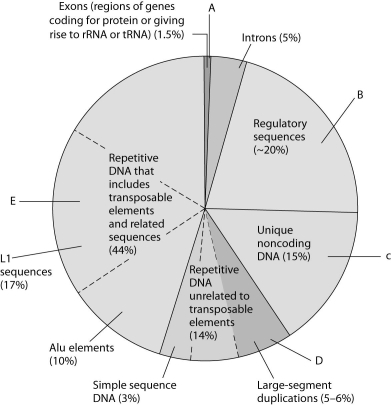 Figure 21.1 Types of DNA sequences in the human genome.
The pie chart in Figure 21.1 represents the relative frequencies of the following in the human genome:
I.repetitive DNA unrelated to transposons
II.repetitive DNA that includes transposons
III.unique noncoding DNA
IV.introns and regulatory sequences
V. exons
-Which region includes Alu elements and LI sequences?
Figure 21.1 Types of DNA sequences in the human genome.
The pie chart in Figure 21.1 represents the relative frequencies of the following in the human genome:
I.repetitive DNA unrelated to transposons
II.repetitive DNA that includes transposons
III.unique noncoding DNA
IV.introns and regulatory sequences
V. exons
-Which region includes Alu elements and LI sequences? (Multiple Choice)
4.7/5 (67)
(67) What characteristic of short tandem repeat DNA makes it useful for DNA fingerprinting?
(Multiple Choice)
4.9/5 (78)
(78) Use the following figure to answer the next few questions.
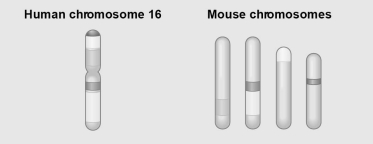 Figure 21.2
 shows a diagram of blocks of genes on human chromosome 16 and the locations of blocks of similar genes on four chromosomes of the mouse.
-The movement of these blocks suggests that
Figure 21.2
Figure 21.2 shows a diagram of blocks of genes on human chromosome 16 and the locations of blocks of similar genes on four chromosomes of the mouse.
-The movement of these blocks suggests that (Multiple Choice)
4.9/5 (80)
(80) Homeotic genes contain a homeobox sequence that is highly conserved among very diverse species. The homeobox is the code for that domain of a protein that binds to DNA in a regulatory developmental process. Which of the following would you then expect?
(Multiple Choice)
4.8/5 (77)
(77) Why is it unwise to try to relate an organism's complexity with its size or number of cells?
(Multiple Choice)
4.9/5 (68)
(68) Barbara McClintock, who achieved fame for discovering that genes could move within genomes, had her meticulous work ignored for nearly four decades, but eventually won the Nobel Prize. Why was her work so distrusted?
(Multiple Choice)
4.8/5 (90)
(90) For mapping studies of genomes, most of which were far along before 2000, the three-stage method was often used. Which of the following is the usual order in which the stages were performed, assuming some overlap of the three?
(Multiple Choice)
4.9/5 (78)
(78) What is the most probable explanation for the continued presence of pseudogenes in a genome such as our own?
(Multiple Choice)
4.8/5 (73)
(73) Why might the cricket genome have 11 times as many base pairs as that of Drosophila melanogaster?
(Multiple Choice)
4.9/5 (74)
(74) Which of the following most correctly describes a shotgun technique for sequencing a genome?
(Multiple Choice)
4.8/5 (78)
(78) The comparison between the number of human genes and those of other animal species has led to many conclusions, including
(Multiple Choice)
4.9/5 (76)
(76) In order to determine the probable function of a particular sequence of DNA in humans, what might be the most reasonable approach?
(Multiple Choice)
4.9/5 (87)
(87) Fragments of DNA have been extracted from the remnants of extinct woolly mammoths, amplified, and sequenced. These can now be used to
(Multiple Choice)
4.8/5 (74)
(74) A microarray known as a GeneChip, with most now-known human protein coding sequences, has been developed to aid in the study of human cancer by first comparing two to three subsets of cancer subtypes. What kind of information might be gleaned from this GeneChip to aid in cancer prevention?
(Multiple Choice)
4.9/5 (91)
(91) In comparing the genomes of humans and those of other higher primates, it is seen that humans have a large metacentric pair we call chromosome 2 among our 46 chromosomes, whereas the other primates of this group have 48 chromosomes and any pair like the human chromosome 2 pair is not present; instead, the primate groups each have two pairs of midsize acrocentric chromosomes. What is the most likely explanation?
(Multiple Choice)
4.8/5 (75)
(75) 
Filters
- Essay(0)
- Multiple Choice(0)
- Short Answer(0)
- True False(0)
- Matching(0)