



 Chat with AI
Exam 19: Viruses

Exam 1: Introduction: Themes in the Study of Life64 Questions
Exam 2: The Chemical Context of Life83 Questions
Exam 3: Water and Life70 Questions
Exam 4: Carbon and the Molecular Diversity of Life71 Questions
Exam 5: The Structure and Function of Large Biological Molecules109 Questions
Exam 6: A Tour of the Cell80 Questions
Exam 7: Membrane Structure and Function80 Questions
Exam 8: An Introduction to Metabolism80 Questions
Exam 9: Cellular Respiration and Fermentation107 Questions
Exam 10: Photosynthesis81 Questions
Exam 11: Cell Communication69 Questions
Exam 12: The Cell Cycle79 Questions
Exam 13: Meiosis and Sexual Life Cycles70 Questions
Exam 14: Mendel and the Gene Idea73 Questions
Exam 15: The Chromosomal Basis of Inheritance61 Questions
Exam 16: The Molecular Basis of Inheritance57 Questions
Exam 17: From Gene to Protein83 Questions
Exam 18: Regulation of Gene Expression99 Questions
Exam 19: Viruses47 Questions
Exam 20: Biotechnology72 Questions
Exam 21: Genomes and Their Evolution42 Questions
Exam 22: Descent with Modification: A Darwinian View of Life55 Questions
Exam 23: The Evolution of Populations78 Questions
Exam 24: The Origin of Species63 Questions
Exam 25: The History of Life on Earth75 Questions
Exam 26: Phylogeny and the Tree of Life73 Questions
Exam 27: Bacteria and Archaea78 Questions
Exam 28: Protists76 Questions
Exam 29: Plant Diversity I: How Plants Colonized Land74 Questions
Exam 30: Plant Diversity II: The Evolution of Seed Plants102 Questions
Exam 31: Fungi89 Questions
Exam 32: An Overview of Animal Diversity74 Questions
Exam 33: An Introduction to Invertebrates93 Questions
Exam 34: The Origin and Evolution of Vertebrates109 Questions
Exam 35: Plant Structure, Growth, and Development67 Questions
Exam 36: Resource Acquisition and Transport in Vascular Plants82 Questions
Exam 37: Soil and Plant Nutrition83 Questions
Exam 38: Angiosperm Reproduction and Biotechnology86 Questions
Exam 39: Plant Responses to Internal and External Signals108 Questions
Exam 40: Basic Principles of Animal Form and Function77 Questions
Exam 41: Animal Nutrition64 Questions
Exam 42: Circulation and Gas Exchange90 Questions
Exam 43: The Immune System100 Questions
Exam 44: Osmoregulation and Excretion69 Questions
Exam 45: Hormones and the Endocrine System72 Questions
Exam 46: Animal Reproduction94 Questions
Exam 47: Animal Development92 Questions
Exam 48: Neurons, Synapses, and Signaling73 Questions
Exam 49: Nervous Systems65 Questions
Exam 50: Sensory and Motor Mechanisms82 Questions
Exam 51: Animal Behavior69 Questions
Exam 52: An Introduction to Ecology and the Biosphere73 Questions
Exam 53: Population Ecology79 Questions
Exam 54: Community Ecology77 Questions
Exam 55: Ecosystems and Restoration Ecology81 Questions
Exam 56: Conservation Biology and Global Change67 Questions
Select questions type


Which of the following accounts for someone who has had a herpesvirus-mediated cold sore or genital sore getting flare-ups for the rest of his or her life?
(Multiple Choice)
4.8/5  (85)
(85) Which of the following series best reflects what we know about how the flu virus moves between species?
(Multiple Choice)
4.9/5 (88)
(88) Use the following information to answer the questions below.
Some viruses can be crystallized and their structures analyzed. One such virus is Desmodium, or yellow mottle virus, which infects beans. This is a member of the tymovirus group and has a single-stranded RNA genome of ~6,300 nucleotides. Its virion is 25-30 nm in diameter, and is made up of 180 copies of a single capsid protein that self-associate to form each capsomere, which has icosahedral symmetry with 20 facets.
-If this virus has capsomeres with 20 facets, how many proteins form each one?
(Multiple Choice)
5.0/5 (80)
(80) Use the following information to answer the following questions.
In 1971, David Baltimore described a scheme for classifying viruses based on how the virus produces mRNA.
The table below shows the results of testing five viruses for nuclease specificity, the ability of the virus to act as an mRNA, and presence (+) or absence (-) of its own viral polymerase.
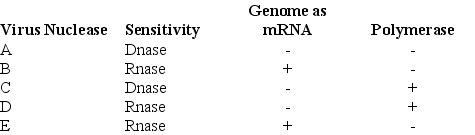 -Based on the above table, which virus meets the requirements for a bacteriophage?
 (Multiple Choice)
4.9/5 (66)
(66) Use the following information to answer the questions below.
Some viruses can be crystallized and their structures analyzed. One such virus is Desmodium, or yellow mottle virus, which infects beans. This is a member of the tymovirus group and has a single-stranded RNA genome of ~6,300 nucleotides. Its virion is 25-30 nm in diameter, and is made up of 180 copies of a single capsid protein that self-associate to form each capsomere, which has icosahedral symmetry with 20 facets.
-In a cell-free system, what other components would you have to provide for this virus to express its genes?
(Multiple Choice)
4.9/5 (72)
(72) Most human-infecting viruses are maintained in the human population only. However, a zoonosis is a disease that is transmitted from other vertebrates to humans, at least sporadically, without requiring viral mutation. Which of the following is the best example of a zoonosis?
(Multiple Choice)
4.8/5 (87)
(87) 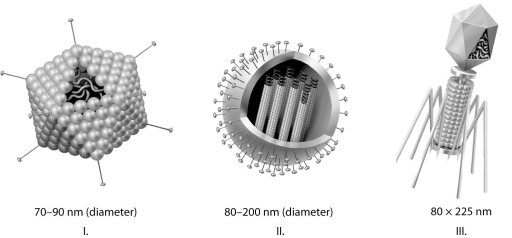 -Which of the three types of viruses shown above would you expect to include glycoproteins?
 (Multiple Choice)
4.9/5 (76)
(76) Refer to the treatments listed below to answer the following questions.
You isolate an infectious substance that is capable of causing disease in plants, but you do not know whether the infectious agent is a bacterium, virus, viroid, or prion. You have four methods at your disposal that you can use to analyze the substance in order to determine the nature of the infectious agent.
I. treating the substance with nucleases that destroy all nucleic acids
and then determining whether it is still infectious
II. filtering the substance to remove all elements smaller than what can
be easily seen under a light microscope
III. culturing the substance by itself on nutritive medium, away from
any plant cells
IV. treating the sample with proteases that digest all proteins and then
determining whether it is still infectious
-Which treatment could definitively determine whether or not the component is a viroid?
(Multiple Choice)
4.9/5 (81)
(81) A bacterium is infected with an experimentally constructed bacteriophage composed of the T2 phage protein coat and T4 phage DNA. The new phages produced would have
(Multiple Choice)
4.8/5 (82)
(82) Use the following information to answer the following questions.
In 1971, David Baltimore described a scheme for classifying viruses based on how the virus produces mRNA.
The table below shows the results of testing five viruses for nuclease specificity, the ability of the virus to act as an mRNA, and presence (+) or absence (-) of its own viral polymerase.
-Given Baltimore's scheme, a positive sense single-stranded RNA virus such as the polio virus would be most closely related to which of the following?
-Given Baltimore's scheme, a positive sense single-stranded RNA virus such as the polio virus would be most closely related to which of the following? (Multiple Choice)
4.9/5 (68)
(68) Use the following information to answer the following questions.
In 1971, David Baltimore described a scheme for classifying viruses based on how the virus produces mRNA.
The table below shows the results of testing five viruses for nuclease specificity, the ability of the virus to act as an mRNA, and presence (+) or absence (-) of its own viral polymerase.
-Based on the above table, which virus meets the Baltimore requirements for a retrovirus?
-Based on the above table, which virus meets the Baltimore requirements for a retrovirus? (Multiple Choice)
4.9/5 (71)
(71) Viral envelopes can best be analyzed with which of the following techniques?
(Multiple Choice)
4.9/5 (97)
(97) A researcher lyses a cell that contains nucleic acid molecules and capsomeres of tobacco mosaic virus (TMV). The cell contents are left in a covered test tube overnight. The next day this mixture is sprayed on tobacco plants. Which of the following would be expected to occur?
(Multiple Choice)
4.9/5 (98)
(98) In many ways, the regulation of the genes of a particular group of viruses will be similar to the regulation of the host genes. Therefore, which of the following would you expect of the genes of the bacteriophage?
(Multiple Choice)
4.8/5 (85)
(85) Which of the following characteristics, structures, or processes is common to both bacteria and viruses?
(Multiple Choice)
4.9/5 (83)
(83) Which viruses have single-stranded RNA that acts as a template for DNA synthesis?
(Multiple Choice)
4.8/5 (72)
(72)  -A linear piece of viral DNA of 8 kb can be cut with either of two restriction enzymes (X or Y). These are subjected to electrophoresis and produce the following bands:
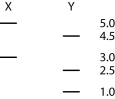 Cutting the same 8 kb piece with both enzymes together results in bands at 4.0, 2.5, 1.0, and 0.5.
Of the possible arrangements of the sites given below, which one is most likely?
-A linear piece of viral DNA of 8 kb can be cut with either of two restriction enzymes (X or Y). These are subjected to electrophoresis and produce the following bands:
Cutting the same 8 kb piece with both enzymes together results in bands at 4.0, 2.5, 1.0, and 0.5.
Of the possible arrangements of the sites given below, which one is most likely? (Multiple Choice)
4.8/5 (78)
(78) Which of the following is the most probable fate of a newly emerging virus that causes high mortality in its host?
(Multiple Choice)
4.9/5 (81)
(81) To cause a human pandemic, the H5N1 avian flu virus would have to
(Multiple Choice)
4.7/5 (78)
(78) 
Filters
- Essay(0)
- Multiple Choice(0)
- Short Answer(0)
- True False(0)
- Matching(0)