



 Chat with AI
Exam 17: From Gene to Protein

Exam 1: Introduction: Themes in the Study of Life64 Questions
Exam 2: The Chemical Context of Life83 Questions
Exam 3: Water and Life70 Questions
Exam 4: Carbon and the Molecular Diversity of Life71 Questions
Exam 5: The Structure and Function of Large Biological Molecules109 Questions
Exam 6: A Tour of the Cell80 Questions
Exam 7: Membrane Structure and Function80 Questions
Exam 8: An Introduction to Metabolism80 Questions
Exam 9: Cellular Respiration and Fermentation107 Questions
Exam 10: Photosynthesis81 Questions
Exam 11: Cell Communication69 Questions
Exam 12: The Cell Cycle79 Questions
Exam 13: Meiosis and Sexual Life Cycles70 Questions
Exam 14: Mendel and the Gene Idea73 Questions
Exam 15: The Chromosomal Basis of Inheritance61 Questions
Exam 16: The Molecular Basis of Inheritance57 Questions
Exam 17: From Gene to Protein83 Questions
Exam 18: Regulation of Gene Expression99 Questions
Exam 19: Viruses47 Questions
Exam 20: Biotechnology72 Questions
Exam 21: Genomes and Their Evolution42 Questions
Exam 22: Descent with Modification: A Darwinian View of Life55 Questions
Exam 23: The Evolution of Populations78 Questions
Exam 24: The Origin of Species63 Questions
Exam 25: The History of Life on Earth75 Questions
Exam 26: Phylogeny and the Tree of Life73 Questions
Exam 27: Bacteria and Archaea78 Questions
Exam 28: Protists76 Questions
Exam 29: Plant Diversity I: How Plants Colonized Land74 Questions
Exam 30: Plant Diversity II: The Evolution of Seed Plants102 Questions
Exam 31: Fungi89 Questions
Exam 32: An Overview of Animal Diversity74 Questions
Exam 33: An Introduction to Invertebrates93 Questions
Exam 34: The Origin and Evolution of Vertebrates109 Questions
Exam 35: Plant Structure, Growth, and Development67 Questions
Exam 36: Resource Acquisition and Transport in Vascular Plants82 Questions
Exam 37: Soil and Plant Nutrition83 Questions
Exam 38: Angiosperm Reproduction and Biotechnology86 Questions
Exam 39: Plant Responses to Internal and External Signals108 Questions
Exam 40: Basic Principles of Animal Form and Function77 Questions
Exam 41: Animal Nutrition64 Questions
Exam 42: Circulation and Gas Exchange90 Questions
Exam 43: The Immune System100 Questions
Exam 44: Osmoregulation and Excretion69 Questions
Exam 45: Hormones and the Endocrine System72 Questions
Exam 46: Animal Reproduction94 Questions
Exam 47: Animal Development92 Questions
Exam 48: Neurons, Synapses, and Signaling73 Questions
Exam 49: Nervous Systems65 Questions
Exam 50: Sensory and Motor Mechanisms82 Questions
Exam 51: Animal Behavior69 Questions
Exam 52: An Introduction to Ecology and the Biosphere73 Questions
Exam 53: Population Ecology79 Questions
Exam 54: Community Ecology77 Questions
Exam 55: Ecosystems and Restoration Ecology81 Questions
Exam 56: Conservation Biology and Global Change67 Questions
Select questions type


Use the following model of a eukaryotic transcript to answer the next few questions.
5' UTR E₁ I₁ E₂ I₂ E₃ I₃ E₄ UTR 3'
-Which of the following is a useful feature of introns for this model?
(Multiple Choice)
4.9/5  (80)
(80) When the ribosome reaches a stop codon on the mRNA, no corresponding tRNA enters the A site. If the translation reaction were to be experimentally stopped at this point, which of the following would you be able to isolate?
(Multiple Choice)
4.9/5 (64)
(64) The following questions refer to this table of codons.
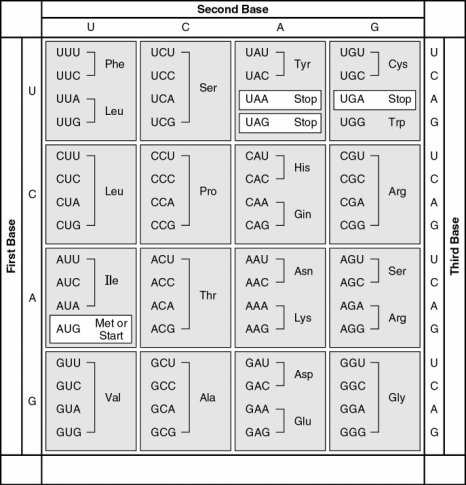 -A peptide has the sequence NH₂-phe-pro-lys-gly-phe-pro-COOH. Which of the following sequences in the coding strand of the DNA could code for this peptide?
 (Multiple Choice)
4.7/5 (90)
(90) Which of the following nucleotide triplets best represents a codon?
(Multiple Choice)
4.8/5 (74)
(74) 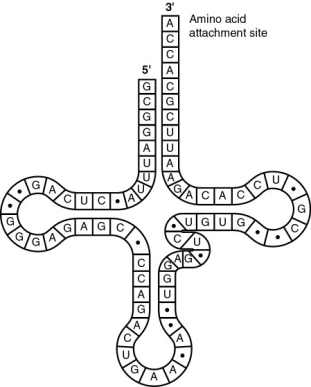 -The tRNA shown in the figure has its 3' end projecting beyond its 5' end. What will occur at this 3' end?
 (Multiple Choice)
4.9/5 (66)
(66) The process of translation, whether in prokaryotes or eukaryotes, requires tRNAs, amino acids, ribosomal subunits, and which of the following?
(Multiple Choice)
4.8/5 (79)
(79) Which of the following mutations is most likely to cause a phenotypic change?
(Multiple Choice)
4.9/5 (82)
(82) Which of the following types of mutation, resulting in an error in the mRNA just after the AUG start of translation, is likely to have the most serious effect on the polypeptide product?
(Multiple Choice)
4.9/5 (79)
(79) The following question refers to this figure of a simple metabolic pathway:
 -A mutation results in a defective enzyme A. Which of the following would be a consequence of that mutation?
 (Multiple Choice)
4.8/5 (80)
(80) During splicing, which molecular component of the spliceosome catalyzes the excision reaction?
(Multiple Choice)
4.9/5 (62)
(62) RNA polymerase in a prokaryote is composed of several subunits. Most of these subunits are the same for the transcription of any gene, but one, known as sigma, varies considerably. Which of the following is the most probable advantage for the organism of such sigma switching?
(Multiple Choice)
4.9/5 (84)
(84) Garrod hypothesized that "inborn errors of metabolism" such as alkaptonuria occur because
(Multiple Choice)
4.8/5 (78)
(78) Use the following information to answer the next few questions.
A transfer RNA (#1) attached to the amino acid lysine enters the ribosome. The lysine binds to the growing polypeptide on the other tRNA (#2) in the ribosome already.
-Which component is not directly involved in translation?
(Multiple Choice)
4.8/5 (74)
(74) The following information should be used for the next few questions.
A part of an mRNA molecule with the following sequence is being read by a ribosome: 5' CCG-ACG 3' (mRNA). The following charged transfer RNA molecules (with their anticodons shown in the 3' to 5' direction) are available. Two of them can correctly match the mRNA so that a dipeptide can form.
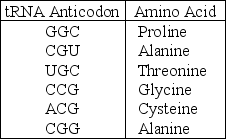 -The anticodon loop of the first tRNA that will complement this mRNA is
 (Multiple Choice)
4.8/5 (90)
(90) In the structural organization of many eukaryotic genes, individual exons may be related to which of the following?
(Multiple Choice)
4.7/5 (83)
(83) Which small-scale mutation would be most likely to have a catastrophic effect on the functioning of a protein?
(Multiple Choice)
4.9/5 (78)
(78) Use this representation to answer the following questions.
DNA template strand 5' ____________________________ 3'
DNA complementary strand 3' ____________________________ 5'
-Given the locally unwound double strand above, in which direction does the RNA polymerase move?
(Multiple Choice)
4.8/5 (74)
(74) A particular triplet of bases in the template strand of DNA is 5' AGT 3'. The corresponding codon for the mRNA transcribed is
(Multiple Choice)
4.7/5 (80)
(80) 
Filters
- Essay(0)
- Multiple Choice(0)
- Short Answer(0)
- True False(0)
- Matching(0)