



 Chat with AI
Exam 7: Membrane Structure and Function

Exam 1: Introduction: Themes in the Study of Life64 Questions
Exam 2: The Chemical Context of Life83 Questions
Exam 3: Water and Life70 Questions
Exam 4: Carbon and the Molecular Diversity of Life71 Questions
Exam 5: The Structure and Function of Large Biological Molecules109 Questions
Exam 6: A Tour of the Cell80 Questions
Exam 7: Membrane Structure and Function80 Questions
Exam 8: An Introduction to Metabolism80 Questions
Exam 9: Cellular Respiration and Fermentation107 Questions
Exam 10: Photosynthesis81 Questions
Exam 11: Cell Communication69 Questions
Exam 12: The Cell Cycle79 Questions
Exam 13: Meiosis and Sexual Life Cycles70 Questions
Exam 14: Mendel and the Gene Idea73 Questions
Exam 15: The Chromosomal Basis of Inheritance61 Questions
Exam 16: The Molecular Basis of Inheritance57 Questions
Exam 17: From Gene to Protein83 Questions
Exam 18: Regulation of Gene Expression99 Questions
Exam 19: Viruses47 Questions
Exam 20: Biotechnology72 Questions
Exam 21: Genomes and Their Evolution42 Questions
Exam 22: Descent with Modification: A Darwinian View of Life55 Questions
Exam 23: The Evolution of Populations78 Questions
Exam 24: The Origin of Species63 Questions
Exam 25: The History of Life on Earth75 Questions
Exam 26: Phylogeny and the Tree of Life73 Questions
Exam 27: Bacteria and Archaea78 Questions
Exam 28: Protists76 Questions
Exam 29: Plant Diversity I: How Plants Colonized Land74 Questions
Exam 30: Plant Diversity II: The Evolution of Seed Plants102 Questions
Exam 31: Fungi89 Questions
Exam 32: An Overview of Animal Diversity74 Questions
Exam 33: An Introduction to Invertebrates93 Questions
Exam 34: The Origin and Evolution of Vertebrates109 Questions
Exam 35: Plant Structure, Growth, and Development67 Questions
Exam 36: Resource Acquisition and Transport in Vascular Plants82 Questions
Exam 37: Soil and Plant Nutrition83 Questions
Exam 38: Angiosperm Reproduction and Biotechnology86 Questions
Exam 39: Plant Responses to Internal and External Signals108 Questions
Exam 40: Basic Principles of Animal Form and Function77 Questions
Exam 41: Animal Nutrition64 Questions
Exam 42: Circulation and Gas Exchange90 Questions
Exam 43: The Immune System100 Questions
Exam 44: Osmoregulation and Excretion69 Questions
Exam 45: Hormones and the Endocrine System72 Questions
Exam 46: Animal Reproduction94 Questions
Exam 47: Animal Development92 Questions
Exam 48: Neurons, Synapses, and Signaling73 Questions
Exam 49: Nervous Systems65 Questions
Exam 50: Sensory and Motor Mechanisms82 Questions
Exam 51: Animal Behavior69 Questions
Exam 52: An Introduction to Ecology and the Biosphere73 Questions
Exam 53: Population Ecology79 Questions
Exam 54: Community Ecology77 Questions
Exam 55: Ecosystems and Restoration Ecology81 Questions
Exam 56: Conservation Biology and Global Change67 Questions
Select questions type


The formulation of a model for a structure or for a process serves which of the following purposes?
(Multiple Choice)
4.9/5  (74)
(74) Human immunodeficiency virus (HIV) infects cells that have both CD4 and CCR5 cell surface molecules. The viral nucleic acid molecules are enclosed in a protein capsid, and the protein capsid is itself contained inside an envelope consisting of a lipid bilayer membrane and viral glycoproteins. One hypothesis for viral entry into cells is that binding of HIV membrane glycoproteins to CD4 and CCR5 initiates fusion of the HIV membrane with the plasma membrane, releasing the viral capsid into the cytoplasm. An alternative hypothesis is that HIV gains entry into the cell via receptor-mediated endocytosis, and membrane fusion occurs in the endocytotic vesicle. To test these alternative hypotheses for HIV entry, researchers labeled the lipids on the HIV membrane with a red fluorescent dye.
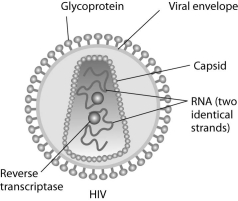 -What would be observed by live-cell fluorescence microscopy if HIV is endocytosed first, and then fuses with the endocytotic vesicle membrane?
 (Multiple Choice)
4.8/5 (80)
(80) Which of the following is true of the evolution of cell membranes?
(Multiple Choice)
4.9/5 (73)
(73) In order for a protein to be an integral membrane protein it would have to be
(Multiple Choice)
5.0/5 (77)
(77) Using live-cell fluorescence microscopy, researchers observed that a red fluorescent spot moved from the plasma membrane into the interior of target cells when red fluorescent dye-labeled HIV was added to the cells. What is the best conclusion from these observations?
(Multiple Choice)
4.7/5 (75)
(75) In which of the following would there be the greatest need for osmoregulation?
(Multiple Choice)
4.8/5 (81)
(81) Which of these are not embedded in the hydrophobic portion of the lipid bilayer at all?
(Multiple Choice)
4.7/5 (83)
(83) When a plant cell, such as one from a peony stem, is submerged in a very hypotonic solution, what is likely to occur?
(Multiple Choice)
4.9/5 (91)
(91) A patient has had a serious accident and lost a lot of blood. In an attempt to replenish body fluids, distilled water-equal to the volume of blood lost-is transferred directly into one of his veins. What will be the most probable result of this transfusion?
(Multiple Choice)
4.8/5 (94)
(94) Which of the following membrane activities require energy from ATP hydrolysis?
(Multiple Choice)
4.8/5 (79)
(79) Five dialysis bags, constructed from a semipermeable membrane that is impermeable to sucrose, were filled with various concentrations of sucrose and then placed in separate beakers containing an initial concentration of 0.6 M sucrose solution. At 10-minute intervals, the bags were massed (weighed) and the percent change in mass of each bag was graphed.
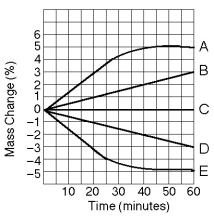 -Which line in the graph represents the bag with the highest initial concentration of sucrose?
 (Multiple Choice)
4.9/5 (78)
(78) For the following questions, match the labeled component of the cell membrane in the figure with its description.
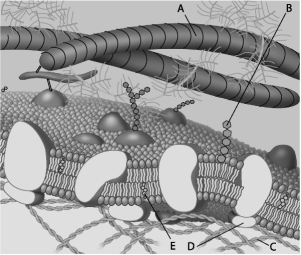 -Which component is the fiber of the extracellular matrix?
 (Multiple Choice)
4.7/5 (84)
(84) Five dialysis bags, constructed from a semipermeable membrane that is impermeable to sucrose, were filled with various concentrations of sucrose and then placed in separate beakers containing an initial concentration of 0.6 M sucrose solution. At 10-minute intervals, the bags were massed (weighed) and the percent change in mass of each bag was graphed.
-Which line or lines in the graph represent(s)bags that contain a solution that is hypertonic at 50 minutes?
-Which line or lines in the graph represent(s)bags that contain a solution that is hypertonic at 50 minutes? (Multiple Choice)
4.9/5 (85)
(85) Which of the following is one of the ways that the membranes of winter wheat are able to remain fluid when it is extremely cold?
(Multiple Choice)
4.7/5 (87)
(87) Singer and Nicolson's fluid mosaic model of the membrane proposed that
(Multiple Choice)
4.7/5 (84)
(84) In an HIV-infected cell producing HIV virus particles, the viral glycoprotein is expressed on the plasma membrane. How do the viral glycoproteins get to the plasma membrane?
(Multiple Choice)
4.7/5 (85)
(85) The cell membranes of Antarctic ice fish might have which of the following adaptations?
(Multiple Choice)
4.7/5 (76)
(76) Nitrous oxide gas molecules diffusing across a cell's plasma membrane is an example of
(Multiple Choice)
4.9/5 (75)
(75) 
Filters
- Essay(0)
- Multiple Choice(0)
- Short Answer(0)
- True False(0)
- Matching(0)