



 Chat with AI
Exam 2: The Chemical Context of Life

Exam 1: Introduction: Themes in the Study of Life64 Questions
Exam 2: The Chemical Context of Life83 Questions
Exam 3: Water and Life70 Questions
Exam 4: Carbon and the Molecular Diversity of Life71 Questions
Exam 5: The Structure and Function of Large Biological Molecules109 Questions
Exam 6: A Tour of the Cell80 Questions
Exam 7: Membrane Structure and Function80 Questions
Exam 8: An Introduction to Metabolism80 Questions
Exam 9: Cellular Respiration and Fermentation107 Questions
Exam 10: Photosynthesis81 Questions
Exam 11: Cell Communication69 Questions
Exam 12: The Cell Cycle79 Questions
Exam 13: Meiosis and Sexual Life Cycles70 Questions
Exam 14: Mendel and the Gene Idea73 Questions
Exam 15: The Chromosomal Basis of Inheritance61 Questions
Exam 16: The Molecular Basis of Inheritance57 Questions
Exam 17: From Gene to Protein83 Questions
Exam 18: Regulation of Gene Expression99 Questions
Exam 19: Viruses47 Questions
Exam 20: Biotechnology72 Questions
Exam 21: Genomes and Their Evolution42 Questions
Exam 22: Descent with Modification: A Darwinian View of Life55 Questions
Exam 23: The Evolution of Populations78 Questions
Exam 24: The Origin of Species63 Questions
Exam 25: The History of Life on Earth75 Questions
Exam 26: Phylogeny and the Tree of Life73 Questions
Exam 27: Bacteria and Archaea78 Questions
Exam 28: Protists76 Questions
Exam 29: Plant Diversity I: How Plants Colonized Land74 Questions
Exam 30: Plant Diversity II: The Evolution of Seed Plants102 Questions
Exam 31: Fungi89 Questions
Exam 32: An Overview of Animal Diversity74 Questions
Exam 33: An Introduction to Invertebrates93 Questions
Exam 34: The Origin and Evolution of Vertebrates109 Questions
Exam 35: Plant Structure, Growth, and Development67 Questions
Exam 36: Resource Acquisition and Transport in Vascular Plants82 Questions
Exam 37: Soil and Plant Nutrition83 Questions
Exam 38: Angiosperm Reproduction and Biotechnology86 Questions
Exam 39: Plant Responses to Internal and External Signals108 Questions
Exam 40: Basic Principles of Animal Form and Function77 Questions
Exam 41: Animal Nutrition64 Questions
Exam 42: Circulation and Gas Exchange90 Questions
Exam 43: The Immune System100 Questions
Exam 44: Osmoregulation and Excretion69 Questions
Exam 45: Hormones and the Endocrine System72 Questions
Exam 46: Animal Reproduction94 Questions
Exam 47: Animal Development92 Questions
Exam 48: Neurons, Synapses, and Signaling73 Questions
Exam 49: Nervous Systems65 Questions
Exam 50: Sensory and Motor Mechanisms82 Questions
Exam 51: Animal Behavior69 Questions
Exam 52: An Introduction to Ecology and the Biosphere73 Questions
Exam 53: Population Ecology79 Questions
Exam 54: Community Ecology77 Questions
Exam 55: Ecosystems and Restoration Ecology81 Questions
Exam 56: Conservation Biology and Global Change67 Questions
Select questions type


What results from an unequal sharing of electrons between atoms?
(Multiple Choice)
4.8/5  (76)
(76) Trace elements are those required by an organism in only minute quantities. Which of the following is a trace element that is required by humans and other vertebrates, but not by other organisms such as bacteria or plants?
(Multiple Choice)
4.9/5 (79)
(79) Knowing just the atomic mass of an element allows inferences about which of the following?
(Multiple Choice)
4.7/5 (80)
(80)  -The illustration above shows a representation of formic acid. A formic acid molecule
 (Multiple Choice)
4.8/5 (62)
(62) The precise weight of a mole of some pure elements like silicon (Si)can vary slightly from the standard atomic mass, or even from sample to sample. Why?
(Multiple Choice)
4.9/5 (76)
(76) We can represent atoms by listing the number of protons, neutrons, and electrons-for example,
2p⁺; 2n⁰; 2e⁻ for helium. Which of the following represents the ¹⁸O isotope of oxygen?
(Multiple Choice)
4.9/5 (79)
(79) 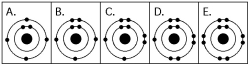 -Which drawing in the figure above depicts the electron configuration of an atom capable of forming three covalent bonds with other atoms?
 (Multiple Choice)
5.0/5 (81)
(81) Why is each element unique and different from other elements in chemical properties?
(Multiple Choice)
4.8/5 (85)
(85) The atomic number of chlorine is 17. The atomic number of magnesium is 12. What is the formula for magnesium chloride?
(Multiple Choice)
4.8/5 (77)
(77) In what way are elements in the same column of the periodic table the same?
(Multiple Choice)
4.7/5 (88)
(88)
-Which drawing in the figure above depicts an atom with a valence of 2?
-Which drawing in the figure above depicts an atom with a valence of 2? (Multiple Choice)
4.8/5 (74)
(74) An atom with atomic number 12 would have what type of chemical behavior in bonding with other elements?
(Multiple Choice)
4.9/5 (80)
(80) In ammonium chloride salt (NH₄Cl)the anion is a single chloride ion, Cl. What is the cation of NH₄Cl?
(Multiple Choice)
4.8/5 (86)
(86) Which bond or interaction would be difficult to disrupt when compounds are put into water?
(Multiple Choice)
4.9/5 (88)
(88) The organic molecules in living organisms have a measurably lower ratio of carbon-13/carbon-12, two stable isotopes of carbon that comprise approximately 1.1% and 98.9% of atmospheric carbon, respectively. What is a reasonable explanation for this phenomenon?
(Multiple Choice)
4.9/5 (83)
(83) What is the difference between covalent bonds and ionic bonds?
(Multiple Choice)
4.9/5 (88)
(88) Which of the following correctly describes any reaction that has reached chemical equilibrium?
(Multiple Choice)
4.8/5 (79)
(79) Oxygen has an atomic number of 8 and a mass number of 16. Thus, what is the atomic mass of an oxygen atom?
(Multiple Choice)
4.7/5 (74)
(74) Which of the following pairs of atoms would be most likely to form an ionic bond?
(Multiple Choice)
4.8/5 (77)
(77) 
Filters
- Essay(0)
- Multiple Choice(0)
- Short Answer(0)
- True False(0)
- Matching(0)