



 Chat with AI
Exam 9: Financial Statement Analysis

Exam 1: An Introduction to Accounting204 Questions
Exam 2: Accounting for Accruals and Deferrals157 Questions
Exam 3: Accounting for Merchandising Businesses38 Questions
Exam 4: Internal Controls, Accounting for Cash, and Ethics38 Questions
Exam 5: Accounting for Receivables and Inventory Cost Flow57 Questions
Exam 6: Accounting for Long-Term Operational Assets157 Questions
Exam 7: Accounting for Liabilities208 Questions
Exam 8: Proprietorships, Partnerships, and Corporations144 Questions
Exam 9: Financial Statement Analysis172 Questions
Exam 10: An Introduction to Management Accounting155 Questions
Exam 11: Cost Behavior, Operating Leverage, and Profitability Analysis43 Questions
Exam 12: Cost Accumulation, Tracing, and Allocation211 Questions
Exam 13: Relevant Information for Special Decisions137 Questions
Exam 14: Planning for Profit and Cost Control156 Questions
Exam 15: Performance Evaluation162 Questions
Exam 16: Planning for Capital Investments172 Questions
Select questions type


Accrual accounting requires the use of many estimates, including:
(Multiple Choice)
4.8/5  (73)
(73) Darden Company has cash of $40,000, accounts receivable of $60,000, inventory of $32,000, and equipment of $100,000. Assuming current liabilities of $48,000, this company's working capital is:
(Multiple Choice)
4.9/5 (74)
(74) Which of the following statements regarding the information disclosed in financial statements is incorrect?
(Multiple Choice)
4.8/5 (71)
(71) The accounts receivable turnover ratio can be used to asses a firm's solvency.
(True/False)
4.8/5 (81)
(81) Many companies have to monitor some of their financial statement ratios, such as the current ratio, due to debt covenants. Selected transactions are provided below for a company that uses a perpetual inventory system, sells its merchandise at a selling price that exceeds cost, and had a current ratio of 1.85 before the event occurred.
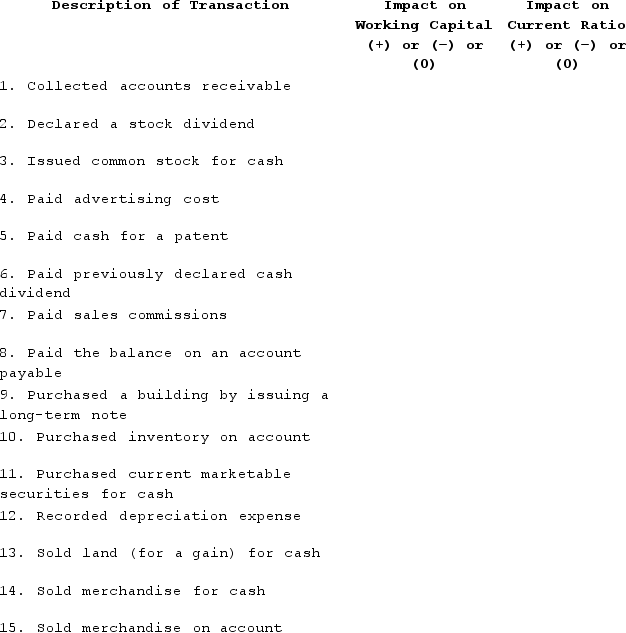 Required:
In the above table, indicate whether each transaction would increase (+), decrease (−), or not affect (0) the company's working capital and the current ratio.
Required:
In the above table, indicate whether each transaction would increase (+), decrease (−), or not affect (0) the company's working capital and the current ratio. (Not Answered)
This question doesn't have any answer yet
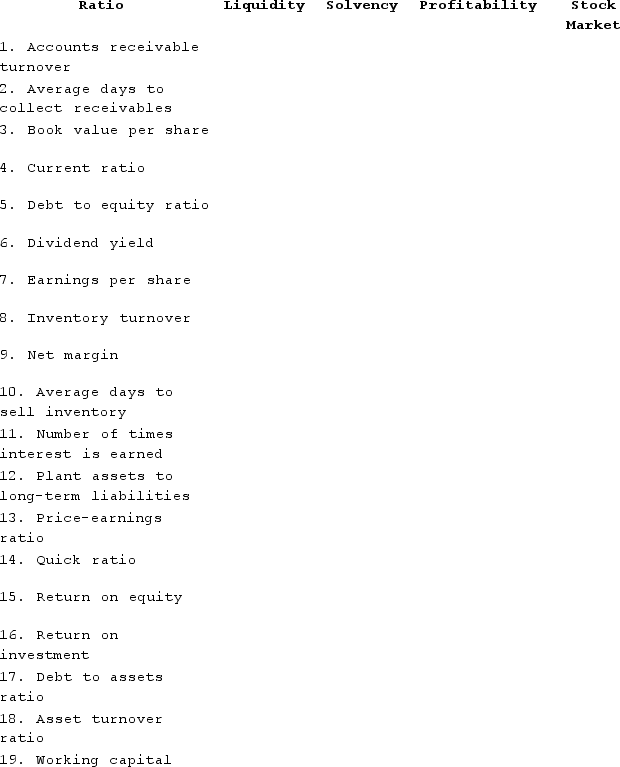
Various ratios are computed to assess different aspects of a company's financial condition and (or) strength.
Required:
In the table below, indicate which aspect of financial condition each specified ratio is designed to assess:
(Essay)
4.8/5 (81)
(81) Long-term creditors are usually most interested in evaluating:
(Multiple Choice)
4.7/5 (60)
(60) If the company purchased a $60,000 piece of equipment by paying $30,000 and having the rest financed with a short-term note from the bank, then immediately after this transaction what is the expected impact on the components of the current ratio?
(Multiple Choice)
4.8/5 (74)
(74) The following balance sheet information was provided by O'Connor Company: Assets Year 2 Year 1 Cash \ 3,600 \ 2,600 Accounts receivable \ 8,600 \ 6,600 Inventory \ 36,000 \ 37,000 Assuming that net credit sales for Year 2 totaled $161,000, what is the company's most recent accounts receivable turnover?
(Multiple Choice)
4.9/5 (71)
(71) For Perez Corporation, return on equity is substantially higher than return on investment. What does that tell you about the company?
(Essay)
4.8/5 (65)
(65) Indicate whether each of the following statements is true or false.
Some forms of financial statement analysis involve identifying changes in the same item for the same company over a period of time. ______
Some forms of financial statement analysis involve comparing operations of different companies in the same industry. ______
Vertical analysis is also called trend analysis. ______
Vertical analysis refers to studying the behavior of individual financial statement items over several periods. ______
Horizontal analysis could be done using changes in the absolute dollar amount of an item or trends in percentages. ______
(Short Answer)
4.8/5 (67)
(67) Which of the following statements regarding ratio analysis is incorrect?
(Multiple Choice)
4.7/5 (85)
(85) The following balance sheet information is provided for Greene Company for Year 2: Assets Cash \ 6,600 Accounts receivable 12,750 Inventory 15,300 Prepaid expenses 2,100 Plant and equipment, net of depreciation 20,000 Land Total assets Liabilities and Stockholders' Equity Accounts payable \ 3,090 Salaries payable 7,730 Bonds payable (Due in ten years) 14,500 Common stock, no par 14,000 Retained earnings Total liabilities and stockholders' equity \ 70,650 What is the company's quick (acid-test) ratio? (Round your answer to 2 decimal places.)
(Multiple Choice)
4.9/5 (80)
(80) Vertical analysis always involves comparing financial statement elements over a span of time.
(True/False)
5.0/5 (82)
(82) Financial ratio analysis is a form of horizontal analysis in that comparisons are made between different accounts in the same set of financial statements.
(True/False)
4.8/5 (69)
(69) Selected financial information for Martin Company for Year 2 follows:
Sales \4 98,000 Cost of goods sold 320,000 Merchandise inventory Beginning of year 72,000 End of year 80,000
Required:
How many times did Martin's merchandise inventory turnover during Year 2? (Round your answer to one decimal place.)
(Short Answer)
4.7/5 (72)
(72) Net income divided by sales is the formula for which of these analytical measures?
(Multiple Choice)
4.8/5 (82)
(82) The Fortune Company reported the following income for Year 2: Sales \1 35,000 Cost of goods sold Gross margin \5 2,500 Selling and administrative expense Operating income \ 32,500 Interest expense Income before taxes \ 27,000 Income tax expense Net income What is the company's number of times interest is earned ratio?
(Multiple Choice)
4.9/5 (83)
(83) While horizontal analysis examines one item over many time periods, vertical analysis examines many items in the same interval of time.
(True/False)
4.9/5 (77)
(77) 
Filters
- Essay(0)
- Multiple Choice(0)
- Short Answer(0)
- True False(0)
- Matching(0)