



 Chat with AI
Exam 2: Motion Along a Line

Exam 1: Introduction74 Questions
Exam 2: Motion Along a Line68 Questions
Exam 3: Motion in a Plane56 Questions
Exam 4: Force and Newtons Laws of Motion130 Questions
Exam 5: Circular Motion85 Questions
Exam 6: Conservation of Energy83 Questions
Exam 7: Linear Momentum90 Questions
Exam 8: Torque and Angular Momentum91 Questions
Exam 9: Fluids88 Questions
Exam 10: Elasticity and Oscillations90 Questions
Exam 11: Waves86 Questions
Exam 12: Sound80 Questions
Exam 13: Temperature and the Ideal Gas85 Questions
Exam 14: Heat88 Questions
Exam 15: Thermodynamics81 Questions
Exam 16: Electric Forces and Fields86 Questions
Exam 17: Electric Potential81 Questions
Exam 18: Electric Current and Circuits75 Questions
Exam 19: Magnetic Forces and Fields68 Questions
Exam 20: Electromagnetic Induction74 Questions
Exam 21: Alternating Current73 Questions
Exam 22: Electromagnetic Waves78 Questions
Exam 23: Reflection and Refraction of Light77 Questions
Exam 24: Optical Instruments68 Questions
Exam 25: Interference and Diffraction72 Questions
Exam 26: Relativity69 Questions
Exam 27: Early Quantum Physics and the Photon74 Questions
Exam 28: Quantum Physics73 Questions
Exam 29: Nuclear Physics77 Questions
Exam 30: Particle Physics58 Questions
Select questions type


The figure shows the graph of vx versus time for an object moving along the x-axis. Solve graphically for the distance traveled from t = 9.0 s to t = 13.0 s. 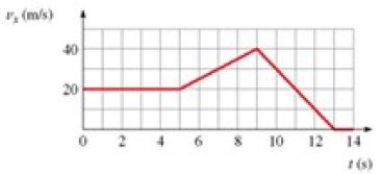
(Multiple Choice)
4.8/5  (87)
(87) An object starts from rest with an acceleration of 2.0 m/s2 in the +x-direction for 3.0 seconds. It then reduces its acceleration to 1.0 m/s2 for 5.0 additional seconds. The total distance covered is about
(Multiple Choice)
4.9/5 (81)
(81) A car traveling at 4.0 m/s has a constant acceleration of 2.0 m/s2 in the same direction as the velocity. After 3.0 seconds, the magnitude of the average velocity during the acceleration is
(Multiple Choice)
4.8/5 (79)
(79) The graph shows vx versus t for an object moving along straight line. What is the acceleration ax at t = 11 s? 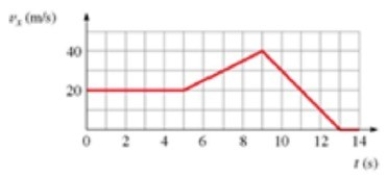
(Multiple Choice)
4.9/5 (79)
(79) A small golden statue falls from a height of 8.2 m and lands on a pillow. If the acceleration of the statue upon striking the pillow is constant, what is the value of the acceleration if the pillow compresses by 3.9 cm as the statue comes to rest?
(Multiple Choice)
4.8/5 (80)
(80) A sprinter runs 100.0 m in 12.2 seconds. If he travels at constant acceleration for the first 50.0 m and then at constant velocity for the final 50.0 m, what was his peak speed?
(Multiple Choice)
4.7/5 (67)
(67) A bullet shot straight up returns to its starting point in 10 s. Ignoring air resistance, what was the initial speed of the bullet?
(Multiple Choice)
4.9/5 (81)
(81) A walker walks 30 m from the origin toward the EAST to point A. She then walks from point A 20 m more toward the WEST to point B. The walker's total displacement from the origin is
(Multiple Choice)
4.8/5 (83)
(83) An object starts with an initial velocity of magnitude 4.0 m/s and accelerates at 4.0 m/s2 in the same direction as the velocity for 6.0 seconds. It then accelerates at 2.0 m/s2 in the opposite direction, until its velocity is the same as the initial value. What is the total distance covered?
(Multiple Choice)
4.8/5 (89)
(89) A 4.0 kg mass has a velocity of 12 m/s to the WEST. The mass experiences a constant acceleration of 2.0 m/s2 to the WEST for 3.0 sec. What is the velocity of the mass at the end of the 3.0 sec interval?
(Multiple Choice)
4.9/5 (78)
(78) A model rocket flies straight upward with constant acceleration, undergoing a displacement of 15.0 m during its first 0.25 s of travel. What was its speed at the end of the first 0.25 s, assuming it started from rest?
(Multiple Choice)
4.8/5 (83)
(83) A runner runs 10 m from the origin toward the WEST to point A. He then runs from point A 20 m more toward the WEST to point B. He then runs from point B 30 m more toward the EAST to point C. The runner's total displacement from the origin to point C is
(Multiple Choice)
4.8/5 (89)
(89) The figure is a graph of vx(t) for a car. Solve graphically for the distance traveled from t = 10 s to t = 15 s. 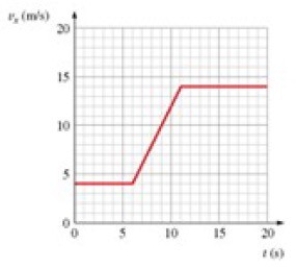
(Multiple Choice)
4.9/5 (81)
(81) Ball A is dropped from the top of a building. One second later ball B is dropped from the same point. As time progresses, the distance between them
(Multiple Choice)
4.8/5 (90)
(90) The figure shows the graph of vx versus time for an object moving along the x-axis. What is the acceleration ax at t = 7.0 s? 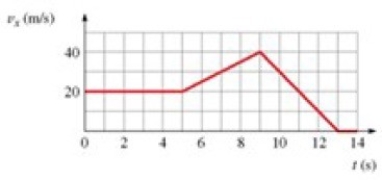
(Multiple Choice)
4.7/5 (71)
(71) A mouse is running away from a cat at a speed of 0.75 m/s. At a distance of 1.25 m from his mouse hole, the mouse accelerates at a constant rate of 0.25 m/s2 until he reaches his hole safely. How long did it take the mouse to cover the last 1.25 m?
(Multiple Choice)
4.9/5 (83)
(83) A boat is traveling at 4.0 m/s as it passes the starting line of a race. If the boat accelerates at 1.0 m/s2 for 6.0 seconds, in the same direction as the velocity, then the magnitude of the average velocity of the boat during the 6.0 seconds is
(Multiple Choice)
4.9/5 (80)
(80) A sprinter runs 100.0 m. If he travels at constant acceleration of 1.95 m/s2 for the first 75.0 m and then at constant velocity for the remaining distance, what was his total elapsed time for the whole race?
(Multiple Choice)
4.9/5 (72)
(72) A walker starts at the origin at 1:00 PM and walks 3.0 km from the origin toward the WEST to point A. She arrives at point A at 2:30 PM. She then walks from point A 2.0 km toward the WEST to point B and arrives at point B at 3:45 PM. The walker's average velocity for the entire trip is
(Multiple Choice)
4.8/5 (78)
(78) A runner runs 10 m from the origin toward the WEST to point A. He then runs from point A 20 m more toward the EAST to point B. He then runs from point B 30 m more toward the WEST to point C. The runner's total displacement from the origin to point C is
(Multiple Choice)
4.9/5 (81)
(81) 
Filters
- Essay(0)
- Multiple Choice(0)
- Short Answer(0)
- True False(0)
- Matching(0)