



 Chat with AI
Exam 6: Conservation of Energy

Exam 1: Introduction74 Questions
Exam 2: Motion Along a Line68 Questions
Exam 3: Motion in a Plane56 Questions
Exam 4: Force and Newtons Laws of Motion130 Questions
Exam 5: Circular Motion85 Questions
Exam 6: Conservation of Energy83 Questions
Exam 7: Linear Momentum90 Questions
Exam 8: Torque and Angular Momentum91 Questions
Exam 9: Fluids88 Questions
Exam 10: Elasticity and Oscillations90 Questions
Exam 11: Waves86 Questions
Exam 12: Sound80 Questions
Exam 13: Temperature and the Ideal Gas85 Questions
Exam 14: Heat88 Questions
Exam 15: Thermodynamics81 Questions
Exam 16: Electric Forces and Fields86 Questions
Exam 17: Electric Potential81 Questions
Exam 18: Electric Current and Circuits75 Questions
Exam 19: Magnetic Forces and Fields68 Questions
Exam 20: Electromagnetic Induction74 Questions
Exam 21: Alternating Current73 Questions
Exam 22: Electromagnetic Waves78 Questions
Exam 23: Reflection and Refraction of Light77 Questions
Exam 24: Optical Instruments68 Questions
Exam 25: Interference and Diffraction72 Questions
Exam 26: Relativity69 Questions
Exam 27: Early Quantum Physics and the Photon74 Questions
Exam 28: Quantum Physics73 Questions
Exam 29: Nuclear Physics77 Questions
Exam 30: Particle Physics58 Questions
Select questions type


A 1.1 kg seagull takes off from a piling along the California coast and accelerates in 0.50 s to a flight speed of 7.5 m/s. Assuming the seagull flies along a horizontal path (at the same height as its takeoff), what average power is delivered by the bird's wings during the takeoff?

Free
(Multiple Choice)
4.9/5  (84)
(84) Correct Answer: Verified
A
A 20.0 kg box slides up a 12.0 m long incline at an angle of 30.0 degrees with the horizontal. A force of 150 N is applied to the box to pull it up the incline. The applied force makes an angle of 10.0 degrees to the incline. What is the work done by the applied force?
Free
(Multiple Choice)
4.9/5 (84)
(84) Correct Answer:Verified
VerifiedB
A 30.00 kg box slides up a 12.00 meter long incline at an angle of 30.00 degrees above the horizontal. Friction is negligible. The change in gravitational potential energy is
Free
(Multiple Choice)
4.8/5 (80)
(80) Correct Answer:Verified
VerifiedD
As a hiker descends a hill, the work done by gravity on the hiker is
(Multiple Choice)
4.8/5 (82)
(82) A dragster drives a quarter mile (402 m) at a constant rate of acceleration, starting from rest and finishing the race with a final speed of 450 km/hr. The mass of the dragster, together with its driver, is 975 kg. What average power is provided by the engine, if 50% of the power output is delivered to the wheels? Neglect dissipative forces.
(Multiple Choice)
4.8/5 (65)
(65) A 5.00 kg box slides up a 10.0 m long incline at an angle of 20.0 degrees with the horizontal, pushed by a 40.0 N force parallel to the incline. The coefficient of kinetic friction is 0.100. The change in kinetic energy is
(Multiple Choice)
4.8/5 (84)
(84) An asteroid of mass 1.4 × 10¹⁴ kg is observed to have an escape speed equal to a typical person's maximum jumping speed, 3.0 m/s. What is its radius?
(Multiple Choice)
4.8/5 (76)
(76) A spring is stretched from 0.500 m to 0.800 m. Assume the unstretched position is 0.00 m. If the spring constant of the spring is 10.0 N/m, what is the work done on the spring?
(Multiple Choice)
5.0/5 (90)
(90) The graph shows the force on an object as it moves a distance x. What is the work done by the force as the object moves from 0.0 m to 6.0 m? 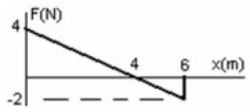
(Multiple Choice)
4.9/5 (78)
(78) A spring-powered launcher has a spring with a constant of 150 N/cm. The launcher is prepared by compressing the spring by 5.00 cm. If the mass of the projectile is 5.00 grams, what is the speed of the projectile when it is launched?
(Multiple Choice)
4.9/5 (93)
(93) A 1.1 kg seagull takes off from a piling along the California coast and accelerates in 0.50 s to a flight speed of 7.5 m/s. The seagull flies along a slightly inclined path, such that at the end of the 0.50 s period, it is 5.3 m above its point of takeoff. What average power is delivered by the bird's wings during the takeoff?
(Multiple Choice)
4.7/5 (77)
(77) A 120 N force is applied at an angle of 30.0 degrees above the horizontal to a 4.00 kg box on a frictionless surface. The box moves a horizontal distance of 8.00 meters. The change in the kinetic energy of the box is
(Multiple Choice)
4.8/5 (78)
(78) A 5.00 gram bullet has a velocity of 300 m/s. It strikes a block of wood and penetrates to a depth of 10.0 cm. The average force of the block of wood on the bullet is
(Multiple Choice)
4.8/5 (76)
(76) A spring with a spring constant of 8.0 N/m is initially compressed to 5.0 cm. The work done (by the external force) as it is compressed another 15 cm, to a total compression of 20 cm, is
(Multiple Choice)
4.8/5 (88)
(88) A 2.00 kg pendulum bob on a string 1.50 m long, is released with a velocity of 4.00 m/s when the support string makes an angle of 30.0 degrees with the vertical. What is the angle with the vertical the bob makes at the highest point of its motion?
(Multiple Choice)
4.7/5 (79)
(79) A 1800 kg car moving at 20 m/s hits an initially uncompressed spring with a spring constant of 2.0 × 10⁶ N/m. The maximum compression of the spring is
(Multiple Choice)
4.8/5 (74)
(74) A 75 kg road bicycle racer rides down the highway from Pikes peak. During one stretch of the ride, he descends 5 meters in 12.5 seconds, while accelerating from 35 km/hr to 55 km/hr. Assuming rotational kinetic energy and dissipative forces to be negligible, what average power is supplied by the gravitational force during this time?
(Multiple Choice)
4.8/5 (76)
(76) A student lifts a weight of 10.0 N a distance of 0.500 meters. The energy needed to do this work in calories is (1 cal = 4.186 Joules)
(Multiple Choice)
4.8/5 (86)
(86) A student lifts a weight of 10.0 N a distance of 0.5 meters. If this exercise is repeated 50 times in 100 seconds, then the average power output of the student is
(Multiple Choice)
4.9/5 (95)
(95) The explosion in a cannon exerts an average force of 30,000 N for L meters, the length of the cannon. What length of the cannon would be necessary to shoot a 2.0 kg projectile from the surface of the Earth to a distance of 6.84 × 10⁸ m from the center of the Earth (the same as the distance to the Moon)? (G = 6.67 × 10⁻¹¹ N·m2/kg2, ME = 5.97 × 1024 kg, and RE = 6.37 × 10⁶ m.)
(Multiple Choice)
4.8/5 (91)
(91) 
Filters
- Essay(0)
- Multiple Choice(0)
- Short Answer(0)
- True False(0)
- Matching(0)