



 Chat with AI
Exam 6: Conservation of Energy

Exam 1: Introduction74 Questions
Exam 2: Motion Along a Line68 Questions
Exam 3: Motion in a Plane56 Questions
Exam 4: Force and Newtons Laws of Motion130 Questions
Exam 5: Circular Motion85 Questions
Exam 6: Conservation of Energy83 Questions
Exam 7: Linear Momentum90 Questions
Exam 8: Torque and Angular Momentum91 Questions
Exam 9: Fluids88 Questions
Exam 10: Elasticity and Oscillations90 Questions
Exam 11: Waves86 Questions
Exam 12: Sound80 Questions
Exam 13: Temperature and the Ideal Gas85 Questions
Exam 14: Heat88 Questions
Exam 15: Thermodynamics81 Questions
Exam 16: Electric Forces and Fields86 Questions
Exam 17: Electric Potential81 Questions
Exam 18: Electric Current and Circuits75 Questions
Exam 19: Magnetic Forces and Fields68 Questions
Exam 20: Electromagnetic Induction74 Questions
Exam 21: Alternating Current73 Questions
Exam 22: Electromagnetic Waves78 Questions
Exam 23: Reflection and Refraction of Light77 Questions
Exam 24: Optical Instruments68 Questions
Exam 25: Interference and Diffraction72 Questions
Exam 26: Relativity69 Questions
Exam 27: Early Quantum Physics and the Photon74 Questions
Exam 28: Quantum Physics73 Questions
Exam 29: Nuclear Physics77 Questions
Exam 30: Particle Physics58 Questions
Select questions type


A spring-powered launcher has a spring with a constant of 50.0 N/cm. The launcher is prepared by compressing the spring by 5.00 cm. If the mass of the projectile is 10.0 grams, what is the speed of the projectile when it is launched?
(Multiple Choice)
4.7/5  (88)
(88) A 1 kg mass is attached to a vertical spring, stretching it by 10 cm from its equilibrium position. With the spring secured in the same stretched position, the 1 kg mass is removed and replaced with a 0.50 kg mass. If the spring is then released, how high will the 0.50 kg mass rise above the point where it was released?
(Multiple Choice)
4.7/5 (80)
(80) An 8000 kg satellite is launched from the surface of the Earth and injected into a circular orbit at an altitude of 100 km above the surface of the Earth. The kinetic energy of the satellite in the circular orbit is (G = 6.67 × 10⁻¹¹ N·m2/kg2, ME = 5.97 × 1024 kg, RE = 6.37 × 10⁶ m)
(Multiple Choice)
4.9/5 (75)
(75) A blob of clay of mass M is dropped onto a spring from a height h above the end of the spring. If the spring compresses by an amount d as the blob comes to rest, what is the spring constant k?
(Multiple Choice)
4.9/5 (68)
(68) A 2500 kg car accelerates from rest to a velocity of 30.0 m/s in 8.00 seconds. The work done by the engine to accelerate the car is
(Multiple Choice)
4.8/5 (66)
(66) A spring-powered dart gun is unstretched and has a spring constant 16.0 N/m. The spring is compressed by 8.00 cm and a 5.00 gram projectile is placed in the gun. The velocity of the projectile when it is shot from the gun is
(Multiple Choice)
4.9/5 (74)
(74) A 2.00 kg pendulum bob on a string 1.50 m long, is released with a velocity of 4.00 m/s when the support string makes an angle of 30.0 degrees with the vertical. What is the speed of the bob at the bottom of the swing?
(Multiple Choice)
4.8/5 (79)
(79) A horizontal force of 12 newtons is applied to a 4.0 kg box that slides on a horizontal surface. The box starts from rest, moves a horizontal distance of 10 meters, and obtains a velocity of 5.0 m/s. The surface has friction. The friction force, assumed constant, is
(Multiple Choice)
4.9/5 (82)
(82) A road bicycle racer rides down the highway from Pike's peak. During one stretch of the ride, he descends 150 m while accelerating from 35 km/hr to some final speed. Assuming friction and air resistance to be negligible, and treating kinetic energy as purely translational (i.e., ignoring any rotational part), what is his final speed?
(Multiple Choice)
4.8/5 (78)
(78) The graph shows the force on an object as it moves a distance x. What is the work done by the force as the object moves from 0.0 m to 4.0 m? 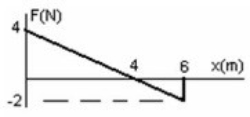
(Multiple Choice)
4.9/5 (84)
(84) A 200 N box is pushed at a constant velocity up an incline that is 5.00 m long and rises 1.00 m. The incline has a coefficient of kinetic friction of 0.200, and the pushing force is parallel to the incline. The work done by the pushing force is
(Multiple Choice)
4.8/5 (80)
(80) A 20.0 kg box slides down a 12.0 m long incline at an angle of 3.0 degrees with the horizontal. A force of 50.0 N is applied to the box to try to prevent it from sliding down the incline. The applied force makes an angle of 0.00 degrees to the incline. If the incline has a coefficient of kinetic friction of 0.100, then the increase in the kinetic energy of the box is
(Multiple Choice)
4.9/5 (85)
(85) A 90.0 kg person is running up some stairs at 0.500 m/s. If the staircase is angled at 45.0° to the horizontal, then the power needed to run up the stairs is
(Multiple Choice)
4.9/5 (73)
(73) An airplane has a mass of 30,000 kg and travels at 300 m/s. If the drag force is 1000 N, then the power the engines have to provide to keep flying at a constant speed is
(Multiple Choice)
5.0/5 (77)
(77) The graph shows the force on an object as it moves a distance x. What is the work done by the force as the object moves from 0.0 m to 10.0 m? 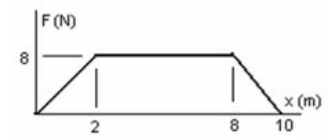
(Multiple Choice)
4.8/5 (77)
(77) A 200 N box is pushed at a constant velocity up an incline that is 5.00 m long and rises 1 m. If the incline is frictionless, then the work done by the pushing force is
(Multiple Choice)
4.7/5 (87)
(87) A 20.0 kg box slides up a 12.0 m long incline at an angle of 30.0 degrees with the horizontal. A force of 150 N is applied to the box to pull it up the incline. The applied force makes an angle of 10.0 degrees to the incline. What is the change in gravitational potential energy of the box?
(Multiple Choice)
5.0/5 (85)
(85) A spring-powered dart gun is unstretched and has a spring constant 16.0 N/m. The spring is compressed by 8.0 cm and a 5.0 gram projectile is placed in the gun. The kinetic energy of the projectile when it is shot from the gun is
(Multiple Choice)
4.8/5 (76)
(76) A 120 N horizontal force is applied to a 4.00 kg box on a frictionless surface. The box moves a horizontal distance of 8.00 meters. The change in the kinetic energy of the box is
(Multiple Choice)
4.9/5 (72)
(72) A 20 N horizontal force is applied to a 4.0 kg box. Friction is negligible. The box moves a horizontal distance of 3.0 meters. The work done by the 20 N force is
(Multiple Choice)
4.8/5 (80)
(80) 
Filters
- Essay(0)
- Multiple Choice(0)
- Short Answer(0)
- True False(0)
- Matching(0)