



 Chat with AI
Exam 11: Waves

Exam 1: Introduction74 Questions
Exam 2: Motion Along a Line68 Questions
Exam 3: Motion in a Plane56 Questions
Exam 4: Force and Newtons Laws of Motion130 Questions
Exam 5: Circular Motion85 Questions
Exam 6: Conservation of Energy83 Questions
Exam 7: Linear Momentum90 Questions
Exam 8: Torque and Angular Momentum91 Questions
Exam 9: Fluids88 Questions
Exam 10: Elasticity and Oscillations90 Questions
Exam 11: Waves86 Questions
Exam 12: Sound80 Questions
Exam 13: Temperature and the Ideal Gas85 Questions
Exam 14: Heat88 Questions
Exam 15: Thermodynamics81 Questions
Exam 16: Electric Forces and Fields86 Questions
Exam 17: Electric Potential81 Questions
Exam 18: Electric Current and Circuits75 Questions
Exam 19: Magnetic Forces and Fields68 Questions
Exam 20: Electromagnetic Induction74 Questions
Exam 21: Alternating Current73 Questions
Exam 22: Electromagnetic Waves78 Questions
Exam 23: Reflection and Refraction of Light77 Questions
Exam 24: Optical Instruments68 Questions
Exam 25: Interference and Diffraction72 Questions
Exam 26: Relativity69 Questions
Exam 27: Early Quantum Physics and the Photon74 Questions
Exam 28: Quantum Physics73 Questions
Exam 29: Nuclear Physics77 Questions
Exam 30: Particle Physics58 Questions
Select questions type


The following figure is a graph of a wave at a fixed position. 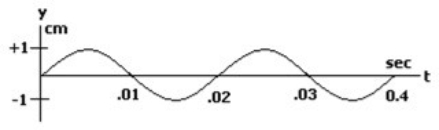 The following figure is a graph of the same wave at a fixed time.
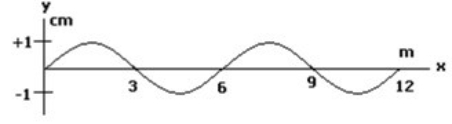 What is the velocity of the wave in the above figure?
The following figure is a graph of the same wave at a fixed time. What is the velocity of the wave in the above figure? (Multiple Choice)
4.9/5  (83)
(83) A longitudinal wave travels on a slinky or any long spring. The wave is represented by the equation z(z, t) = 1.2 cm cos(1800 rad/s t + 60 m−1 z). What are the wavenumber and direction of propagation of the wave?
(Multiple Choice)
4.7/5 (69)
(69) Visible light consists of electromagnetic waves with wavelengths (in air) in the range 400-700 nm. The speed of light in air is 3.0 × 10⁸ m/s. What are the frequencies of visible light?
(Multiple Choice)
4.8/5 (77)
(77) The intensity of the sound wave from an airplane is 1.0 × 10² W/m2 at 5.0 m. What is the intensity at 100 m?
(Multiple Choice)
4.7/5 (71)
(71) The period of a periodic wave is 2.80 milliseconds. The frequency of the vibration motion of the wave is
(Multiple Choice)
4.9/5 (76)
(76) A wave is traveling with a velocity of 300 m/s and strikes a surface at an angle of 30.0 degrees with the normal to the surface. The wave splits into a reflected part and a refracted part. The refracted wave travels with a velocity of 400 m/s. What is the angle of refraction?
(Multiple Choice)
4.9/5 (78)
(78) A string on a violin is stretched between two points 20.00 cm apart with a tension of 120.0 N. The mass/length of the string is 0.002000 kg/m. The frequency of the mode next higher than the fundamental mode is
(Multiple Choice)
4.9/5 (77)
(77) A wave is traveling with a velocity of 350 m/s and strikes a surface at an angle of 30.0 degrees with the normal to the surface. The wave splits into a reflected part and a refracted part. The refracted wave travels with a velocity of 300 m/s. What is the angle of refraction?
(Multiple Choice)
4.8/5 (89)
(89) A transverse periodic wave is represented by the equation y(x, t) = 2.50 cm cos(2,500 rad/s t − 15.0 m−1 x). What is the direction of the vibration of the wave?
(Multiple Choice)
4.8/5 (79)
(79) The wavelength of a periodic wave is 0.750 m. If the frequency is 425 Hz, then what is the angular frequency ω of the wave?
(Multiple Choice)
4.8/5 (98)
(98) A transverse wave travels at 230.0 m/s along the y-axis. If the frequency of the periodic vibrations of the wave is 390.0 Hz, then what is the wavelength of the wave?
(Multiple Choice)
4.8/5 (64)
(64) A string on a guitar is stretched between two points 30.0 cm apart with a tension of 100 N. The mass/length of the string is 0.00300 kg/m. The velocity of wave propagation on the string is
(Multiple Choice)
4.9/5 (86)
(86) A string is stretched with a tension of 100 N. The string has a length of 2.00 meters. The velocity of wave propagation along the string is 220 m/s. The mass of the string is
(Multiple Choice)
4.8/5 (94)
(94) A wave is represented by the equation y(x, t) = 3.2 cm sin(1000 rad/s t − 50 m−1 x). Another wave, with the same wavelength and frequency, has an amplitude of 4.2 cm. If the two waves interfere destructively, then which equation could represent the superposition of the two waves?
(Multiple Choice)
4.9/5 (89)
(89) A sound wave radiates from a source uniformly in all directions. If the power of the sound source is 200 watts, then the intensity of the sound wave 100 m from the source is
(Multiple Choice)
4.9/5 (77)
(77) A transverse periodic wave is represented by the equation y(x, t) = 2.50 cm cos(2,500 rad/s t − 15.0 m−1 x). What is the frequency of the vibration of the wave?
(Multiple Choice)
4.9/5 (94)
(94) A transverse periodic wave is represented by the equation z(y, t) = 1.50 cm sin(1,250 rad/s t + 10.0 m−1 y). What is the direction of the vibration of the wave?
(Multiple Choice)
4.9/5 (76)
(76) The wavelength of a periodic wave is 0.500 m. If the frequency is 400 Hz, then what is the wavenumber k of the wave?
(Multiple Choice)
4.7/5 (81)
(81) A transverse periodic wave is represented by the equation z(y, t) = 1.50 cm sin(1,250 rad/s t + 10.0 m−1 y). What is the frequency of the vibration of the wave?
(Multiple Choice)
4.9/5 (79)
(79) A sound source radiates sound uniformly in all directions. The intensity of the sound at a distance of 100 m is 1.00 × 10⁻⁴ W/m2. The power output of the sound source is
(Multiple Choice)
4.9/5 (68)
(68) 
Filters
- Essay(0)
- Multiple Choice(0)
- Short Answer(0)
- True False(0)
- Matching(0)