



 Chat with AI
Exam 18: Electric Current and Circuits

Exam 1: Introduction74 Questions
Exam 2: Motion Along a Line68 Questions
Exam 3: Motion in a Plane56 Questions
Exam 4: Force and Newtons Laws of Motion130 Questions
Exam 5: Circular Motion85 Questions
Exam 6: Conservation of Energy83 Questions
Exam 7: Linear Momentum90 Questions
Exam 8: Torque and Angular Momentum91 Questions
Exam 9: Fluids88 Questions
Exam 10: Elasticity and Oscillations90 Questions
Exam 11: Waves86 Questions
Exam 12: Sound80 Questions
Exam 13: Temperature and the Ideal Gas85 Questions
Exam 14: Heat88 Questions
Exam 15: Thermodynamics81 Questions
Exam 16: Electric Forces and Fields86 Questions
Exam 17: Electric Potential81 Questions
Exam 18: Electric Current and Circuits75 Questions
Exam 19: Magnetic Forces and Fields68 Questions
Exam 20: Electromagnetic Induction74 Questions
Exam 21: Alternating Current73 Questions
Exam 22: Electromagnetic Waves78 Questions
Exam 23: Reflection and Refraction of Light77 Questions
Exam 24: Optical Instruments68 Questions
Exam 25: Interference and Diffraction72 Questions
Exam 26: Relativity69 Questions
Exam 27: Early Quantum Physics and the Photon74 Questions
Exam 28: Quantum Physics73 Questions
Exam 29: Nuclear Physics77 Questions
Exam 30: Particle Physics58 Questions
Select questions type


A capacitor in an RC circuit is charged, storing 1.25 mJ of energy. What is the time required to discharge this capacitor (say, to 1% of its initial charge), as compared to the time required to discharge (to 1%) an identical capacitor in an identical RC circuit which has stored 2.5 mJ of energy instead?
(Multiple Choice)
4.9/5  (75)
(75) A resistor has a resistance of 30 Ω at 20°C. If the temperature coefficient of resistivity is 4.5 × 10⁻³ °C−1, what is its resistance at 200°C?
(Multiple Choice)
4.8/5 (90)
(90) A 6.0 Ω resistor and a 3.0 Ω resistor are connected in series to a 1.5 V battery of negligible internal resistance. What is the current in the 3.0 Ω resistor?
(Multiple Choice)
4.8/5 (72)
(72) Two identical circuits have a capacitor in series with a resistor and a switch. In circuit A, the resistor has resistance R, while in circuit B, its resistance is 4R. The capacitors are identical. Each capacitor begins fully charged, and each circuit is open. When each circuit is completed (i.e., the switch in them is closed), the capacitor will begin to discharge. If a time t is required for circuit A's capacitor to fully discharge (say, by 99%), what time will be required for circuit B's capacitor to do the same?
(Multiple Choice)
4.8/5 (72)
(72) Three resistors, R1 = 4.0 Ω, R2 = 3.0 Ω, and R3 = 2.0 Ω, are connected in series to a 9.0 V battery. What is the total power dissipated by the circuit?
(Multiple Choice)
4.9/5 (75)
(75) Three resistors, R1 = 9.00 Ω, R2 = 3.00 Ω, and R3 = 1.00 Ω, are connected in parallel to a 9.00 V battery. What is the total power dissipated in the circuit?
(Multiple Choice)
4.9/5 (84)
(84) A series circuit consists of a 12.0 V source of emf, a 2.00 mF capacitor, a 1000 Ω resistor, and a switch. When the switch is closed, how long does it take for the current to reach one-half its maximum value?
(Multiple Choice)
4.8/5 (74)
(74) A flashlight, which uses two 1.5 V batteries in series, is turned on for 2.0 minutes. If the current in the flashlight is 100 mA, what is the energy dissipated?
(Multiple Choice)
4.9/5 (85)
(85) A 1000 Ω resistor is in a circuit with 30.0 mA flowing through it. A voltmeter with internal resistance 1000 Ω is used to measure the voltage across the resistor. What is the reading on the voltmeter if a total current of 30.0 mA still flows in the circuit?
(Multiple Choice)
4.9/5 (81)
(81) A carbon resistor is made of a cylinder of carbon, of diameter 7.4 mm. If the resistivity of carbon is 3.5 × 10⁻⁵ W·m, and a potential difference of 0.15 V causes a current of 12 A to flow through the resistor, what is the length of the cylinder?
(Multiple Choice)
4.8/5 (82)
(82) A three-cell flashlight has 3 batteries in series, each with an emf of 1.5 V. If the bulb has a resistance of 50 Ω, what current flows when the flashlight is operating? (Assume the internal resistance of the batteries is negligible.)
(Multiple Choice)
4.9/5 (68)
(68) In the diagram, if the current through R1 is 5 A up, and the current through R3 is 3 A up, what is the current in R2? 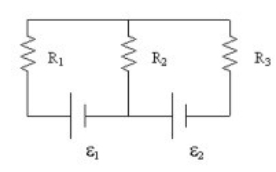
(Multiple Choice)
4.9/5 (77)
(77) A wire of radius 0.15 mm is made of an unknown metal and carries a current of 8.4 mA. The drift velocity for electrons in the wire is measured to be 36 × 10−6 m/s. What is the charge carrier density of the metal from which the wire is made?
(Multiple Choice)
4.9/5 (66)
(66) A series circuit consists of a 12.0 V source of emf, a 2.00 mF capacitor, a 1000 Ω resistor, and a switch. What is the time constant for this circuit?
(Multiple Choice)
4.8/5 (66)
(66) Copper has 8.5 × 1028 current carrying electrons per m3. A copper wire carries a current of 17 mA, and the drift velocity of the electrons is measured to be 18 × 10−6 m/s. What is the wire's radius?
(Multiple Choice)
4.9/5 (69)
(69) A bird can safely land on a bare, high-voltage power line because
(Multiple Choice)
4.7/5 (92)
(92) A 12.0 V battery has an internal resistance of 0.080 Ω. If the battery supplies 100 A when connected to a starter motor, what is the resistance of the motor?
(Multiple Choice)
4.9/5 (81)
(81) Two capacitors of values 6.0 mF and 9.0 mF are connected in series to a 30.0 V power supply. What is the resulting potential difference across the 6.0 mF capacitor?
(Multiple Choice)
4.9/5 (85)
(85) An electron beam contains 1.5 × 10¹⁷ electrons per m3 and is confined to circular cross-sectional region of diameter 0.025 mm. The electrons in the beam are extremely energetic and travel at nearly the speed of light. What is the current in the beam?
(Multiple Choice)
4.8/5 (73)
(73) Two carbon cylinders have radii 2r and r, and the first has length 2L, while the second has length L. What is the resistance of the first if the resistance of the second is 12 Ω?
(Multiple Choice)
4.9/5 (79)
(79) 
Filters
- Essay(0)
- Multiple Choice(0)
- Short Answer(0)
- True False(0)
- Matching(0)