



 Chat with AI
Exam 14: Exchange Rate Adjustments and the Balance-of-payments

Exam 1: The International Economy and Globalization71 Questions
Exam 2: Foundations of Modern Trade Theory: Comparative Advantage215 Questions
Exam 3: Sources of Comparative Advantage143 Questions
Exam 4: Tariffs162 Questions
Exam 5: Nontariff Trade Barriers164 Questions
Exam 6: Trade Regulations and Industrial Policies187 Questions
Exam 7: Trade Policies for the Developing Nations305 Questions
Exam 8: Regional Trading Arrangements164 Questions
Exam 9: International Factor Movements and Multinational Enterprises123 Questions
Exam 10: The Balance-of-payments156 Questions
Exam 11: Foreign Exchange206 Questions
Exam 12: Exchange Rate Determination199 Questions
Exam 13: Mechanisms of International Adjustment107 Questions
Exam 14: Exchange Rate Adjustments and the Balance-of-payments122 Questions
Exam 15: Exchange Rate Systems and Currency Crises168 Questions
Exam 16: Macroeconomic Policy in an Open-economy72 Questions
Exam 17: International Banking: Reserves, Debt, and Risk96 Questions
Select questions type


According to the absorption approach (B = Y - A),currency devaluation improves a nation's trade balance if:
(Multiple Choice)
4.8/5  (86)
(86) The absorption approach suggests that one of the following causes a trade deficit to decrease following currency depreciation:
(Multiple Choice)
4.9/5 (61)
(61) Assume the Canadian demand elasticity for imports equals 1.2,while the foreign demand elasticity for Canadian exports equals 1.8.Responding to a trade deficit,suppose the Canadian dollar depreciates by 10 percent.For Canada,the depreciation would lead to a(n):
(Multiple Choice)
4.8/5 (86)
(86) Assume that General Motors employs labor and materials,whose costs are denominated in dollars,in the production of automobiles.If the dollar's exchange value appreciates by 10 percent against the yen,the yen-denominated cost of a GM vehicle falls by 10 percent.
(True/False)
4.8/5 (81)
(81) The ______ is a theory of the balance of payments that shows how home-country spending on home-country goods changes relative to home-country output
(Multiple Choice)
4.8/5 (70)
(70) Which approach analyzes a nation's balance of payments in terms of money demand and money supply?
(Multiple Choice)
4.9/5 (87)
(87) Assume that Ford Motor Company obtains all of its inputs in the United States and all of its costs are denominated in dollars.A depreciation of the dollar's exchange value:
(Multiple Choice)
4.8/5 (91)
(91) Given favorable elasticity conditions,a depreciation of the lira tends to result in:
(Multiple Choice)
4.8/5 (76)
(76) To the extent that labor unions attain higher wages during periods of currency depreciation,the resulting wage inflation reduces the improving competitiveness of a country's business firms caused by depreciation
(True/False)
4.8/5 (76)
(76) How do demand elasticities influence a country's trade position when exchange rates change?
(Essay)
4.8/5 (82)
(82) Empirical evidence regarding the effects of currency devaluation on the balance of trade indicates that
(Multiple Choice)
4.9/5 (80)
(80) The purpose of currency devaluation is to cause a depreciation in a currency's exchange value.
(True/False)
4.9/5 (81)
(81) Which approach predicts that if an economy operates at full employment and faces a trade deficit,currency devaluation (depreciation) will improve the trade balance only if domestic spending is cut,thus freeing resources to produce exports?
(Multiple Choice)
4.8/5 (68)
(68) Figure 14.1US market for Imported Toyotas
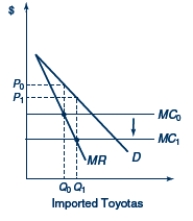 -In Figure 14.1,D represents the US demand curve for Toyotas and MC0 represents the marginal cost of producing Toyotas.A shift in the marginal cost curve from MC0 to MC1 represents
 (Multiple Choice)
4.8/5 (73)
(73) According to the ______,following a currency devaluation,the balance of trade worsens for a while before improving.
(Multiple Choice)
4.8/5 (85)
(85) Assume that a country realizes unemployment and excess production capacity.According to the absorption approach,currency devaluation tends to decrease domestic output and worsen the balance of trade.
(True/False)
4.9/5 (77)
(77) According to the absorption approach,an increase in domestic expenditures must occur for currency devaluation to promote balance of trade equilibrium.
(True/False)
4.9/5 (61)
(61) Suppose a country devalues its currency.If the country's demand for imports is elastic,the price increase resulting from the devaluation results in a relatively small decrease in the volume of imports,causing to total import expenditures to increase.
(True/False)
4.8/5 (92)
(92) According to the Marshall-Lerner condition,currency depreciation would have a negative effect on a country's trade balance if the elasticity of demand for its exports plus the elasticity of demand for its imports equals:
(Multiple Choice)
4.9/5 (72)
(72) 
Filters
- Essay(0)
- Multiple Choice(0)
- Short Answer(0)
- True False(0)
- Matching(0)