



 Chat with AI
Exam 11: Foreign Exchange

Exam 1: The International Economy and Globalization71 Questions
Exam 2: Foundations of Modern Trade Theory: Comparative Advantage215 Questions
Exam 3: Sources of Comparative Advantage143 Questions
Exam 4: Tariffs162 Questions
Exam 5: Nontariff Trade Barriers164 Questions
Exam 6: Trade Regulations and Industrial Policies187 Questions
Exam 7: Trade Policies for the Developing Nations305 Questions
Exam 8: Regional Trading Arrangements164 Questions
Exam 9: International Factor Movements and Multinational Enterprises123 Questions
Exam 10: The Balance-of-payments156 Questions
Exam 11: Foreign Exchange206 Questions
Exam 12: Exchange Rate Determination199 Questions
Exam 13: Mechanisms of International Adjustment107 Questions
Exam 14: Exchange Rate Adjustments and the Balance-of-payments122 Questions
Exam 15: Exchange Rate Systems and Currency Crises168 Questions
Exam 16: Macroeconomic Policy in an Open-economy72 Questions
Exam 17: International Banking: Reserves, Debt, and Risk96 Questions
Select questions type


In the early 1980s,the Federal Reserve pursued a tight monetary policy.All else being equal,the impact of that policy was to ____ interest rates in the United States relative to those in Europe and cause the dollar to ____ against European currencies.
(Multiple Choice)
4.9/5  (96)
(96) Table 11.2.Supply and Demand of British Pounds
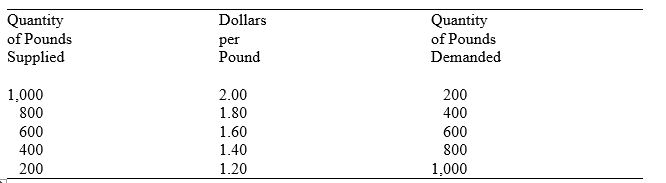 -Refer to Table 11.2.At the exchange rate of $1.40 per pound,there is an ____ for pounds.This imbalance causes ____ in the price of the pound,which leads to ____ in the quantity of pounds supplied and ____ in the quantity of pounds demanded.
 (Multiple Choice)
4.8/5 (75)
(75) If the exchange rate is $0.01 per yen in New York and $0.015 per yen in Tokyo,an arbitrager could profit by buying yen in Tokyo and simultaneously sell them in New York.
(True/False)
4.9/5 (89)
(89) If the spot price of the Swiss franc is $0.4020 and the 90-day forward franc sells for $0.4026,the franc is at a 90-day forward discount of $0.0006,or at a 0.2 percent forward discount per annum against the dollar.
(True/False)
4.8/5 (88)
(88) Table 11.3.Key Currency Cross Rates
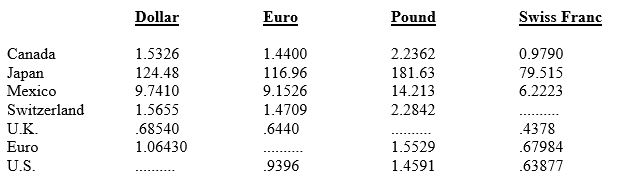 -Referring to Table 11.3,the cross exchange rate between the euro and Swiss franc is approximately:
 (Multiple Choice)
4.8/5 (92)
(92) Stabilizing speculation reinforces market forces by intensifying an appreciation or a depreciation in a currency's exchange value.
(True/False)
4.9/5 (72)
(72) Given an upward-sloping supply schedule of pounds and a downward-sloping demand schedule for pounds,an increase in the supply schedule causes an appreciation of the dollar against the pound.
(True/False)
4.9/5 (87)
(87) Similar to stock and commodity exchanges,the foreign exchange market is an organized structure with a central meeting place and formal licensing requirements.
(True/False)
4.7/5 (77)
(77) Suppose the selling price of one-month forward British pounds is $1.6036 per pound and the spot price of the pound is $1.6039.This means that there is an annual forward discount on the pound equal to 0.2 percent.
(True/False)
4.9/5 (80)
(80) During the era of dollar appreciation,in the 1980s,a main reason why the dollar did not fall in value was:
(Multiple Choice)
4.9/5 (68)
(68) If Citibank quoted bid and offer rates for the Swiss franc at $.4850/$.4854,the bank would be prepared to buy,say,1 million francs for $485,000 and sell them for $485,400.
(True/False)
4.8/5 (84)
(84) Given the foreign currency market for the Swiss franc,the supply of francs slopes upward,because as the dollar price of the franc rises:
(Multiple Choice)
4.8/5 (85)
(85) The supply for foreign exchange results from transactions that appear on the
a.credit side of a country's balance of payments statement
b.debit side of a country's balance of payments statement
c.both the credit side and the debit side of a country's balance of payments statement
d.neither the credit side nor the debit side of a country balance of payments statement
(Short Answer)
4.8/5 (78)
(78) Currency arbitrage tends to result in identical yen/dollar exchange rates in New York and in Tokyo.
(True/False)
4.7/5 (78)
(78) Suppose the exchange value of the British pound is $2 per pound while the exchange value of the Swiss franc is 50 cents per pound.The cross exchange rate between the pound and the franc is:
(Multiple Choice)
4.8/5 (75)
(75) If the Swiss demand for dollars is inelastic,a depreciation of the dollar against the franc will lead to a greater quantity of francs being supplied to the foreign exchange market to obtain dollars.
(True/False)
4.7/5 (69)
(69) Concerning the covering of exchange market risks--assuming that a depreciation of the domestic currency is anticipated,one can say that there is an incentive for:
(Multiple Choice)
4.7/5 (82)
(82) Most foreign exchange transactions are conducted between commercial banks and household customers.
(True/False)
4.7/5 (73)
(73) 
Filters
- Essay(0)
- Multiple Choice(0)
- Short Answer(0)
- True False(0)
- Matching(0)