



 Chat with AI
Exam 2: Foundations of Modern Trade Theory: Comparative Advantage

Exam 1: The International Economy and Globalization71 Questions
Exam 2: Foundations of Modern Trade Theory: Comparative Advantage215 Questions
Exam 3: Sources of Comparative Advantage143 Questions
Exam 4: Tariffs162 Questions
Exam 5: Nontariff Trade Barriers164 Questions
Exam 6: Trade Regulations and Industrial Policies187 Questions
Exam 7: Trade Policies for the Developing Nations305 Questions
Exam 8: Regional Trading Arrangements164 Questions
Exam 9: International Factor Movements and Multinational Enterprises123 Questions
Exam 10: The Balance-of-payments156 Questions
Exam 11: Foreign Exchange206 Questions
Exam 12: Exchange Rate Determination199 Questions
Exam 13: Mechanisms of International Adjustment107 Questions
Exam 14: Exchange Rate Adjustments and the Balance-of-payments122 Questions
Exam 15: Exchange Rate Systems and Currency Crises168 Questions
Exam 16: Macroeconomic Policy in an Open-economy72 Questions
Exam 17: International Banking: Reserves, Debt, and Risk96 Questions
Select questions type


The price-specie-flow mechanism illustrated why one nation's gains from trade were accompanied by another country's losses.
(True/False)
4.8/5  (80)
(80) The domestic cost ratios of nations set the outer limits to the equilibrium terms of trade.
(True/False)
4.8/5 (77)
(77) A terms-of-trade index that equals 150 indicates that compared to the base year:
(Multiple Choice)
4.8/5 (83)
(83) Figure 2.2 illustrates trade data for Canada.The figure assumes that Canada attains international trade equilibrium at point C.
Figure 2.2.Canadian Trade Possibilities
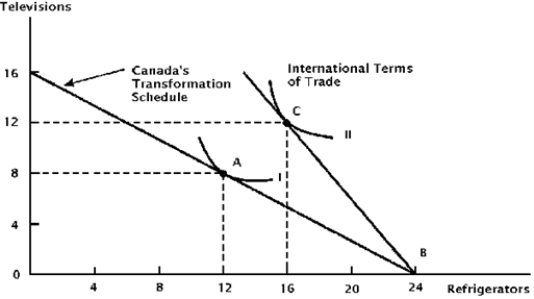 -Consider Figure 2.2.In the absence of trade,Canada would produce and consume:
 (Multiple Choice)
4.7/5 (81)
(81) In Adam Smith's trade theory,______ is the only factor of production and is of one quality (homogeneous)
(Multiple Choice)
4.9/5 (79)
(79) The Ricardian theory of comparative advantage could fully explain the distribution of the gains from trade among trading partners.
(True/False)
4.7/5 (82)
(82) A nation realizes maximum gains from trade at the point where the international terms-of-trade line is tangent to its community indifference curve.
(True/False)
4.7/5 (78)
(78) The writings of G.MacDougall emphasized which of the following as an explanation of a country's competitive position?
(Multiple Choice)
4.9/5 (69)
(69) Assume that Canada has a comparative advantage in wheat and a comparative disadvantage in autos.As the Canadian demand for wheat increases,Canada's equilibrium terms of trade improves.
(True/False)
4.9/5 (75)
(75) Figure 2.1.Production Possibilities Schedule
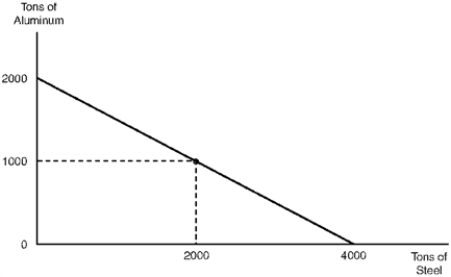 -Refer to Figure 2.1.If the relative cost of steel were to rise,then the production possibilities schedule would:
 (Multiple Choice)
4.9/5 (75)
(75) A nation's trade triangle denotes its exports,imports,and terms of trade.
(True/False)
4.8/5 (86)
(86) Given a two-country and two-product world,the United States would enjoy all the attainable gains from free trade with Canada if it:
(Multiple Choice)
4.8/5 (72)
(72) Unlike Adam Smith,David Ricardo's trading principle emphasizes the:
(Multiple Choice)
4.9/5 (59)
(59) According to J.S.Mill,if we know the domestic demand expressed by both trading partners for both products,the equilibrium terms of trade can be defined.
(True/False)
4.8/5 (82)
(82) Is it possible to add up the preferences of all consumers in an entire nation?
(Essay)
4.7/5 (74)
(74) Adam Smith and David Ricardo reasoned that in a world of two countries,at least one country will be worse off as the result of trade.
(True/False)
4.9/5 (78)
(78) According to the principle of comparative advantage,specialization and trade increase a nation's total output since:
(Multiple Choice)
5.0/5 (75)
(75) The British economist,G.MacDougall compared the labor productivity ratios and export ratios for the United Kingdom and the United States in order to test
(Multiple Choice)
4.8/5 (89)
(89) 
Filters
- Essay(0)
- Multiple Choice(0)
- Short Answer(0)
- True False(0)
- Matching(0)