



 Chat with AI
Exam 15: Radical Reactions

Exam 1: Structure and Bonding69 Questions
Exam 2: Acids and Bases52 Questions
Exam 3: Introduction to Organic Molecules and Functional Groups45 Questions
Exam 4: Alkanes57 Questions
Exam 5: Stereochemistry59 Questions
Exam 6: Understanding Organic Reactions45 Questions
Exam 7: Alkyl Halides and Nucleophilic Substitution61 Questions
Exam 8: Alkyl Halides and Elimination Reactions43 Questions
Exam 9: Alcohols, Ethers, and Related Compounds49 Questions
Exam 10: Alkenes43 Questions
Exam 11: Alkynes42 Questions
Exam 12: Oxidation and Reduction39 Questions
Exam 13: Mass Spectrometry and Infrared Spectroscopy35 Questions
Exam 14: Nuclear Magnetic Resonance Spectroscopy29 Questions
Exam 15: Radical Reactions42 Questions
Exam 16: Conjugation, Resonance, and Dienes43 Questions
Exam 17: Benzene and Aromatic Compounds31 Questions
Exam 18: Reactions of Aromatic Compounds54 Questions
Exam 19: Carboxylic Acids and the Acidity of the O-H Bond36 Questions
Exam 20: Introduction to Carbonyl Chemistry;29 Questions
Exam 21: Aldehydes and Ketones Nucleophilic Addition42 Questions
Exam 22: Carboxylic Acids and Derivatives46 Questions
Exam 23: Substitution Reactions of Carbonyl Compounds at the Alpha-Carbon40 Questions
Exam 24: Carbonyl Condensation Reactions45 Questions
Exam 25: Amines53 Questions
Exam 26: Carbon-Carbon Bond Forming Reactions in Organic Synthesis37 Questions
Exam 27: Pericyclic Reactions47 Questions
Exam 28: Carbohydrates38 Questions
Exam 29: Amino Acids and Proteins35 Questions
Exam 30: Synthetic Polymers36 Questions
Exam 31: Lipids39 Questions
Select questions type


Which steps are the rate-determining step in the mechanism of radical halogenation?
(Multiple Choice)
4.8/5  (76)
(76) How many monochlorination products can be formed (constitutional isomers only) from the reaction of CH3CH2CH2CH2CH2CH3 with Cl2 and hn?
(Multiple Choice)
4.9/5 (71)
(71) Which of the following statements about radical reactions is not true?
(Multiple Choice)
4.8/5 (87)
(87) What is the product in the following sequence of reactions?

(Multiple Choice)
4.7/5 (72)
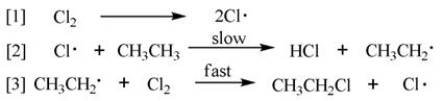
(72) A possible reaction of ethane with chlorine is shown below.This reaction could conceivably occur by the following chain mechanisms [1], [2], and [3].The chain propagating step(s) is (are) _______. 
(Multiple Choice)
4.8/5 (71)
(71) How many products, including stereoisomers, are formed when 2-methylpent-2-ene is treated with HBr in presence of peroxides?
(Multiple Choice)
4.7/5 (80)
(80) 
How many monochlorination products (constitutional isomers and stereoisomers) are formed from the reaction of butane with Cl2 and hn?
(Multiple Choice)
4.9/5 (82)
(82) Which of the following statements is (are) true about free radical halogenation of alkanes?
(Multiple Choice)
4.9/5 (82)
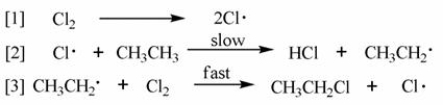
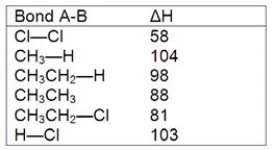
(82) A possible reaction of ethane with chlorine is shown below.This reaction could conceivably occur by the following chain mechanisms [1], [2], and [3].Determine DH for step [1]. 
 Bond dissociation energies (kcal/mol):
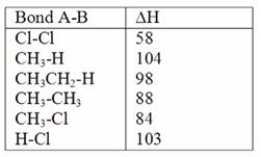
Bond dissociation energies (kcal/mol):
(Multiple Choice)
4.8/5 (72)
(72) What is the product in the following sequence of reactions?

(Multiple Choice)
4.7/5 (72)
(72) How many monochlorination products, including stereoisomers, are formed from (S,S)-1,2-dimethylcyclopropane?

(Multiple Choice)
4.9/5 (86)
(86) How many monochlorination products can be formed from the reaction of (CH3)3CH with Cl2 and hn?
(Multiple Choice)
4.7/5 (84)
(84) Which of the following statements about carbon radicals is not true?
(Multiple Choice)
4.9/5 (76)
(76) How many products, including stereoisomers, are formed when (R)-2,4-dimethylpent-2-ene is treated with HBr in presence of peroxides?
(Multiple Choice)
4.9/5 (89)
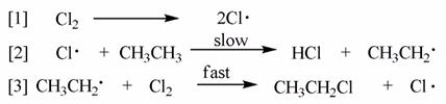
(89) A possible reaction of ethane with chlorine is shown below.This reaction could conceivably occur by the following chain mechanisms [1], [2], and [3].Determine DH for step [2].Bond dissociation energies (kcal/mol):

(Multiple Choice)
4.9/5 (76)
(76) Which of the following statements about the propagation steps in the chlorination of ethane is true?
(Multiple Choice)
5.0/5 (89)
(89) How many allylic halides can be formed when 3-methycyclohexene undergoes allylic halogenation with one equivalent of NBS and light?
(Multiple Choice)
4.8/5 (77)
(77) 
Filters
- Essay(0)
- Multiple Choice(0)
- Short Answer(0)
- True False(0)
- Matching(0)