



 Chat with AI
Exam 9: The Cost of Capital

Exam 1: An Overview of Financial Management and the Financial Environment38 Questions
Exam 2: Financial Statements, Cash Flow, and Taxes3 Questions
Exam 3: Analysis of Financial Statements104 Questions
Exam 4: Time Value of Money139 Questions
Exam 5: Bonds, Bond Valuation, and Interest Rates100 Questions
Exam 6: Risks and Rates of Return132 Questions
Exam 7: Stocks and Their Valuation48 Questions
Exam 8: Financial Options and Applications in Corporate Finance22 Questions
Exam 9: The Cost of Capital87 Questions
Exam 10: The Basics of Capital Budgeting98 Questions
Exam 11: Cash Flow Estimation and Risk Analysis66 Questions
Exam 12: Financial Planning and Forecasting Financial Statements46 Questions
Exam 13: Corporate Valuation, Value-Based Management, and Corporate Governance24 Questions
Exam 14: Distributions to Shareholders: Dividends and Repurchases26 Questions
Exam 15: Capital Structure Decisions70 Questions
Exam 16: Working Capital Management129 Questions
Exam 17: Multinational Financial Management39 Questions
Exam 18: Lease Financing20 Questions
Exam 19: Hybrid Financing: Preferred Stock, Warrants, and Convertibles27 Questions
Exam 20: Initial Public Offerings, Investment Banking, and Financial Restructuring22 Questions
Exam 21: Mergers, Lbos, Divestitures, and Holding Companies41 Questions
Exam 22: Bankruptcy, Reorganization, and Liquidation8 Questions
Exam 23: Derivatives and Risk Management14 Questions
Exam 24: Portfolio Theory, Asset Pricing Models, and Behavioral Finance25 Questions
Exam 25: Real Options15 Questions
Exam 26: Analysis of Capital Structure Theory27 Questions
Exam 27: Providing and Obtaining Credit31 Questions
Exam 28: Advanced Issues in Cash Management and Inventory Control20 Questions
Exam 29: Pension Plan Management9 Questions
Exam 30: Financial Management in Not-For-Profit Businesses10 Questions
Select questions type


The cost of debt is equal to one minus the marginal tax rate multiplied by the interest rate on new debt.
(True/False)
4.9/5  (87)
(87) For a typical firm, which of the following sequences is CORRECT? All rates are after taxes, and assume that the firm operates at its target capital structure.
(Multiple Choice)
4.9/5 (82)
(82) Which of the following is NOT a capital component when calculating the weighted average cost of capital (WACC) for use in capital budgeting?
(Multiple Choice)
4.8/5 (70)
(70) The cost of capital used in capital budgeting should reflect the average cost of the various sources of long-term funds a firm uses to acquire assets.
(True/False)
4.8/5 (71)
(71)
Assume that you have been hired as a consultant by CGT, a major producer of chemicals and plastics, including plastic grocery bags, styrofoam cups, and fertilizers, to estimate the firm's weighted average cost of capital. The balance sheet and some other information are provided below.
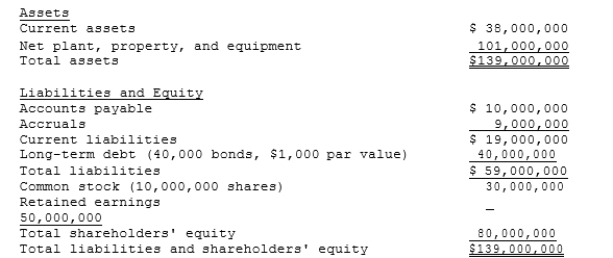 The stock is currently selling for $15.25 per share, and its noncallable
$1,000 par value, 20-year, 7.25% bonds with semiannual payments are selling for $875.00. The beta is 1.25, the yield on a 6-month Treasury bill is 3.50%, and the yield on a 20-year Treasury bond is 5.50%. The required return on the stock market is 11.50%, but the market has had an average annual return of 14.50% during the past 5 years. The firm's tax rate is 40%.
-Based on the CAPM, what is the firm's cost of common stock?
The stock is currently selling for $15.25 per share, and its noncallable
$1,000 par value, 20-year, 7.25% bonds with semiannual payments are selling for $875.00. The beta is 1.25, the yield on a 6-month Treasury bill is 3.50%, and the yield on a 20-year Treasury bond is 5.50%. The required return on the stock market is 11.50%, but the market has had an average annual return of 14.50% during the past 5 years. The firm's tax rate is 40%.
-Based on the CAPM, what is the firm's cost of common stock? (Multiple Choice)
4.9/5 (79)
(79) Assume that Kish Inc. hired you as a consultant to help estimate its cost of common equity. You have obtained the following data: D0 =
$0)90; P0 = $27.50; and g = 7.00% (constant). Based on the DCF approach, what is the cost of common from retained earnings?
(Multiple Choice)
4.7/5 (80)
(80) O'Brien Inc. has the following data: rRF = 5.00%; RPM = 6.00%; and b =
1.05. What is the firm's cost of common from retained earnings based on the CAPM?
(Multiple Choice)
4.9/5 (72)
(72) Cranberry Corp. has two divisions of equal size: a computer manufacturing division and a data processing division. Its CFO believes that stand-alone data processor companies typically have a WACC of 8%, while stand-alone computer manufacturers typically have a 12% WACC. He also believes that the data processing and manufacturing divisions have the same risk as their typical peers. Consequently, he estimates that the composite, or corporate, WACC is 10%. A consultant has suggested using an 8% hurdle rate for the data processing division and a 12% hurdle rate for the manufacturing division. However, the CFO disagrees, and he has assigned a 10% WACC to all projects in both divisions. Which of the following statements is CORRECT?
(Multiple Choice)
4.9/5 (88)
(88) The cost of perpetual preferred stock is found as the preferred's annual dividend divided by the market price of the preferred stock. No adjustment is needed for taxes because preferred dividends, unlike interest on debt, is not deductable by the issuing firm.
(True/False)
4.8/5 (82)
(82) The CFO of Lenox Industries hired you as a consultant to help estimate its cost of common equity. You have obtained the following data: (1) rd = yield on the firm's bonds = 7.00% and the risk premium over its own debt cost = 4.00%. (2) rRF = 5.00%, RPM = 6.00%, and b = 1.25. (3) D1 =
$1)20, P0 = $35.00, and g = 8.00% (constant). You were asked to estimate the cost of common based on the three most commonly used methods and then to indicate the difference between the highest and lowest of these estimates. What is that difference?
(Multiple Choice)
4.8/5 (81)
(81) Bolster Foods' (BF) balance sheet shows a total of $25 million long- term debt with a coupon rate of 8.50%. The yield to maturity on this debt is 8.00%, and the debt has a total current market value of $27 million. The balance sheet also shows that the company has 10 million shares of stock, and the stock has a book value per share of $5.00. The current stock price is $20.00 per share, and stockholders' required rate of return, rs, is 12.25%. The company recently decided that its target capital structure should have 35% debt, with the balance being common equity. The tax rate is 40%. Calculate WACCs based on book, market, and target capital structures. What is the sum of these three WACCs?
(Multiple Choice)
4.9/5 (86)
(86) Firm M's earnings and stock price tend to move up and down with other firms in the S&P 500, while Firm W's earnings and stock price move counter cyclically with M and other S&P companies. Both M and W estimate their costs of equity using the CAPM, they have identical market values, their standard deviations of returns are identical, and they both finance only with common equity. Which of the following statements is CORRECT?
(Multiple Choice)
4.9/5 (70)
(70) Suppose the debt ratio (D/TA) is 50%, the interest rate on new debt is 8%, the current cost of equity is 16%, and the tax rate is 40%. An increase in the debt ratio to 60% would decrease the weighted average cost of capital (WACC).
(True/False)
4.8/5 (67)
(67) "Capital" is sometimes defined as funds supplied to a firm by investors.
(True/False)
4.9/5 (78)
(78) The text identifies three methods for estimating the cost of common stock from retained earnings: the CAPM method, the DCF method, and the bond-yield-plus-risk-premium method. However, only the CAPM method always provides an accurate and reliable estimate.
(True/False)
4.8/5 (84)
(84) The reason why retained earnings have a cost equal to rs is because investors think they can (i.e., expect to) earn rs on investments with the same risk as the firm's common stock, and if the firm does not think that it can earn rs on the earnings that it retains, it should distribute those earnings to its investors. Thus, the cost of retained earnings is based on the opportunity cost principle.
(True/False)
4.8/5 (77)
(77) 
Filters
- Essay(0)
- Multiple Choice(0)
- Short Answer(0)
- True False(0)
- Matching(0)