



 Chat with AI
Exam 9: The Cost of Capital

Exam 1: An Overview of Financial Management and the Financial Environment38 Questions
Exam 2: Financial Statements, Cash Flow, and Taxes3 Questions
Exam 3: Analysis of Financial Statements104 Questions
Exam 4: Time Value of Money139 Questions
Exam 5: Bonds, Bond Valuation, and Interest Rates100 Questions
Exam 6: Risks and Rates of Return132 Questions
Exam 7: Stocks and Their Valuation48 Questions
Exam 8: Financial Options and Applications in Corporate Finance22 Questions
Exam 9: The Cost of Capital87 Questions
Exam 10: The Basics of Capital Budgeting98 Questions
Exam 11: Cash Flow Estimation and Risk Analysis66 Questions
Exam 12: Financial Planning and Forecasting Financial Statements46 Questions
Exam 13: Corporate Valuation, Value-Based Management, and Corporate Governance24 Questions
Exam 14: Distributions to Shareholders: Dividends and Repurchases26 Questions
Exam 15: Capital Structure Decisions70 Questions
Exam 16: Working Capital Management129 Questions
Exam 17: Multinational Financial Management39 Questions
Exam 18: Lease Financing20 Questions
Exam 19: Hybrid Financing: Preferred Stock, Warrants, and Convertibles27 Questions
Exam 20: Initial Public Offerings, Investment Banking, and Financial Restructuring22 Questions
Exam 21: Mergers, Lbos, Divestitures, and Holding Companies41 Questions
Exam 22: Bankruptcy, Reorganization, and Liquidation8 Questions
Exam 23: Derivatives and Risk Management14 Questions
Exam 24: Portfolio Theory, Asset Pricing Models, and Behavioral Finance25 Questions
Exam 25: Real Options15 Questions
Exam 26: Analysis of Capital Structure Theory27 Questions
Exam 27: Providing and Obtaining Credit31 Questions
Exam 28: Advanced Issues in Cash Management and Inventory Control20 Questions
Exam 29: Pension Plan Management9 Questions
Exam 30: Financial Management in Not-For-Profit Businesses10 Questions
Select questions type


Schalheim Sisters Inc. has always paid out all of its earnings as dividends; hence, the firm has no retained earnings. This same situation is expected to persist in the future. The company uses the CAPM to calculate its cost of equity, and its target capital structure consists of common stock, preferred stock, and debt. Which of the following events would REDUCE its WACC?
(Multiple Choice)
4.7/5  (82)
(82) Trahan Lumber Company hired you to help estimate its cost of common equity. You obtained the following data: D1 = $1.25; P0 = $27.50; g = 5.00% (constant); and F = 6.00%. What is the cost of equity raised by selling new common stock?
(Multiple Choice)
4.9/5 (82)
(82) If the expected dividend growth rate is zero, then the cost of external equity capital raised by issuing new common stock (re) is equal to the cost of equity capital from retaining earnings (rs) divided by one minus the percentage flotation cost required to sell the new stock, (1 - F). If the expected growth rate is not zero, then the cost of external equity must be found using a different formula.
(True/False)
4.8/5 (101)
(101) If a firm is privately owned, and its stock is not traded in public markets, then we cannot measure its beta for use in the CAPM model, we cannot observe its stock price for use in the DCF model, and we don't know what the risk premium is for use in the bond-yield-plus-risk- premium method. All this makes it especially difficult to estimate the cost of equity for a private company.
(True/False)
4.9/5 (87)
(87) Norris Enterprises, an all-equity firm, has a beta of 2.0. The chief financial officer is evaluating a project with an expected return of 14%, before any risk adjustment. The risk-free rate is 5%, and the market risk premium is 4%. The project being evaluated is riskier than an average project, in terms of both its beta risk and its total risk. Which of the following statements is CORRECT?
(Multiple Choice)
4.8/5 (66)
(66) Assume that you are a consultant to Broske Inc., and you have been provided with the following data: D1 = $0.67; P0 = $27.50; and g = 8.00% (constant). What is the cost of common from retained earnings based on the DCF approach?
(Multiple Choice)
4.8/5 (71)
(71) Suppose you are the president of a small, publicly-traded corporation. Since you believe that your firm's stock price is temporarily depressed, all additional capital funds required during the current year will be raised using debt. In this case, the appropriate marginal cost of capital for use in capital budgeting during the current year is the after-tax cost of debt.
(True/False)
4.8/5 (69)
(69) Daves Inc. recently hired you as a consultant to estimate the company's WACC. You have obtained the following information. (1) The firm's noncallable bonds mature in 20 years, have an 8.00% annual coupon, a par value of $1,000, and a market price of $1,050.00. (2) The company's tax rate is 40%. (3) The risk-free rate is 4.50%, the market risk premium is 5.50%, and the stock's beta is 1.20. (4) The target capital structure consists of 35% debt and the balance is common equity. The firm uses the CAPM to estimate the cost of common stock, and it does not expect to issue any new shares. What is its WACC?
(Multiple Choice)
4.8/5 (84)
(84) S. Bouchard and Company hired you as a consultant to help estimate its cost of common equity. You have obtained the following data: D0 =
$0)85; P0 = $22.00; and g = 6.00% (constant). The CEO thinks, however, that the stock price is temporarily depressed, and that it will soon rise to $40.00. Based on the DCF approach, by how much would the cost of common from retained earnings change if the stock price changes as the CEO expects?
(Multiple Choice)
4.8/5 (84)
(84) The text identifies three methods for estimating the cost of common stock from retained earnings: the CAPM method, the DCF method, and the bond-yield-plus-risk-premium method. Since we cannot be sure that the estimate obtained with any of these methods is correct, it is often appropriate to use all three methods, then consider all three estimates, and end up using a judgmental estimate when calculating the WACC.
(True/False)
4.8/5 (76)
(76) The before-tax cost of debt, which is lower than the after-tax cost, is used as the component cost of debt for purposes of developing the firm's WACC.
(True/False)
4.8/5 (94)
(94) When estimating the cost of equity by use of the CAPM, three potential problems are (1) whether to use long-term or short-term rates for rRF,
(2) whether or not the historical beta is the beta that investors use when evaluating the stock, and (3) how to measure the market risk premium, RPM. These problems leave us unsure of the true value of rs.
(True/False)
4.9/5 (81)
(81) You were hired as a consultant to Giambono Company, whose target capital structure is 40% debt, 15% preferred, and 45% common equity. The after-tax cost of debt is 6.00%, the cost of preferred is 7.50%, and the cost of common using retained earnings is 12.75%. The firm will not be issuing any new stock. What is its WACC?
(Multiple Choice)
4.9/5 (72)
(72) Which of the following statements is CORRECT? Assume that the firm is a publicly-owned corporation and is seeking to maximize shareholder wealth.
(Multiple Choice)
4.8/5 (71)
(71) If a typical U.S. company correctly estimates its WACC at a given point in time and then uses that same cost of capital to evaluate all projects for the next 10 years, then the firm will most likely
(Multiple Choice)
4.8/5 (85)
(85) The cost of debt is equal to one minus the marginal tax rate multiplied by the average coupon rate on all outstanding debt.
(True/False)
5.0/5 (65)
(65)
Assume that you have been hired as a consultant by CGT, a major producer of chemicals and plastics, including plastic grocery bags, styrofoam cups, and fertilizers, to estimate the firm's weighted average cost of capital. The balance sheet and some other information are provided below.
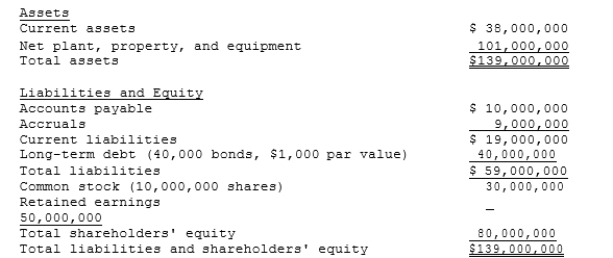 The stock is currently selling for $15.25 per share, and its noncallable
$1,000 par value, 20-year, 7.25% bonds with semiannual payments are selling for $875.00. The beta is 1.25, the yield on a 6-month Treasury bill is 3.50%, and the yield on a 20-year Treasury bond is 5.50%. The required return on the stock market is 11.50%, but the market has had an average annual return of 14.50% during the past 5 years. The firm's tax rate is 40%.
-Which of the following is the best estimate for the weight of debt for
Use in calculating the firm's WACC?
The stock is currently selling for $15.25 per share, and its noncallable
$1,000 par value, 20-year, 7.25% bonds with semiannual payments are selling for $875.00. The beta is 1.25, the yield on a 6-month Treasury bill is 3.50%, and the yield on a 20-year Treasury bond is 5.50%. The required return on the stock market is 11.50%, but the market has had an average annual return of 14.50% during the past 5 years. The firm's tax rate is 40%.
-Which of the following is the best estimate for the weight of debt for
Use in calculating the firm's WACC? (Multiple Choice)
4.9/5 (96)
(96) The firm's cost of external equity raised by issuing new stock is the same as the required rate of return on the firm's outstanding common stock.
(True/False)
4.8/5 (86)
(86) 
Filters
- Essay(0)
- Multiple Choice(0)
- Short Answer(0)
- True False(0)
- Matching(0)