
Exam 10: Analytic Geometry in Three Dimensions

arrow
  • Select Tags
search iconSearch Question
flashcardsStudy Flashcards
  • Select Tags

Find a unit vector orthogonal to u\mathbf { u } and v\mathbf { v } . u=\mathbf { u } = leadcoeff(a)i coeff⁡(b)jcoeff⁡(c)k,v=\operatorname { coeff } ( b ) \mathbf { j } \operatorname { coeff } ( \mathrm { c } ) \mathbf { k } , \mathbf { v } = leadcoeff(d) coeff(f)jcoeff⁡(g)k\mathbf { c o e f f } ( \mathrm { f } ) \mathbf { j } \operatorname { coeff } ( \mathrm { g } ) \mathbf { k }

(Multiple Choice)
4.8/5
(82)

Find u×v\mathbf { u } \times \mathbf { v } . u=−7i−3j−9k,v=i+4j+7k\mathbf { u } = - 7 \mathbf { i } - 3 \mathbf { j } - 9 \mathbf { k } , \mathbf { v } = \mathbf { i } + 4 \mathbf { j } + 7 \mathbf { k }

(Multiple Choice)
4.9/5
(79)

Find a set of symmetric equations of the line that passes through the points (5,0,5)( 5,0,5 ) and (7,8,−6)( 7,8 , - 6 )

(Multiple Choice)
4.8/5
(89)

Find the area of the triangle with the given vertices. (−4,−2,2),(−9,−7,0),(−4,−3,5)( - 4 , - 2,2 ) , ( - 9 , - 7,0 ) , ( - 4 , - 3,5 )

(Multiple Choice)
4.9/5
(85)

Find the triple scalar product u⋅(v×w)\mathbf { u } \cdot ( \mathbf { v } \times \mathbf { w } ) for the vectors u=−i−5j+9k,v=−2i−3j−8k,w=−i−6j+k\mathbf { u } = - \mathbf { i } - 5 \mathbf { j } + 9 \mathbf { k } , \mathbf { v } = - 2 \mathbf { i } - 3 \mathbf { j } - 8 \mathbf { k } , \mathbf { w } = - \mathbf { i } - 6 \mathbf { j } + \mathbf { k }

(Multiple Choice)
4.9/5
(86)

Find the volume of the parallelpiped with the given vertices. A(0,−5,3),B(3,−1,−4),C(7,−3,−1),D(10,1,−8), A ( 0 , - 5,3 ) , B ( 3 , - 1 , - 4 ) , C ( 7 , - 3 , - 1 ) , D ( 10,1 , - 8 ) \text {, } E(−3,−13,6),F(0,−9,−1),G(4,−11,2),H(7,−7,−5)E ( - 3 , - 13,6 ) , F ( 0 , - 9 , - 1 ) , G ( 4 , - 11,2 ) , H ( 7 , - 7 , - 5 )

(Multiple Choice)
4.9/5
(74)

Find the vector z\mathbf { z } , given u=⟨−3,3,9⟩\mathbf { u } = \langle - 3,3,9 \rangle and v=⟨−7,5,7⟩\mathbf { v } = \langle - 7,5,7 \rangle . z=−3u−5v\mathbf { z } = - 3 \mathbf { u } - 5 \mathbf { v }

(Multiple Choice)
4.8/5
(92)

Find the area of the parallelogram that has the vectors as adjacent sides. u=2i+j+k,v=5i−5j+5k\mathbf { u } = 2 \mathbf { i } + \mathbf { j } + \mathbf { k } , \mathbf { v } = 5 \mathbf { i } - 5 \mathbf { j } + 5 \mathbf { k }

(Multiple Choice)
4.8/5
(77)

For the points A(1,−2,−1),B(2,−7,4),C(1,−6,−5),D(2,−11,0)A ( 1 , - 2 , - 1 ) , B ( 2 , - 7,4 ) , C ( 1 , - 6 , - 5 ) , D ( 2 , - 11,0 ) : a. Verify that the points are vertices of a parallelogram. Show all work. b. Find the area of the parallelogram. Show all work. c. Determine whether the parallelogram is a rectangle.

(Essay)
4.8/5
(86)

Use the scalar triple product to find the volume of the parallelepiped having adjacent edges ⟨1,3,5⟩,⟨2,3,3⟩\langle 1,3,5 \rangle , \langle 2,3,3 \rangle , and ⟨3,3,4⟩\langle 3,3,4 \rangle .

(Multiple Choice)
4.8/5
(85)

Find the general form of the equation of the plane passing through the three points. [Be sure to reduce the coefficients in your answer to lowest terms by dividing out any common factor.] (5,−5,−6),(6,−1,4),(−2,−5,5)( 5 , - 5 , - 6 ) , ( 6 , - 1,4 ) , ( - 2 , - 5,5 )

(Multiple Choice)
4.7/5
(81)

Find the magnitude of the vector v\mathbf { v } described below. Initial point: (1,−8,−6)( 1 , - 8 , - 6 ) Terminal point: (−9,−1,−6)( - 9 , - 1 , - 6 )

(Multiple Choice)
5.0/5
(83)

Find the coordinates of the point located four units in front of the yzy z -plane, nine units to the right of the xzx z -plane, and three units below the xyx y -plane.

(Multiple Choice)
4.7/5
(73)

Find the dot product of u\mathbf { u } and v\mathbf { v } . u=⟨−3,−2,4⟩,v=⟨−4,−5,−7⟩\mathbf { u } = \langle - 3 , - 2,4 \rangle , \mathbf { v } = \langle - 4 , - 5 , - 7 \rangle

(Multiple Choice)
5.0/5
(82)

Find the angle between the vectors u\mathbf { u } and v\mathbf { v } . Express your answer in degrees and round to the nearest tenth of a degree. u=−6i+9j+2k,v=−3i−7j−4k\mathbf { u } = - 6 \mathbf { i } + 9 \mathbf { j } + 2 \mathbf { k } , \mathbf { v } = - 3 \mathbf { i } - 7 \mathbf { j } - 4 \mathbf { k }

(Multiple Choice)
4.7/5
(79)

Find u×v\mathbf { u } \times \mathbf { v } . u=−8i−5j+3k,v=−6i−7j−3k\mathbf { u } = - 8 \mathbf { i } - 5 \mathbf { j } + 3 \mathbf { k } , \mathbf { v } = - 6 \mathbf { i } - 7 \mathbf { j } - 3 \mathbf { k }

(Multiple Choice)
4.8/5
(81)

Find the general form of the equation of the plane with the given characteristics. The plane passes through the point (−3,6,−2)( - 3,6 , - 2 ) and is parallel to the yzy z -plane.

(Multiple Choice)
4.9/5
(67)

Find u×v\mathbf { u } \times \mathbf { v } . u=⟨7,−5,1⟩,v=⟨−3,4,8⟩\mathbf { u } = \langle 7 , - 5,1 \rangle , \mathbf { v } = \langle - 3,4,8 \rangle

(Multiple Choice)
4.9/5
(72)

Find the general form of the equation of the plane passing through the three points. [Be sure to reduce the coefficients in your answer to lowest terms by dividing out any common factor.] (5,2,−1),(3,3,2),(4,4,1)( 5,2 , - 1 ) , ( 3,3,2 ) , ( 4,4,1 )

(Multiple Choice)
4.8/5
(77)

The weight of a crate is 200 newtons. Find the tension in each of the supporting cables shown in the figure. The coordinates of the points A,B,CA , B , C , and DD are given below the figure. Round to the nearest newton.  The weight of a crate is 200 newtons. Find the tension in each of the supporting cables shown in the figure. The coordinates of the points  A , B , C , and  D  are given below the figure. Round to the nearest newton.    point  A = ( 0,0 , - 180 ) , point  B = ( 110,0,0 ) , point  C = ( - 40,50,0 ) , point  D = ( 0 , - 130,0 ) point A=(0,0,−180)A = ( 0,0 , - 180 ) , point B=(110,0,0)B = ( 110,0,0 ) , point C=(−40,50,0)C = ( - 40,50,0 ) , point D=(0,−130,0)D = ( 0 , - 130,0 )
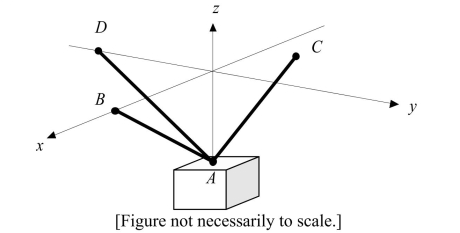
(Multiple Choice)
4.8/5
(91)
Showing 101 - 120 of 120
close modal

Filters

  • Essay(0)
  • Multiple Choice(0)
  • Short Answer(0)
  • True False(0)
  • Matching(0)