



 Chat with AI
Exam 10: Fluids

Exam 1: Introduction, Measurement, Estimating29 Questions
Exam 2: Describing Motion: Kinematics in One Dimension527 Questions
Exam 3: Kinematics in Two Dimensions; Vectors183 Questions
Exam 4: Dynamics: Newtons Laws of Motion146 Questions
Exam 5: Circular Motion; Gravitation105 Questions
Exam 6: Work and Energy153 Questions
Exam 7: Linear Momentum139 Questions
Exam 8: Rotational Motion148 Questions
Exam 9: Static Equilibrium; Elasticity and Fracture83 Questions
Exam 10: Fluids98 Questions
Exam 11: Oscillations and Waves114 Questions
Exam 12: Sound21 Questions
Exam 13: Temperature and Kinetic Theory87 Questions
Exam 14: Heat88 Questions
Exam 15: The Laws of Thermodynamics78 Questions
Exam 16: Electric Charge and Electric Field99 Questions
Exam 17: Electric Potential107 Questions
Exam 18: Electric Currents96 Questions
Exam 19: Dc Circuits384 Questions
Exam 20: Magnetism164 Questions
Exam 21: Electromagnetic Induction and Faradays Law60 Questions
Exam 22: Electromagnetic Waves167 Questions
Exam 23: Light: Geometric Optics144 Questions
Exam 24: The Wave Nature of Light58 Questions
Exam 25: Optical Instruments156 Questions
Exam 26: The Special Theory of Relativity126 Questions
Exam 27: Early Quantum Theory and Models of the Atom192 Questions
Exam 28: Quantum Mechanics of Atoms74 Questions
Exam 29: Molecules and Solids26 Questions
Exam 30: Nuclear Physics and Radioactivity153 Questions
Exam 31: Nuclear Energy; Effects and Uses of Radiation36 Questions
Exam 32: Elementary Particles19 Questions
Exam 33: Astrophysics and Cosmology25 Questions
Select questions type


The Tonga Trench in the Pacific Ocean is 36,000 feet deep. Assuming that sea water has an average density of calculate the absolute (total) pressure at the bottom of the trench in atmospheres.
(Multiple Choice)
4.7/5  (69)
(69) A rectangular wooden block measures
When the block is placed in water, it floats horizontally, with its bottom face 1.65 cm below the surface. What is the density of the wood? The density of water is
(Multiple Choice)
4.8/5 (73)
(73) In a section of horizontal pipe with a diameter of 3.0 cm, the pressure is 100 kPa and water is flowing with a speed of 1.5 m/s. The pipe narrows to 2.0 cm. What is the pressure in the narrower region? Treat the water as an ideal incompressible fluid.
(Multiple Choice)
4.7/5 (88)
(88) Water flows out of a large reservoir through an open pipe, as shown in the figure. What is the speed of the water as it comes out of the pipe?

(Multiple Choice)
4.9/5 (65)
(65) The small piston of a hydraulic lift has a diameter of 8.0 cm, and its large piston has a diameter of 40 cm. The lift raises a load of 15,000 N. Assume the pistons each have negligible weight.
(a) Determine the force that must be applied to the small piston.
(b) Determine the pressure applied to the fluid in the lift.
(Short Answer)
5.0/5 (73)
(73) The bathyscaphe Trieste consists of a thin-walled but very strong cylindrical hull, 15.2 m long and 3.66 m in diameter, filled with gasoline with a density of to make it buoyant. If it is totally submerged in seawater with a density of and neither rising nor sinking, what is the weight of the Trieste craft?
(Multiple Choice)
4.8/5 (71)
(71) A large cylindrical water tank 11.5 m in diameter and 13.5 m tall is supported with its base 8.75 m above the ground by a stand as shown in the figure. The water level in the tank is 10.6 m deep, and the density of the water in the tank is
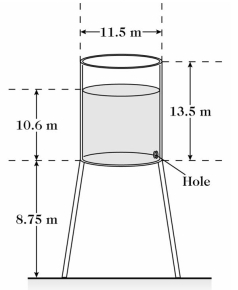 A very small hole is formed at the base of the vertical wall of the tank, and water is squirting out of this hole horizontally. When this water hits the ground, how far has it traveled horizontally from the hole, assuming no air resistance?
 (Short Answer)
5.0/5 (85)
(85) A 12,000-N car is raised using a hydraulic lift, which consists of a U-tube with arms of unequal areas, filled with oil with a density of and capped at both ends with tight-fitting pistons. The wider arm of the U-tube has a radius of 18.0 cm and the narrower arm has a radius of 5.00 cm. The car rests on the piston on the wider arm of the U-tube. The pistons are initially at the same level. What is the force that must be applied to the smaller piston in order to lift the car after it has been raised 1.20 m? For purposes of this problem, neglect the weight of the pistons.
(Multiple Choice)
4.9/5 (90)
(90) What force does the water exert (in addition to that due to atmospheric pressure) on a submarine window of radius 44.0 cm at a depth of 9400 m in sea water? The density of sea water is 1025
(Multiple Choice)
4.8/5 (94)
(94) A hollow sphere of negligible mass and radius R is completely filled with a liquid so that its density is You now enlarge the sphere so its radius is 2R and completely fill it with the same liquid. What is the density of the enlarged sphere?
(Multiple Choice)
4.8/5 (79)
(79) A compressed gas with a total mass of 107 kg is stored in a spherical container having a radius of 0.521 m. What is the density of the compressed gas?
(Multiple Choice)
4.8/5 (91)
(91) A water tank is filled to a depth of 10 m, and the bottom of the tank is 20 m above ground. A water-filled hose that is 2.0 cm in diameter extends from the bottom of the tank to the ground, but no water is flowing in this hose. The water pressure at ground level in the hose is closest to which of the following values? The density of water is
(Multiple Choice)
4.9/5 (80)
(80) In a hydraulic garage lift, the small piston has a radius of 5.0 cm and the large piston has a radius of 15 cm. What force must be applied on the small piston in order to lift a car weighing 20,000 N on the large piston? Assume the pistons each have negligible weight.
(Multiple Choice)
4.7/5 (81)
(81) A cubical block of stone is lowered at a steady rate into the ocean by a crane, always keeping the top and bottom faces horizontal. Which one of the following graphs best describes the gauge pressure p on the bottom of this block as a function of time t if the block just enters the water at time t = 0 s?
(Multiple Choice)
4.9/5 (71)
(71) The density of material at the center of a neutron star is approximately What is the mass of a cube of this material that is 1.76 microns on each side. (One micron is equal to
(Multiple Choice)
4.8/5 (78)
(78) A fluid is flowing with an average speed of 1.5 m/s through a tube that has a radius of 2.0 mm and is 18 cm long. The drop in pressure is 967 Pa. What is the viscosity of the fluid?
(Multiple Choice)
4.7/5 (66)
(66) A spherical ball of lead is placed in a tub of mercury
Which answer best describes the result?
(Multiple Choice)
4.7/5 (87)
(87) Ideal incompressible fluid flows through a 4.0-cm-diameter pipe at 1.0 m/s . There is a 2.0 cm diameter constriction in the line. What is the speed of the fluid in this constriction?
(Multiple Choice)
4.7/5 (76)
(76) An ideal incompressible fluid flows at 0.252 m/s through a 44-mm diameter cylindrical pipe. The pipe widens to a square cross sectional area that is 5.5 cm on a side. Assume steady flow throughout the system.
(a) What is the speed of the fluid through the square section of pipe?
(b) What is the flow rate in liters per minute?
(Short Answer)
4.8/5 (81)
(81) A container has a vertical tube, whose inner radius is 12.00 mm, connected to it at its side, as shown in the figure. An unknown liquid reaches level A in the container and level B in the tube -level A being 5.0 cm higher than level B. The liquid supports a 20-cm high column of oil, between levels B and C , whose density is
The gauge pressure at level B is closest to

(Multiple Choice)
4.8/5 (76)
(76) 
Filters
- Essay(0)
- Multiple Choice(0)
- Short Answer(0)
- True False(0)
- Matching(0)