



 Chat with AI
Exam 13: Temperature and Kinetic Theory

Exam 1: Introduction, Measurement, Estimating29 Questions
Exam 2: Describing Motion: Kinematics in One Dimension527 Questions
Exam 3: Kinematics in Two Dimensions; Vectors183 Questions
Exam 4: Dynamics: Newtons Laws of Motion146 Questions
Exam 5: Circular Motion; Gravitation105 Questions
Exam 6: Work and Energy153 Questions
Exam 7: Linear Momentum139 Questions
Exam 8: Rotational Motion148 Questions
Exam 9: Static Equilibrium; Elasticity and Fracture83 Questions
Exam 10: Fluids98 Questions
Exam 11: Oscillations and Waves114 Questions
Exam 12: Sound21 Questions
Exam 13: Temperature and Kinetic Theory87 Questions
Exam 14: Heat88 Questions
Exam 15: The Laws of Thermodynamics78 Questions
Exam 16: Electric Charge and Electric Field99 Questions
Exam 17: Electric Potential107 Questions
Exam 18: Electric Currents96 Questions
Exam 19: Dc Circuits384 Questions
Exam 20: Magnetism164 Questions
Exam 21: Electromagnetic Induction and Faradays Law60 Questions
Exam 22: Electromagnetic Waves167 Questions
Exam 23: Light: Geometric Optics144 Questions
Exam 24: The Wave Nature of Light58 Questions
Exam 25: Optical Instruments156 Questions
Exam 26: The Special Theory of Relativity126 Questions
Exam 27: Early Quantum Theory and Models of the Atom192 Questions
Exam 28: Quantum Mechanics of Atoms74 Questions
Exam 29: Molecules and Solids26 Questions
Exam 30: Nuclear Physics and Radioactivity153 Questions
Exam 31: Nuclear Energy; Effects and Uses of Radiation36 Questions
Exam 32: Elementary Particles19 Questions
Exam 33: Astrophysics and Cosmology25 Questions
Select questions type


A steel pipe 36.0 m long, installed when the temperature was is used to transport superheated steam at a temperature of Steel's coefficient of Iinear expansion is
The pipe is allowed to expand freely when the steam is transported. What is the increase in the length of the pipe when it is used with the superheated steam?
(Multiple Choice)
5.0/5  (81)
(81) The coefficient of linear expansion of copper is A sheet of copper has a round hole with a radius of 3.0 m cut out of it. If the sheet is heated and undergoes a change in temperature of 80 K, what is the change in the radius of the hole?
(Multiple Choice)
4.9/5 (62)
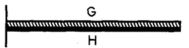
(62) As shown in the figure, a bimetallic strip, consisting of metal G on the top and metal H on the bottom, is rigidly attached to a wall at the left. The coefficient of linear thermal expansion for metal G is greater than that of metal H. If the strip is uniformly heated, it will
(Multiple Choice)
5.0/5 (89)
(89) For the mercury in a thermometer to expand from what change in temperature is necessary? The mercury has a volume expansion coefficient of
(Multiple Choice)
4.9/5 (84)
(84) The coefficient of linear expansion for aluminum is
What is its coefficient of volume expansion?
(Multiple Choice)
4.9/5 (87)
(87) A temperature change of corresponds to a Fahrenheit temperature change of
(Multiple Choice)
4.9/5 (77)
(77) At what, if any, temperature are the numerical readings on the Fahrenheit and Celsius scales the same?
(Multiple Choice)
4.9/5 (76)
(76) The temperature changes from during the night to during the day. What is the temperature change on the Celsius scale?
(Multiple Choice)
4.8/5 (72)
(72) What is the total translational kinetic energy of the gas in a classroom filled with nitrogen at The dimensions of the classroom are The Boltzmann constant is molecules/mol.
(Short Answer)
4.8/5 (71)
(71) Oxygen molecules are 16 times more massive than hydrogen molecules. At a given temperature, how do their average molecular speeds compare? The oxygen molecules are moving
(Multiple Choice)
4.8/5 (79)
(79) Consider two equal-volume flasks of gas at the same temperature and pressure. One gas, oxygen, has a molecular mass of 32 . The other gas, nitrogen, has a molecular mass of 28 . What is the ratio of the number of oxygen molecules to the number of nitrogen molecules in these flasks?
(Multiple Choice)
4.8/5 (70)
(70) The molecular weight of nitrogen, is 28 g/mol. What is the rms speed of nitrogen molecules in a cooler at The Boltzmann constant is molecules/mol.
(Multiple Choice)
4.8/5 (82)
(82) A sealed container holds 0.020 moles of ideal nitrogen gas, at a pressure of 1.5 atm and a temperature of 290 K. The atomic mass of nitrogen is 14.0 g/mol. What is the average translational kinetic energy of a nitrogen molecule? The Boltzmann constant is
(Multiple Choice)
4.9/5 (69)
(69) A solid object has a volume density at a temperature of 315K. The coefficient of volume expansion for the material of which it is made is What will be its density (in terms of at a temperature of 425 K, assuming that it does not melt and that its thermal properties do not change with temperature?
(Short Answer)
5.0/5 (71)
(71) A flask contains a mixture of argon and neon gases at a stabilized temperature. The root-mean-square speed of the argon gas is determined to be 1.21 km/s. What is the root-mean-square speed of the neon gas? The atomic mass of argon is 39.95 g/mol, and that of neon is 20.18 g/mol.
(Short Answer)
4.8/5 (82)
(82) A certain automobile tire has a volume of If the absolute (or total) pressure in the tire is 500 kPa and the temperature is 298 K, how many molecules are there inside the tire?
(Multiple Choice)
5.0/5 (90)
(90) A quantity of an ideal gas is kept in a rigid container of constant volume. If the gas is originally at a temperature of at what temperature will the pressure of the gas double from its original value?
(Multiple Choice)
4.8/5 (72)
(72) The absolute temperature of a gas is T. In order to double the rms speed of its molecules, what should be the new absolute temperature?
(Multiple Choice)
4.8/5 (74)
(74) A 4.2-L flask of ideal neon gas (which is monatomic) is at a pressure of 3.3 atm and a temperature of 450 K. The atomic mass of neon is 20.2 g/mol. How many neon atoms are in the flask?
(Multiple Choice)
4.8/5 (79)
(79) 
Filters
- Essay(0)
- Multiple Choice(0)
- Short Answer(0)
- True False(0)
- Matching(0)