



 Chat with AI
Exam 13: Temperature and Kinetic Theory

Exam 1: Introduction, Measurement, Estimating29 Questions
Exam 2: Describing Motion: Kinematics in One Dimension527 Questions
Exam 3: Kinematics in Two Dimensions; Vectors183 Questions
Exam 4: Dynamics: Newtons Laws of Motion146 Questions
Exam 5: Circular Motion; Gravitation105 Questions
Exam 6: Work and Energy153 Questions
Exam 7: Linear Momentum139 Questions
Exam 8: Rotational Motion148 Questions
Exam 9: Static Equilibrium; Elasticity and Fracture83 Questions
Exam 10: Fluids98 Questions
Exam 11: Oscillations and Waves114 Questions
Exam 12: Sound21 Questions
Exam 13: Temperature and Kinetic Theory87 Questions
Exam 14: Heat88 Questions
Exam 15: The Laws of Thermodynamics78 Questions
Exam 16: Electric Charge and Electric Field99 Questions
Exam 17: Electric Potential107 Questions
Exam 18: Electric Currents96 Questions
Exam 19: Dc Circuits384 Questions
Exam 20: Magnetism164 Questions
Exam 21: Electromagnetic Induction and Faradays Law60 Questions
Exam 22: Electromagnetic Waves167 Questions
Exam 23: Light: Geometric Optics144 Questions
Exam 24: The Wave Nature of Light58 Questions
Exam 25: Optical Instruments156 Questions
Exam 26: The Special Theory of Relativity126 Questions
Exam 27: Early Quantum Theory and Models of the Atom192 Questions
Exam 28: Quantum Mechanics of Atoms74 Questions
Exam 29: Molecules and Solids26 Questions
Exam 30: Nuclear Physics and Radioactivity153 Questions
Exam 31: Nuclear Energy; Effects and Uses of Radiation36 Questions
Exam 32: Elementary Particles19 Questions
Exam 33: Astrophysics and Cosmology25 Questions
Select questions type


If an ideal gas molecule has a speed of 0.50 km/s at what is its speed at
(Multiple Choice)
4.9/5  (79)
(79) Nitrogen boils at What is the corresponding temperature in the Fahrenheit scale?
(Multiple Choice)
4.8/5 (87)
(87) By what length will a slab of concrete that is originally 18 m long contract when the temperature drops from
The coefficient of linear thermal expansion for this concrete is
(Multiple Choice)
4.8/5 (72)
(72) At what temperature is the rms speed of hydrogen molecules, which have a molecular weight of 2.02 g/mole, equal to 2.0 km/s? The Boltzmann constant is molecules/mol.
(Multiple Choice)
4.8/5 (79)
(79) An ideal gas occupies At what temperature will it occupy if the pressure is held constant?
(Multiple Choice)
4.8/5 (88)
(88) How many molecules are in (a) of air at STP and (b) of helium at STP? (R
(Short Answer)
5.0/5 (68)
(68) A 24.0-L tank contains ideal helium gas at and a pressure of 22.0 atm. How many moles of gas are in the tank?
(Multiple Choice)
4.9/5 (85)
(85) The root-mean-square speed of the molecules of an ideal gas is v. The gas is now slowly compressed to one-half its original volume with no change in temperature. What is the
Root-mean-square speed of the molecules now?
(Multiple Choice)
4.8/5 (85)
(85) The coefficient of linear expansion of aluminum is \quad and the coefficient of volume
expansion of olive oil is . A novice cook, in preparation of some pesto, fills a 1.00-L
aluminum pot to the brim and heats the oil and the pot from an initial temperature of to
To his consternation some olive oil spills over the top. How much?
(Multiple Choice)
4.9/5 (77)
(77) A vertical cylinder, closed at the bottom end, contains 0.0100 mol of ideal gas. It is fitted at the top with a piston that can move freely. The mass of the piston is 14.0 kg and the initial height of the piston above the bottom of the cylinder is 25 cm. What is the temperature of the gas?
(Multiple Choice)
4.9/5 (85)
(85) An aluminum rod is 10.0 cm long and a steel rod is 80.0 cm long when both rods are at a temperature of Both rods have the same diameter. The rods are now joined end-to-end to form a rod 90.0 cm long. If the temperature is now raised from what is the increase in the length of the joined rod? The coefficient of linear expansion of aluminum is and that of steel is
(Multiple Choice)
4.9/5 (64)
(64) A jar holds 2.0 L of ideal nitrogen gas, at STP. The atomic mass of nitrogen is 14.0 g/mol, the ideal gas constant is Avogadro's number is and 1.00 atm=101 kPa
(a) How many moles of nitrogen are in the jar?
(b) How many nitrogen molecules are in the jar?
(c) What is the mass of the nitrogen in the jar?
(Short Answer)
4.9/5 (72)
(72) Platinum melts at What is the corresponding temperature in the Kelvin scale?
(Multiple Choice)
4.9/5 (73)
(73) The weather outside is frightful. The temperature is What is the corresponding temperature in the Celsius scale?
(Multiple Choice)
4.8/5 (74)
(74) An ideal gas is held in a container of volume V at pressure p . The rms speed of a gas molecule under these conditions is If now the volume and pressure are changed to 2 V and 2 p , the rms speed of a molecule will be
(Multiple Choice)
4.8/5 (79)
(79) The coefficient of linear expansion of copper is A block of copper 30 cm wide, 45 cm Iong, and 10 cm thick is heated from
What is the change in the volume of the block?
(Multiple Choice)
4.8/5 (69)
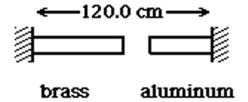
(69) A brass rod is 69.5 cm long and an aluminum rod is 49.3 cm long when both rods are at an initial temperature of The rods are placed in line with a gap of 1.2 cm between them, as shown in the figure. The distance between the far ends of the rods is maintained at 120.0 cm throughout. The temperature of both rods is raised equally until they are barely in contact. At what temperature does contact occur? The coefficients of linear expansion of brass and aluminum are
(Multiple Choice)
4.9/5 (77)
(77) A gas-filled vertical cylinder, closed at the bottom end, is fitted at the top with a piston that can move freely. The mass of the piston is 10.0 kg, and the initial height of the piston above the bottom of the cylinder is 25 cm. A mass of 8.0 kg is placed on the piston. What is the resulting height of the piston, assuming that the temperature of the ideal gas is kept constant?
(Multiple Choice)
4.8/5 (77)
(77) A 5.3 L flask of ideal neon gas (which is monatomic) is at a pressure of 6.0 atm and a temperature of 290 K. The atomic mass of neon is 20.2 g/mol. What is the mass of the neon gas in the flask.
(Multiple Choice)
4.8/5 (78)
(78) An oxygen molecule, falls in a vacuum. From what height must it fall so that its translational kinetic energy at the bottom of its fall equals the average translational kinetic energy of an oxygen molecule at 920 K? The mass of one molecule is and the Boltzmann constant is Neglect air resistance and assume that g remains constant at throughout the fall of the molecule.
(Multiple Choice)
4.9/5 (80)
(80) 
Filters
- Essay(0)
- Multiple Choice(0)
- Short Answer(0)
- True False(0)
- Matching(0)