



 Chat with AI
Exam 14: Heat

Exam 1: Introduction, Measurement, Estimating29 Questions
Exam 2: Describing Motion: Kinematics in One Dimension527 Questions
Exam 3: Kinematics in Two Dimensions; Vectors183 Questions
Exam 4: Dynamics: Newtons Laws of Motion146 Questions
Exam 5: Circular Motion; Gravitation105 Questions
Exam 6: Work and Energy153 Questions
Exam 7: Linear Momentum139 Questions
Exam 8: Rotational Motion148 Questions
Exam 9: Static Equilibrium; Elasticity and Fracture83 Questions
Exam 10: Fluids98 Questions
Exam 11: Oscillations and Waves114 Questions
Exam 12: Sound21 Questions
Exam 13: Temperature and Kinetic Theory87 Questions
Exam 14: Heat88 Questions
Exam 15: The Laws of Thermodynamics78 Questions
Exam 16: Electric Charge and Electric Field99 Questions
Exam 17: Electric Potential107 Questions
Exam 18: Electric Currents96 Questions
Exam 19: Dc Circuits384 Questions
Exam 20: Magnetism164 Questions
Exam 21: Electromagnetic Induction and Faradays Law60 Questions
Exam 22: Electromagnetic Waves167 Questions
Exam 23: Light: Geometric Optics144 Questions
Exam 24: The Wave Nature of Light58 Questions
Exam 25: Optical Instruments156 Questions
Exam 26: The Special Theory of Relativity126 Questions
Exam 27: Early Quantum Theory and Models of the Atom192 Questions
Exam 28: Quantum Mechanics of Atoms74 Questions
Exam 29: Molecules and Solids26 Questions
Exam 30: Nuclear Physics and Radioactivity153 Questions
Exam 31: Nuclear Energy; Effects and Uses of Radiation36 Questions
Exam 32: Elementary Particles19 Questions
Exam 33: Astrophysics and Cosmology25 Questions
Select questions type


Object 1 has three times the specific heat capacity and four times the mass of Object 2. The two objects are given the same amount of heat. If the temperature of Object 1 changes by an amount the change in temperature of Object 2 will be
(Multiple Choice)
4.7/5  (87)
(87) The figure shows a graph of the temperature of a pure substance as a function of time as heat is added to it at a constant rate in a closed container. If is the latent heat of fusion of this substance and is its latent heat of vaporization, what is the value of the ratio
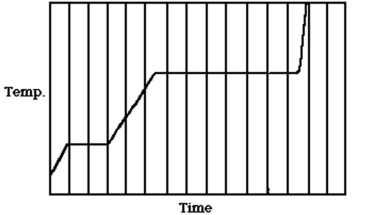
(Multiple Choice)
4.8/5 (87)
(87) A 600-g piece of iron at is dropped into a calorimeter of negligible heat capacity
containing 100 g of ice at and 120 g of water, also at What is the final temperature
of the system? The specific heat of iron is the latent heat of fusion of water is
and the specific heat of water is
(Essay)
4.7/5 (87)
(87) A blacksmith is flattening a steel plate having dimensions
He has heated the plate to 900 K. If the emissivity of the plate is 0.75 , at what rate does it lose energy by radiation? Ignore any heat exchange with the surroundings.
(Multiple Choice)
4.8/5 (86)
(86) A lab assistant pours 330 g of water at into an 855-g aluminum container that is at an initial temperature of The specific heat of aluminum is and that of water is What is the final temperature of the system, assuming no heat is exchanged with the surroundings?
(Multiple Choice)
4.9/5 (68)
(68) A person is walking outdoors on a cold day when the temperature is He is breathing at the rate of 16 breaths per minute, and each time he breathes in he inhales of air. At what rate does he lose heat from breathing if the air in his lungs is heated to body temperature before it is exhaled? The specific heat of air is and the density of air is
(Multiple Choice)
5.0/5 (80)
(80) A metal has a latent heat of fusion of a specific heat of and a melting point of A 30-g pellet of this metal at hits a solid wall and comes to a complete stop. What would the speed of the pellet have to be in order for it to melt completely when it hits the wall, assuming that all of its kinetic energy is transformed into heat within the pellet?
(Multiple Choice)
4.8/5 (81)
(81) In grinding a steel knife, the metal can get as hot as If the blade has a mass of 80 g, what is the minimum amount of water needed at if the water is to remain liquid and not rise above when the hot blade is quenched in it? The specific heat of the steel is and the specific heat of water is
(Multiple Choice)
4.7/5 (85)
(85) 
Filters
- Essay(0)
- Multiple Choice(0)
- Short Answer(0)
- True False(0)
- Matching(0)