



 Chat with AI
Exam 14: Heat

Exam 1: Introduction, Measurement, Estimating29 Questions
Exam 2: Describing Motion: Kinematics in One Dimension527 Questions
Exam 3: Kinematics in Two Dimensions; Vectors183 Questions
Exam 4: Dynamics: Newtons Laws of Motion146 Questions
Exam 5: Circular Motion; Gravitation105 Questions
Exam 6: Work and Energy153 Questions
Exam 7: Linear Momentum139 Questions
Exam 8: Rotational Motion148 Questions
Exam 9: Static Equilibrium; Elasticity and Fracture83 Questions
Exam 10: Fluids98 Questions
Exam 11: Oscillations and Waves114 Questions
Exam 12: Sound21 Questions
Exam 13: Temperature and Kinetic Theory87 Questions
Exam 14: Heat88 Questions
Exam 15: The Laws of Thermodynamics78 Questions
Exam 16: Electric Charge and Electric Field99 Questions
Exam 17: Electric Potential107 Questions
Exam 18: Electric Currents96 Questions
Exam 19: Dc Circuits384 Questions
Exam 20: Magnetism164 Questions
Exam 21: Electromagnetic Induction and Faradays Law60 Questions
Exam 22: Electromagnetic Waves167 Questions
Exam 23: Light: Geometric Optics144 Questions
Exam 24: The Wave Nature of Light58 Questions
Exam 25: Optical Instruments156 Questions
Exam 26: The Special Theory of Relativity126 Questions
Exam 27: Early Quantum Theory and Models of the Atom192 Questions
Exam 28: Quantum Mechanics of Atoms74 Questions
Exam 29: Molecules and Solids26 Questions
Exam 30: Nuclear Physics and Radioactivity153 Questions
Exam 31: Nuclear Energy; Effects and Uses of Radiation36 Questions
Exam 32: Elementary Particles19 Questions
Exam 33: Astrophysics and Cosmology25 Questions
Select questions type


An aluminum electric tea kettle with a mass of 500 g is heated with a 500 -W heating coil. How Iong will it take to heat up 1.0 kg of water from in the tea kettle? The specific heat of aluminum is 900 and that of water is 4186
(Multiple Choice)
5.0/5  (71)
(71) 11A 90-g aluminum calorimeter contains 390 g of water at an equilibrium temperature of A 160-g piece of metal, initially at is added to the calorimeter. The final temperature at equilibrium is Assume there is no external heat exchange. The specific heat capacities of aluminum and water are 910 (aluminum) and 4190 (water). What is the specific heat capacity of the 160-\mathrm{g} piece of metal?
(Multiple Choice)
4.9/5 (95)
(95) How much heat must be added to a 8.0 -kg block of ice at to change it to water at The
specific heat of ice is the specific heat of water is the latent heat of fusion of ice is 334,000 J/kg, and 1cal=4.186 J.
(Multiple Choice)
4.7/5 (62)
(62) A 400-g block of iron at is dropped into a calorimeter (of negligible heat capacity) containing 60 g of water at How much steam is produced? The latent heat of vaporization of water is J/kg and its specific heat capacity is 4186 The average specific heat of iron over this temperature range is
(Multiple Choice)
4.9/5 (86)
(86) A concrete wall of a cold storage room measures 3.0 m high, 5.0 m wide, and 20 cm thick. The inside wall is to be covered by a layer of wood in order to reduce the rate of heat flow through the wall by 90 percent. The inner surface of the wooden wall is maintained at and the outer surface of the concrete wall is at The thermal conductivities of concrete and wood are 0.80 (concrete) and 0.040 (wood). What should be the thickness of the layer of wood?
(Multiple Choice)
4.8/5 (90)
(90) Object 1 has three times the specific heat capacity and four times the mass of Object 2 . The two objects are heated from the same initial temperature, to the same final temperature During this process, if Object 1 absorbs heat Q , the amount of heat absorbed by Object 2 will be
(Multiple Choice)
4.9/5 (83)
(83) A heat conducting rod, 1.60 m Iong and wrapped in insulation, is made of an aluminum section
that is 0.90 m long and a copper section that is 0.70 m long. Both sections have a cross-sectional
area of The aluminum end and the copper end are maintained at temperatures of
Respectively. The thermal conductivities of aluminum and copper are 205 W/m . K (aluminum) and At what rate is heat conducted in the rod under state conditions?
(Multiple Choice)
4.9/5 (75)
(75) If you add 700 kJ of heat to 700 g of water originally at how much water is left in the container? The latent heat of vaporization of water is and its specific heat capacity is
(Multiple Choice)
4.9/5 (73)
(73) When 50 g of a certain material at is mixed with 100 g of water at the final temperature is What is the specific heat of the material? The specific heat of water is
(Multiple Choice)
4.8/5 (87)
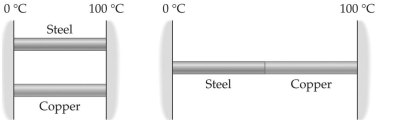
(87) Two metal rods are to be used to conduct heat from a region at to a region at as shown in the figure. The rods can be placed in parallel, as shown on the left, or in series, as on the right. When steady state flow is established, the heat conducted in the series arrangement is
(Multiple Choice)
4.8/5 (73)
(73) A 35-g block of ice at - is dropped into a calorimeter (of negligible heat capacity) containing 400 g of water at When the system reaches equilibrium, how much ice is left in the calorimeter? The specific heat of ice is that of water is and the latent heat of fusion of water is
(Multiple Choice)
4.9/5 (78)
(78) A rod, with sides insulated to prevent heat loss, has one end immersed in boiling water at and the other end in a water-ice mixture at The rod has uniform cross-sectional area and length 87 cm. The heat conducted by the rod melts the ice at a rate of 1.0 g every 11 seconds. What is the thermal conductivity of the rod? Recall that the heat of fusion of water is
(Short Answer)
4.9/5 (74)
(74) A person tries to heat up her bath water by adding 5.0 L of water at to 60 L of water at What is the final temperature of the bath water?
(Multiple Choice)
4.8/5 (73)
(73) Some properties of a certain glass are listed here:
Density
Specific heat capacity
Coefficient of thermal expansion
Thermal conductivity
A glass window pane is 2.7 m high, 2.4 m wide, and 9.0 mm thick. The temperature at the inner surface of the glass is and at the outer surface How much heat is lost each hour through the window?
(Multiple Choice)
4.9/5 (69)
(69) If 150 kcal of heat raises the temperature of 2.0 kg of a material by 400 F°, what is the specific heat capacity of the material?
(Multiple Choice)
4.7/5 (92)
(92) A lab assistant drops a 400.0-g piece of metal at into a 100.0-g aluminum cup containing 500.0 g of water at In a few minutes, she measures the final temperature of the system to be What is the specific heat of the 400.0-g piece of metal, assuming that no significant heat is exchanged with the surroundings? The specific heat of this aluminum is and that of water is
(Multiple Choice)
4.8/5 (92)
(92) A runner generates 1260 W of thermal energy. If this heat has to be removed only by evaporation, how much water does this runner lose in 15 minutes of running? The latent heat of vaporization of water is
(Multiple Choice)
4.9/5 (70)
(70) The melting point of aluminum is its latent heat of fusion is and its specific heat is How much heat must be added to 500 g of aluminum at to completely melt it?
(Multiple Choice)
4.8/5 (82)
(82) A substance has a melting point of and a heat of fusion of The boiling point is and the heat of vaporization is at a pressure of one atmosphere. The specific heats for the solid, liquid, and gaseous phases are 600 and 400 How much heat is required to raise the temperature of 1.90 kg of this substance from at a pressure of one atmosphere?
(Multiple Choice)
4.9/5 (69)
(69) A camper is about to drink his morning coffee. He pours 400 grams of coffee, initially at into a 250-g aluminum cup, initially at What is the equilibrium temperature of the coffee-cup system, assuming no heat is lost to the surroundings? The specific heat of aluminum is 900 and the specific heat of coffee is essentially the same as that of water, which is
(Multiple Choice)
4.8/5 (62)
(62) 
Filters
- Essay(0)
- Multiple Choice(0)
- Short Answer(0)
- True False(0)
- Matching(0)