



 Chat with AI
Exam 15: The Laws of Thermodynamics

Exam 1: Introduction, Measurement, Estimating29 Questions
Exam 2: Describing Motion: Kinematics in One Dimension527 Questions
Exam 3: Kinematics in Two Dimensions; Vectors183 Questions
Exam 4: Dynamics: Newtons Laws of Motion146 Questions
Exam 5: Circular Motion; Gravitation105 Questions
Exam 6: Work and Energy153 Questions
Exam 7: Linear Momentum139 Questions
Exam 8: Rotational Motion148 Questions
Exam 9: Static Equilibrium; Elasticity and Fracture83 Questions
Exam 10: Fluids98 Questions
Exam 11: Oscillations and Waves114 Questions
Exam 12: Sound21 Questions
Exam 13: Temperature and Kinetic Theory87 Questions
Exam 14: Heat88 Questions
Exam 15: The Laws of Thermodynamics78 Questions
Exam 16: Electric Charge and Electric Field99 Questions
Exam 17: Electric Potential107 Questions
Exam 18: Electric Currents96 Questions
Exam 19: Dc Circuits384 Questions
Exam 20: Magnetism164 Questions
Exam 21: Electromagnetic Induction and Faradays Law60 Questions
Exam 22: Electromagnetic Waves167 Questions
Exam 23: Light: Geometric Optics144 Questions
Exam 24: The Wave Nature of Light58 Questions
Exam 25: Optical Instruments156 Questions
Exam 26: The Special Theory of Relativity126 Questions
Exam 27: Early Quantum Theory and Models of the Atom192 Questions
Exam 28: Quantum Mechanics of Atoms74 Questions
Exam 29: Molecules and Solids26 Questions
Exam 30: Nuclear Physics and Radioactivity153 Questions
Exam 31: Nuclear Energy; Effects and Uses of Radiation36 Questions
Exam 32: Elementary Particles19 Questions
Exam 33: Astrophysics and Cosmology25 Questions
Select questions type


If the efficiency of a Carnot engine were to be , the heat sink would have to be
(Multiple Choice)
5.0/5  (73)
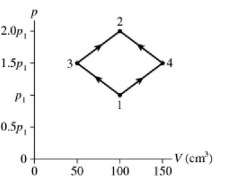
(73) The figure shows a diagram for of ideal nitrogen gas in a sealed container. The temperature of state 1 is , the atomic mass of the nitrogen atom is , and - K. What are (a) pressure and (b) temperature ?
(Multiple Choice)
4.9/5 (84)
(84) A 40.0-L container is divided into two equal parts by a rubber membrane. One half of the container has moles of an ideal monatomic gas at , and the other half is a vacuum. The container is well insulated, so there is no exchange of heat with the surroundings. The membrane breaks, and eventually the gas reaches a new equilibrium condition occupying the entire volume. What is the final temperature of the gas?
(Multiple Choice)
4.9/5 (90)
(90) What is the change in entropy of the ice when a ice cube at melts? The latent heat of fusion for water is .
(Short Answer)
4.9/5 (91)
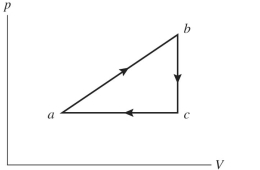
(91) An ideal gas undergoes the process shown in the diagram. In the figure, , and . How much heat is gained by the gas in this process?
(Multiple Choice)
5.0/5 (83)
(83) On a cold winter day, the outside temperature is and the inside temperature is maintained at . There is a net heat flow to the outside through the walls, roof, etc., of . At what rate is the entropy of the air outside the house changing as a result of this process?
(Multiple Choice)
4.9/5 (70)
(70) A heat engine has an efficiency of 35.0% and receives 150 J of heat per cycle.
(a) How much work does it do in each cycle?
(b) How much heat does it "waste" in each cycle?
(Short Answer)
4.9/5 (78)
(78) 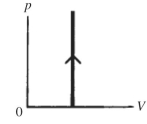
The figure shows a diagram of a gas for a complete cycle. During part of the cycle, of heat flows into a system, and at the same time the system expands against a constant external pressure of as its volume increases from to . Calculate the change in internal (thermal) energy of the system during part of the cycle. If the change is nonzero, be sure to indicate whether the change is positive or negative.
(Short Answer)
4.7/5 (81)
(81) An ideal Carnot engine operates between a warm reservoir at and a colder reservoir. During each cycle, this engine extracts of heat from the warm reservoir and does of work. What is the temperature of the colder reservoir?
(Multiple Choice)
4.8/5 (92)
(92) A 0.42-kg quantity of ethanol, in the liquid state at its melting point of , is frozen at atmospheric pressure. The heat of fusion of ethanol is , and its molecular mass is . What is the change in the entropy of the ethanol as it freezes?
(Multiple Choice)
5.0/5 (71)
(71) During each cycle, a heat engine takes in 4.0 J of heat, does 1.0 J of work, and expels 3.0 J
of heat. What is its efficiency?
(Short Answer)
4.9/5 (65)
(65) A heat engine absorbs 64 kcal of heat each cycle and exhausts 42 kcal.
(a) What is the efficiency of this engine?
(b) How much work does this engine do per cycle?
(Short Answer)
4.8/5 (81)
(81) An ideal gas undergoes an isothermal expansion. During this process, its entropy
(Multiple Choice)
4.8/5 (74)
(74) An ideal Carnot engine operates between a high temperature reservoir at and a river with water at . If it absorbs of heat each cycle, how much work per cycle does it perform?
(Multiple Choice)
4.9/5 (80)
(80) During an isothermal process, of heat is removed from an ideal gas. What is the change in internal (thermal) energy of the gas?
(Multiple Choice)
4.8/5 (71)
(71) When of steam at condenses to water at , what is the change in entropy of the steam? The latent heat of vaporization of water is .
(Multiple Choice)
4.8/5 (76)
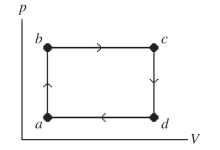
(76) A gas is taken through the cycle shown in the diagram in the figure. During one cycle, how much work is done by the gas?
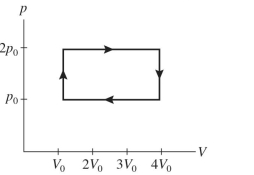
(Multiple Choice)
4.9/5 (77)
(77) 
Filters
- Essay(0)
- Multiple Choice(0)
- Short Answer(0)
- True False(0)
- Matching(0)