



 Chat with AI
Exam 15: The Laws of Thermodynamics

Exam 1: Introduction, Measurement, Estimating29 Questions
Exam 2: Describing Motion: Kinematics in One Dimension527 Questions
Exam 3: Kinematics in Two Dimensions; Vectors183 Questions
Exam 4: Dynamics: Newtons Laws of Motion146 Questions
Exam 5: Circular Motion; Gravitation105 Questions
Exam 6: Work and Energy153 Questions
Exam 7: Linear Momentum139 Questions
Exam 8: Rotational Motion148 Questions
Exam 9: Static Equilibrium; Elasticity and Fracture83 Questions
Exam 10: Fluids98 Questions
Exam 11: Oscillations and Waves114 Questions
Exam 12: Sound21 Questions
Exam 13: Temperature and Kinetic Theory87 Questions
Exam 14: Heat88 Questions
Exam 15: The Laws of Thermodynamics78 Questions
Exam 16: Electric Charge and Electric Field99 Questions
Exam 17: Electric Potential107 Questions
Exam 18: Electric Currents96 Questions
Exam 19: Dc Circuits384 Questions
Exam 20: Magnetism164 Questions
Exam 21: Electromagnetic Induction and Faradays Law60 Questions
Exam 22: Electromagnetic Waves167 Questions
Exam 23: Light: Geometric Optics144 Questions
Exam 24: The Wave Nature of Light58 Questions
Exam 25: Optical Instruments156 Questions
Exam 26: The Special Theory of Relativity126 Questions
Exam 27: Early Quantum Theory and Models of the Atom192 Questions
Exam 28: Quantum Mechanics of Atoms74 Questions
Exam 29: Molecules and Solids26 Questions
Exam 30: Nuclear Physics and Radioactivity153 Questions
Exam 31: Nuclear Energy; Effects and Uses of Radiation36 Questions
Exam 32: Elementary Particles19 Questions
Exam 33: Astrophysics and Cosmology25 Questions
Select questions type


A gas expands from an initial volume of to a final volume of while its pressure increases linearly with the volume (so that the process follows a straight-line path in a diagram) from to . How much work is done by the gas during this expansion?
(Multiple Choice)
4.7/5  (94)
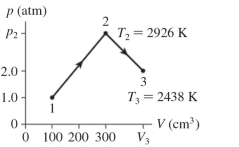
(94) The figure shows a diagram for mol of ideal gas that undergoes the process . What is the volume ?
(atm)
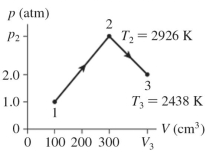
(Multiple Choice)
4.8/5 (74)
(74) A gas follows the trajectory shown in Figure 16.2. How much work is done per cycle by the gas if The gas in a heat engine follows the cycle shown in the diagram. How much work does this engine do each cycle if atm?
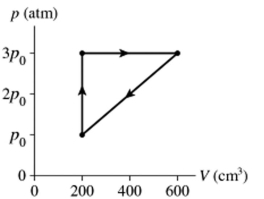
(Multiple Choice)
4.8/5 (89)
(89) The figure shows a diagram for a cycle of a heat engine for which . What is the thermal efficiency of the engine?
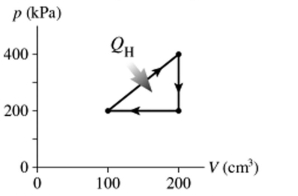
(Multiple Choice)
4.8/5 (74)
(74) An irreversible engine operating between the temperatures of and extracts of heat from the hot reservoir and produces of work. How much entropy is created in the process?
(Multiple Choice)
4.7/5 (74)
(74) A 10-L flask and a 1-L flask each contain two moles of ideal diatomic gas (but not the same gas) at . Which of the following statements about these gases must be true? (There could be more than one correct choice.)
(Multiple Choice)
4.9/5 (72)
(72) A cyclic process is carried out on an ideal gas such that it returns to its initial state at the end of a cycle, as shown in the diagram in the figure. If the process is carried out in a counter-clockwise sense around the enclosed area, as shown on the figure, then the magnitude of the enclosed area represents
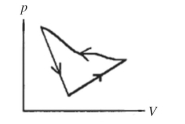
(Multiple Choice)
4.8/5 (61)
(61) A refrigerator has a performance coefficient (COP) of , and it extracts of heat from the cold reservoir during each cycle.
(a) How much work is done on the gas in each cycle?
(b) How much heat is exhausted into the hot reservoir in each cycle?
(Short Answer)
4.8/5 (69)
(69) A heat engine has an efficiency of 31.4% and receives 8.72 kJ of heat per cycle.
(a) How much work does it perform in each cycle?
(b) How much heat does it exhaust in each cycle?
(Short Answer)
4.8/5 (83)
(83) An ideal Carnot engine operating between a warm reservoir of unknown temperature and a cold reservoir at has an efficiency of . What is the temperature of the warm reservoir?
(Multiple Choice)
5.0/5 (68)
(68) What is the entropy change of of water when it changes from (a) liquid to steam at its usual boiling point and (b) ice to liquid at its usual melting point? For water, .
(Short Answer)
4.9/5 (99)
(99) The figure shows a diagram for mol of ideal gas that undergoes the process . What is the pressure
(atm)
(Multiple Choice)
4.7/5 (77)
(77) For a certain ideal Carnot engine, the hot reservoir is higher than the cold reservoir. If this engine is to have an efficiency of , what must be the temperature of the hot reservoir?
(Multiple Choice)
4.9/5 (76)
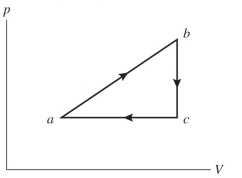
(76) An ideal gas undergoes the process shown in the diagram. The heat gained by the gas in process is , while in process the gas loses of heat. In process the gas performs of work, while in process of work is done on the gas. How much heat is gained by the gas in process ?
(Multiple Choice)
4.7/5 (83)
(83) Two ideal Carnot heat engines have the same efficiency. One operates between and , and the other between and some lower temperature. What is the lower temperature?
(Multiple Choice)
4.9/5 (89)
(89) A compression at a constant pressure of is performed on moles of an ideal monatomic gas. The compression reduces the volume of the gas from to . How much work was done by the gas during this process?
(Multiple Choice)
4.8/5 (72)
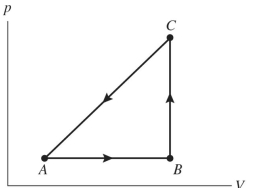
(72) The figure shows a diagram for a gas going through a cycle from to to and back to A. From point to point , the gas absorbs of heat and finds its internal (thermal) energy has increased by . Going from B to , the internal (thermal) energy decreases by .
(a) How much work was done by the gas from to ?
(b) How much heat was absorbed by the gas from to ?
(c) How much work was done by the gas going from to ?
(Short Answer)
4.8/5 (86)
(86) A certain automobile engine takes in 4.00 kJ of heat and performs 1.10 kJ of mechanical
work in each cycle.
(a) Calculate the engine's efficiency.
(b) How much heat is "wasted" in each cycle?
(Short Answer)
4.9/5 (77)
(77) A Carnot engine operates between two reservoirs with unknown temperatures. If the Carnot engine operates at efficiency, what is the ratio of the absolute temperatures of the reservoirs, ?
(Multiple Choice)
4.9/5 (80)
(80) 
Filters
- Essay(0)
- Multiple Choice(0)
- Short Answer(0)
- True False(0)
- Matching(0)