



 Chat with AI
Exam 26: The Special Theory of Relativity

Exam 1: Introduction, Measurement, Estimating29 Questions
Exam 2: Describing Motion: Kinematics in One Dimension527 Questions
Exam 3: Kinematics in Two Dimensions; Vectors183 Questions
Exam 4: Dynamics: Newtons Laws of Motion146 Questions
Exam 5: Circular Motion; Gravitation105 Questions
Exam 6: Work and Energy153 Questions
Exam 7: Linear Momentum139 Questions
Exam 8: Rotational Motion148 Questions
Exam 9: Static Equilibrium; Elasticity and Fracture83 Questions
Exam 10: Fluids98 Questions
Exam 11: Oscillations and Waves114 Questions
Exam 12: Sound21 Questions
Exam 13: Temperature and Kinetic Theory87 Questions
Exam 14: Heat88 Questions
Exam 15: The Laws of Thermodynamics78 Questions
Exam 16: Electric Charge and Electric Field99 Questions
Exam 17: Electric Potential107 Questions
Exam 18: Electric Currents96 Questions
Exam 19: Dc Circuits384 Questions
Exam 20: Magnetism164 Questions
Exam 21: Electromagnetic Induction and Faradays Law60 Questions
Exam 22: Electromagnetic Waves167 Questions
Exam 23: Light: Geometric Optics144 Questions
Exam 24: The Wave Nature of Light58 Questions
Exam 25: Optical Instruments156 Questions
Exam 26: The Special Theory of Relativity126 Questions
Exam 27: Early Quantum Theory and Models of the Atom192 Questions
Exam 28: Quantum Mechanics of Atoms74 Questions
Exam 29: Molecules and Solids26 Questions
Exam 30: Nuclear Physics and Radioactivity153 Questions
Exam 31: Nuclear Energy; Effects and Uses of Radiation36 Questions
Exam 32: Elementary Particles19 Questions
Exam 33: Astrophysics and Cosmology25 Questions
Select questions type


An unstable particle is moving at a speed of relative to a laboratory. Its lifetime is measured by a stationary observer in the laboratory to be . What is the lifetime of the particle as measured in the rest frame of the particle?
(Short Answer)
4.7/5  (73)
(73) Two stars are at rest relative to each other. A spaceship is moving between these two stars at 0.932c relative to each star. To someone in the ship, the distance between the two stars appears to be
26)4 light-years. What is the distance between the stars in their own rest frame?
(Multiple Choice)
4.8/5 (65)
(65) What is the total energy of an electron moving with a speed of )
(Multiple Choice)
4.8/5 (75)
(75) A starship is constructed to be 100 m long in the factory. It is launched and as it coasts by
Earth, it is measured to be shortened to 5.48 m long.
(a) How fast, in terms of the speed of light, is it moving past Earth?
(b) What length does the ship's crew measure for the ship?
(Short Answer)
4.8/5 (75)
(75) A aluminum ingot is heated from to . By what amount does its mass change? The specific heat of aluminum is
(Multiple Choice)
4.8/5 (87)
(87) A 30-year-old astronaut goes off on a long-term mission in a spacecraft that travels at speeds close to that of light. The mission lasts exactly 20 years as measured on Earth. Biologically speaking, at the end of the mission, the astronaut's age would be
(Multiple Choice)
4.9/5 (71)
(71) An electron has a speed of 0.783c. Through what potential difference would the electron need to be accelerated from rest in order to reach this speed? The rest mass energy of an electron is 0.511
MeV)
(Multiple Choice)
4.8/5 (82)
(82) A spaceship is moving away from an asteroid with a speed of 0.80c relative to the asteroid. The spaceship then fires a missile with a speed of 0.50c relative to the spaceship. What is the speed of
The missile measured by astronauts on the asteroid if the missile is fired away from the asteroid?
(Multiple Choice)
4.9/5 (88)
(88) How many joules of energy are required to accelerate a rock from rest to a speed of ? ( )
(Multiple Choice)
4.9/5 (77)
(77) If the kinetic energy of a particle is times its rest energy, the speed of the particle is closest to which of the following values?
(Multiple Choice)
4.8/5 (74)
(74) How much work must be done to accelerate a particle of mass from a speed of to a speed of ?
(Short Answer)
4.7/5 (72)
(72) The figure shows a right-angled construction frame . When measured at rest, it has dimensions as follows: , and . This frame is now given a new velocity of c, relative to Earth, in a direction parallel to AC. How long is part AC of this frame with the new velocity as measured by Earth-based engineers?
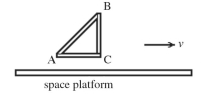
(Multiple Choice)
4.9/5 (89)
(89) Two spaceships, each 100 m long in its own rest frame, approach Earth from opposite directions, each with a speed 0.50c relative to Earth. As measured by a passenger in one of the spaceships,
How long is the other spaceship?
(Multiple Choice)
4.8/5 (80)
(80) A certain unstable particle has a mean lifetime of . This is the time interval between its creation in a nuclear process and its extinction into decay products, as measured in a frame of reference at rest with respect to the particle. An average such particle is observed by a scientist on Earth to travel in its lifetime. What is the speed of the particle relative to Earth? )
(Multiple Choice)
4.8/5 (81)
(81) When a proton is traveling at 0.80c, what is the ratio of its kinetic energy to its rest energy?
(Multiple Choice)
4.9/5 (79)
(79) The total energy of a moving electron is . What is the speed of the electron in terms of ? The rest mass energy of an electron is .
(Multiple Choice)
4.9/5 (69)
(69) A spaceship traveling at constant velocity passes by Earth and later passes by Mars. In which frame of reference is the amount of time separating these two events the proper time?
(Multiple Choice)
4.8/5 (93)
(93) One 20-year-old twin brother takes a space trip with a speed of 0.80c for 30 years according to a clock on his spaceship. At the end of this trip, what are (a) his own age and (b) the age of his
Earth-based twin brother?
(Multiple Choice)
4.9/5 (74)
(74) A spacecraft is measured by a scientist on the ground to have a length of as it flies overhead with a speed . The spacecraft then lands and its length is again measured by the scientist at rest on the ground. What result does he now get for the Iength of the spacecraft?
(Short Answer)
4.8/5 (82)
(82) A proton, which has a mass of , is moving at relative to the laboratory. What does a physicist in that lab measure for its momentum?
(Multiple Choice)
4.7/5 (64)
(64) 
Filters
- Essay(0)
- Multiple Choice(0)
- Short Answer(0)
- True False(0)
- Matching(0)