



 Chat with AI
Exam 26: The Special Theory of Relativity

Exam 1: Introduction, Measurement, Estimating29 Questions
Exam 2: Describing Motion: Kinematics in One Dimension527 Questions
Exam 3: Kinematics in Two Dimensions; Vectors183 Questions
Exam 4: Dynamics: Newtons Laws of Motion146 Questions
Exam 5: Circular Motion; Gravitation105 Questions
Exam 6: Work and Energy153 Questions
Exam 7: Linear Momentum139 Questions
Exam 8: Rotational Motion148 Questions
Exam 9: Static Equilibrium; Elasticity and Fracture83 Questions
Exam 10: Fluids98 Questions
Exam 11: Oscillations and Waves114 Questions
Exam 12: Sound21 Questions
Exam 13: Temperature and Kinetic Theory87 Questions
Exam 14: Heat88 Questions
Exam 15: The Laws of Thermodynamics78 Questions
Exam 16: Electric Charge and Electric Field99 Questions
Exam 17: Electric Potential107 Questions
Exam 18: Electric Currents96 Questions
Exam 19: Dc Circuits384 Questions
Exam 20: Magnetism164 Questions
Exam 21: Electromagnetic Induction and Faradays Law60 Questions
Exam 22: Electromagnetic Waves167 Questions
Exam 23: Light: Geometric Optics144 Questions
Exam 24: The Wave Nature of Light58 Questions
Exam 25: Optical Instruments156 Questions
Exam 26: The Special Theory of Relativity126 Questions
Exam 27: Early Quantum Theory and Models of the Atom192 Questions
Exam 28: Quantum Mechanics of Atoms74 Questions
Exam 29: Molecules and Solids26 Questions
Exam 30: Nuclear Physics and Radioactivity153 Questions
Exam 31: Nuclear Energy; Effects and Uses of Radiation36 Questions
Exam 32: Elementary Particles19 Questions
Exam 33: Astrophysics and Cosmology25 Questions
Select questions type


A spaceship, traveling at 0.560c towards a stationary space platform, launches a secondary towards the station with a speed of 0.100c relative to the spaceship. What is the speed of the
Secondary rocket relative to the space platform?
(Multiple Choice)
4.9/5  (75)
(75) The figure shows a right-angled construction frame . When measured at rest, it has dimensions as follows: , and . This frame is now given a new velocity of c, relative to Earth, in a direction parallel to . How long is part of this frame with the new velocity as measured by Earth-based engineers? 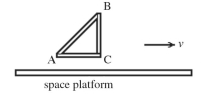
(Multiple Choice)
4.8/5 (75)
(75) A satellite with a rest mass of 200 kg and a speed of 0.800c and a second satellite with a rest mass of 100 kg and a speed of 0.600c are traveling toward each other in deep space. The satellites collide
And somehow manage to stick together. What is the rest mass of the combined object after the
Collision?
(Multiple Choice)
4.8/5 (82)
(82) How many MeV of energy is released during a reaction in which of material is converted to energy?
(Multiple Choice)
4.9/5 (95)
(95) Two stars are at rest relative to each other. In their common rest frame, these stars are 90.0 light-years apart. If they are measured to be 68.7 light-years apart by the navigator of a spaceship
Traveling between them, how fast is the spaceship moving relative to these stars?
(Multiple Choice)
4.8/5 (93)
(93) An electron-volt is the energy gained by an electron if it is accelerated through a potential difference of one volt. What is the equivalent to an electron-volt in kilograms? )
(Short Answer)
4.9/5 (67)
(67) The energy released by a certain reaction is enough to totally evaporate of water at its boiling point. How much mass was lost during this reaction? for water, )
(Short Answer)
4.7/5 (70)
(70) Consider a student whose mass is . If all his mass were converted to electrical energy, for how many years could he keep a light bulb burning?
(Short Answer)
4.9/5 (88)
(88) One of the first atomic bombs released energy equivalent to that of 20,000 tons of TNT explosive. How much mass was converted to energy by this explosion, given that 1000 tons of TNT produce of energy. Incidentally, modern -bombs have energy yields 1000 times as much!
(Short Answer)
4.9/5 (82)
(82) One of Einstein's postulates in formulating the special theory of relativity was that the laws of physics are the same in reference frames that
(Multiple Choice)
4.9/5 (73)
(73) A person in a rocket ship traveling past the earth at a speed of 0.500c fires a laser gun in
the forward direction. With what speed does an observer on Earth measure for the light
pulse?
(Short Answer)
4.9/5 (81)
(81) If, instead of the correct formula for kinetic energy, we carelessly use the classical expression for kinetic energy for a particle moving at half the speed of light, by what magnitude percent will our calculation be in error?
(Multiple Choice)
4.8/5 (83)
(83) A muon at rest decays in s. Moving at the speed of light, it would be seen to "live" for how long?
(Short Answer)
4.8/5 (78)
(78) What is the momentum of a proton when it is moving with a speed of ? 

(Multiple Choice)
4.9/5 (81)
(81) A pion is an unstable particle that has a mean lifetime of . This is the time interval between its creation in a nuclear process and its extinction into decay products, as measured in a frame of reference at rest with respect to the pion. An average pion is traveling at relative to Earth. How far does it travel in its lifetime, relative to Earth?
(Multiple Choice)
4.8/5 (83)
(83) Calculate the speed at which a object has the same momentum as a object that is moving .
(Multiple Choice)
4.9/5 (72)
(72) Two satellites with equal rest masses of 100 kg are traveling toward each other in deep space. They have identical speeds of 0.600c. The satellites collide and somehow manage to stick together. What
Is the rest mass of the combined object after the collision?
(Multiple Choice)
4.7/5 (80)
(80) At age 21, you set out for a star that is 50 light-years from Earth. How fast would your spaceship have to travel in order to reach that star when you are 61 years old? One light-year is the distance light travels in one year.
(Multiple Choice)
4.9/5 (80)
(80) Two spaceships, each 100 m long in its own rest frame, approach Earth from opposite directions, with equal speeds relative to Earth. As measured by a passenger in one of the spaceships, the other
Spaceship is 96 m long. What is the speed of the spaceships relative to Earth?
(Multiple Choice)
4.8/5 (81)
(81) 
Filters
- Essay(0)
- Multiple Choice(0)
- Short Answer(0)
- True False(0)
- Matching(0)