



 Chat with AI
Exam 8: Rotational Motion

Exam 1: Introduction, Measurement, Estimating29 Questions
Exam 2: Describing Motion: Kinematics in One Dimension527 Questions
Exam 3: Kinematics in Two Dimensions; Vectors183 Questions
Exam 4: Dynamics: Newtons Laws of Motion146 Questions
Exam 5: Circular Motion; Gravitation105 Questions
Exam 6: Work and Energy153 Questions
Exam 7: Linear Momentum139 Questions
Exam 8: Rotational Motion148 Questions
Exam 9: Static Equilibrium; Elasticity and Fracture83 Questions
Exam 10: Fluids98 Questions
Exam 11: Oscillations and Waves114 Questions
Exam 12: Sound21 Questions
Exam 13: Temperature and Kinetic Theory87 Questions
Exam 14: Heat88 Questions
Exam 15: The Laws of Thermodynamics78 Questions
Exam 16: Electric Charge and Electric Field99 Questions
Exam 17: Electric Potential107 Questions
Exam 18: Electric Currents96 Questions
Exam 19: Dc Circuits384 Questions
Exam 20: Magnetism164 Questions
Exam 21: Electromagnetic Induction and Faradays Law60 Questions
Exam 22: Electromagnetic Waves167 Questions
Exam 23: Light: Geometric Optics144 Questions
Exam 24: The Wave Nature of Light58 Questions
Exam 25: Optical Instruments156 Questions
Exam 26: The Special Theory of Relativity126 Questions
Exam 27: Early Quantum Theory and Models of the Atom192 Questions
Exam 28: Quantum Mechanics of Atoms74 Questions
Exam 29: Molecules and Solids26 Questions
Exam 30: Nuclear Physics and Radioactivity153 Questions
Exam 31: Nuclear Energy; Effects and Uses of Radiation36 Questions
Exam 32: Elementary Particles19 Questions
Exam 33: Astrophysics and Cosmology25 Questions
Select questions type


A bowling ball of mass 7.5 kg and diameter 18 cm rolls without slipping down a 10-m
bowling lane with a constant speed 4.3 m/s.
(a) Through what angle does the bowling ball turn as it travels the length of the lane?
(b) What is the angular speed of the bowling ball?
(c) Calculate the maximum radial acceleration that a point on the surface of the bowling
ball could have.
(d) Calculate the tangential acceleration of a point on the surface of the bowling ball.
(Short Answer)
4.9/5  (66)
(66) A bicycle wheel has an initial angular speed of 7.2 rad/s. After turning through one-half of a revolution, the angular speed is reduced to 2.2 rad/s. If the angular acceleration of the wheel was constant during the motion, how long will it take the wheel to make the one-half revolution?
(Short Answer)
4.9/5 (92)
(92) A majorette fastens two batons together at their centers to form an X shape. Each baton
consists of an extremely light 1.2-m bar with small 0.25-kg balls at each end. What is the
moment of inertia of this baton about an axis through the center of the X?
(Short Answer)
5.0/5 (76)
(76) A ball in the shape of a uniform spherical shell (like a soccer ball) of mass 1.5 kg and
radius 15 cm rolls down a incline that is 6.0 m high, measured vertically. The ball starts
from rest, and there is enough friction on the incline to prevent slipping of the ball.
(a) How fast is the ball moving forward when it reaches the bottom of the incline, and
what is its angular speed at that instant?
(b) If there were no friction on the incline, how fast would the ball be moving forward and
what would be its angular speed at the bottom?
(Essay)
4.9/5 (90)
(90) A uniform solid cylinder of mass 10 kg can rotate about a frictionless axle through its center O, as shown in the cross-sectional view in the figure. A rope wrapped around the outer radius m exerts a force of magnitude to the right. A second rope wrapped around another section of radius exerts a force of magnitude downward. What is the angular acceleration of the cylinder?

(Multiple Choice)
4.8/5 (77)
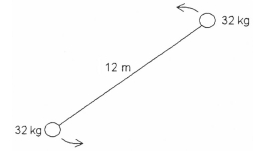
(77) NASA puts a satellite into space that consists of two small 32-kg balls connected by a
12-m long light cable, as shown in the figure. The entire system is initially rotating at 4.0
rpm about an axis perpendicular to the cable at the center of mass. Motors in each mass
reel out more cable so that the masses double their separation to 24 m.
(a) What is the final rotational speed (in rpm) of the balls?
(b) If the initial rotational kinetic energy of the system was K, what is the final rotational
(Short Answer)
4.8/5 (81)
(81) A disk and a hoop of the same mass and radius are released at the same time at the top of an inclined plane. If both are uniform, which one reaches the bottom of the incline first if there is no
Slipping?
(Multiple Choice)
4.9/5 (77)
(77) A 24.5-kg child is standing on the outer edge of a horizontal merry-go-round that has a
moment of inertia of about a vertical axis through its center and a radius of
2.40 m. The entire system (including the child) is initially rotating at 0.180 rev/s. Find the
angular velocity if the child moves to a new position 1.10 m from the center of the
merry-go-round.
(Short Answer)
4.8/5 (82)
(82) A light-weight potter's wheel, having a moment of inertia of is spinning freely at 40.0 rpm. The potter drops a small but dense lump of clay onto the wheel, where it sticks a distance 1.2 m from the rotational axis. If the subsequent angular speed of the wheel and clay is 32 rpm, what is the mass of the clay?
(Multiple Choice)
4.7/5 (78)
(78) A solid sphere and a solid cylinder, both uniform and of the same mass and radius, roll without slipping at the same forward speed. It is correct to say that the total kinetic energy of the solid
Sphere is
(Multiple Choice)
4.9/5 (86)
(86) When you ride a bicycle, in what direction is the angular velocity of the wheels?
(Multiple Choice)
4.9/5 (87)
(87) A uniform solid cylinder of mass 10 kg can rotate about a frictionless axle through its center O , as shown in the cross-sectional view in the figure. A rope wrapped around the outer radius m exerts a force of magnitude to the right. A second rope wrapped around another section of radius exerts a force of magnitude downward. How many radians does the cylinder rotate through in the first 5.0 seconds, if it starts from rest?

(Multiple Choice)
4.8/5 (87)
(87) If the answer to your calculation has units of What type pf quantity could it be? (There could be more than one correct choice.)
(Multiple Choice)
4.8/5 (83)
(83) The drive chain in a bicycle is applying a torque of to the wheel of the bicycle. You can treat the wheel as a thin uniform hoop (or ring) with a mass of 0.750 kg and a radius of 33.0 cm. What is the angular acceleration of the wheel?
(Multiple Choice)
4.7/5 (93)
(93) A person sits on a freely spinning lab stool that has no friction in its axle. When this person extends her arms,
(Multiple Choice)
4.7/5 (87)
(87) An old LP record that is originally rotating at 33.3 rad/s is given a uniform angular acceleration of 2.15 rad/s2. Through what angle has the record turned when its angular speed reaches 72.0 rad/s?
(Multiple Choice)
4.9/5 (81)
(81) The L-shaped object shown in the figure consists of three small masses connected by extremely light rods. Assume that the masses shown are accurate to three significant figures. What is the moment of inertia of this object (a) about the x -axis, and (b) about the y -axis?

(Short Answer)
5.0/5 (77)
(77) In the figure, a weightlifter's barbell consists of two identical small but dense spherical
weights, each of mass 50 kg. These weights are connected by a thin 0.96-m rod with a
mass of 24 kg. Find the moment of inertia of the barbell through the axis perpendicular to
the rod at its center, assuming the two weights are small enough to be treated as point
masses. 
(Short Answer)
4.9/5 (78)
(78) A figure skater rotating at 5.00 rad/s with arms extended has a moment of inertia of If he pulls in his arms so his moment of inertia decreases to angular speed? what will be his new
(Multiple Choice)
4.8/5 (87)
(87) 
Filters
- Essay(0)
- Multiple Choice(0)
- Short Answer(0)
- True False(0)
- Matching(0)