



 Chat with AI
Exam 8: Rotational Motion

Exam 1: Introduction, Measurement, Estimating29 Questions
Exam 2: Describing Motion: Kinematics in One Dimension527 Questions
Exam 3: Kinematics in Two Dimensions; Vectors183 Questions
Exam 4: Dynamics: Newtons Laws of Motion146 Questions
Exam 5: Circular Motion; Gravitation105 Questions
Exam 6: Work and Energy153 Questions
Exam 7: Linear Momentum139 Questions
Exam 8: Rotational Motion148 Questions
Exam 9: Static Equilibrium; Elasticity and Fracture83 Questions
Exam 10: Fluids98 Questions
Exam 11: Oscillations and Waves114 Questions
Exam 12: Sound21 Questions
Exam 13: Temperature and Kinetic Theory87 Questions
Exam 14: Heat88 Questions
Exam 15: The Laws of Thermodynamics78 Questions
Exam 16: Electric Charge and Electric Field99 Questions
Exam 17: Electric Potential107 Questions
Exam 18: Electric Currents96 Questions
Exam 19: Dc Circuits384 Questions
Exam 20: Magnetism164 Questions
Exam 21: Electromagnetic Induction and Faradays Law60 Questions
Exam 22: Electromagnetic Waves167 Questions
Exam 23: Light: Geometric Optics144 Questions
Exam 24: The Wave Nature of Light58 Questions
Exam 25: Optical Instruments156 Questions
Exam 26: The Special Theory of Relativity126 Questions
Exam 27: Early Quantum Theory and Models of the Atom192 Questions
Exam 28: Quantum Mechanics of Atoms74 Questions
Exam 29: Molecules and Solids26 Questions
Exam 30: Nuclear Physics and Radioactivity153 Questions
Exam 31: Nuclear Energy; Effects and Uses of Radiation36 Questions
Exam 32: Elementary Particles19 Questions
Exam 33: Astrophysics and Cosmology25 Questions
Select questions type


An Atwood machine consists of a mass of 3.5 kg connected by a light string to a mass of 6.0 kg over a frictionless pulley with a moment of inertia of 0.0352 and a radius of 12.5 cm. If the system is released from rest, what is the speed of the masses after they have moved through 1.25 m if the string does not slip on the pulley?
(Multiple Choice)
4.9/5  (70)
(70) Two forces produce equal torques on a door about the door hinge. The first force is applied at the midpoint of the door; the second force is applied at the doorknob. Both forces are applied
Perpendicular to the door. Which force has a greater magnitude?
(Multiple Choice)
4.8/5 (81)
(81) Suppose a uniform solid sphere of mass M and radius R rolls without slipping down an inclined plane starting from rest. The linear velocity of the sphere at the bottom of the incline depends on
(Multiple Choice)
4.7/5 (71)
(71) A small uniform disk and a small uniform sphere are released simultaneously at the top of a high inclined plane, and they roll down without slipping. Which one will reach the bottom first?
(Multiple Choice)
4.9/5 (80)
(80) A solid ball of mass 1.0 kg and radius 10 cm rolls with a forward speed of 10 m/s when it
comes to a hill. There is enough friction on the hill to keep the ball from slipping as it rolls
up.
(a) How high vertically up the hill can the ball roll before coming to rest?
(b) How high vertically could the ball go if the hill were totally frictionless?
(c) How is it that the ball can go higher with friction than without friction?
(Essay)
4.9/5 (77)
(77) In the figure, point P is on the rim of a wheel of radius 2.0 m . At time t=0 , the wheel is at rest, and P is on the x -axis. The wheel undergoes a uniform counterclockwise angular acceleration of about the center O.
(a) At time t=0 , what is the tangential acceleration of P?
(b) What is the linear speed of P when it reaches the y -axis?
(c) What is the magnitude of the net linear acceleration of P when it reaches the y -axis?
(d) How long after starting does it take for P to return to its original position on the x -axis?

(Essay)
4.9/5 (86)
(86) While spinning down from 500 rpm to rest, a flywheel does 3.9 kJ of work. This flywheel is in the shape of a solid uniform disk of radius 1.2 m. What is the mass of this flywheel?
(Multiple Choice)
4.8/5 (72)
(72) The L-shaped object shown in the figure consists of three small masses connected by extremely light rods. Assume that the masses shown are accurate to three significant figures. How much work must be done to accelerate the object from rest to an angular speed of 3.25 rad/s (a) about the x -axis, (b) about the y -axis?

(Short Answer)
4.7/5 (78)
(78) The torque required to turn the crank on an ice cream maker is How much work does it take to turn the crank through 300 full turns?
(Multiple Choice)
4.7/5 (90)
(90) A bicycle wheel has an outside diameter of 66 cm. Through what distance does a point on
the rim move as the wheel rotates through an angle o
(Short Answer)
4.8/5 (68)
(68) A 375-g stone hangs from a thin light string that is wrapped around the circumference of a frictionless pulley with a moment of inertia of and a radius of 26 cm. When the stone is released, the stone accelerates downward and the pulley rotates about its axis as the string unwinds.
(a) What is the magnitude of the acceleration of the stone?
(b) What is the tension in the string?
(Short Answer)
4.7/5 (88)
(88) Two uniform solid spheres have the same mass, but one has twice the radius of the other. The ratio of the larger sphere's moment of inertia about a central axis to that of the smaller sphere is
(Multiple Choice)
4.8/5 (78)
(78) As shown in the figure, two blocks are connected by a light string that passes over a frictionless pulley having a moment of inertia of 0.0040 and diameter 10 cm. The coefficient of kinetic friction between the table top and the upper block is 0.30 . The blocks are released from rest, and th string does not slip on the pulley. How fast is the upper block moving when the lower one has fallen 0.60 m?

(Multiple Choice)
4.7/5 (88)
(88) A rolling wheel of diameter of 68 cm slows down uniformly from 8.4 m/s to rest over a distance of 115 m. What is the magnitude of its angular acceleration if there was no slipping?
(Multiple Choice)
4.9/5 (71)
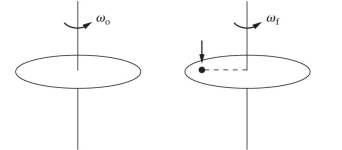
(71) A solid, uniform, horizontal disk with a diameter of 2.0 m and a mass of 4.0 kg freely
rotates at 36 rpm about a vertical axis through its center. A small 0.50-kg stone is suddenly
dropped onto the disk and sticks to the disk at a distance of 80 cm from the axis of
rotation. The figure shows before and after views.
(a) Before the stone fell, what was the moment of inertia of the disk about its central axis?
(b) After the stone stuck, what was the moment of inertia of the system about the same
axis?
(Short Answer)
4.9/5 (89)
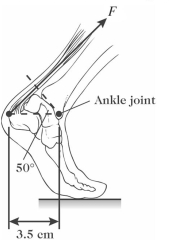
(89) The figure shows a person's foot. In that figure, the Achilles tendon exerts a force of magnitude F= 720 N . What is the magnitude of the torque that this force produces about the ankle joint?
(Multiple Choice)
4.8/5 (69)
(69) A cylinder of radius 8.0 cm rolls 20 cm in 5.0 s without slipping. Through how many
degrees does the cylinder turn during this time?
(Short Answer)
4.8/5 (82)
(82) Two children, Ahmed and Jacques, ride on a merry-go-round. Ahmed is at a greater distance from the axis of rotation than Jacques. Which of the following are true statements? (There could be
More than one correct choice.)
(Multiple Choice)
4.8/5 (79)
(79) The diameter of the Moon is and it subtends an angle of 0.00904 rad when viewed from the surface of Earth. How far is the Moon from Earth?
(Short Answer)
4.9/5 (69)
(69) A solid uniform disk of diameter 3.20 m and mass 42 kg rolls without slipping to the bottom of a hill, starting from rest. If the angular speed of the disk is 4.27 rad/s at the bottom, how high did it start on the hill?
(Multiple Choice)
4.8/5 (85)
(85) 
Filters
- Essay(0)
- Multiple Choice(0)
- Short Answer(0)
- True False(0)
- Matching(0)