Exam 8: Polar Coordinates; Vectors

arrow
  • Select Tags
search iconSearch Question
  • Select Tags

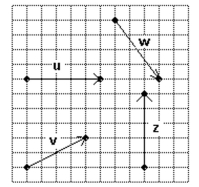
Use the vectors in the figure below to graph the following vector.  Use the vectors in the figure below to graph the following vector.   - v - w     - v−wv - w  Use the vectors in the figure below to graph the following vector.   - v - w
(Multiple Choice)
4.8/5
(94)

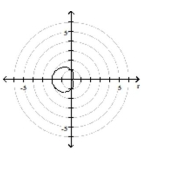
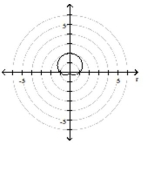
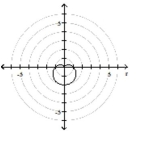
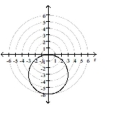
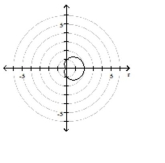
Identify and graph the polar equation. - r=1−cos⁡θr=1-\cos \theta  Identify and graph the polar equation. - r=1-\cos \theta    A)   cardioid  B)   cardioid  C)   cardioid  D)   cardioid  A)  Identify and graph the polar equation. - r=1-\cos \theta    A)   cardioid  B)   cardioid  C)   cardioid  D)   cardioid  cardioid B)  Identify and graph the polar equation. - r=1-\cos \theta    A)   cardioid  B)   cardioid  C)   cardioid  D)   cardioid  cardioid C)  Identify and graph the polar equation. - r=1-\cos \theta    A)   cardioid  B)   cardioid  C)   cardioid  D)   cardioid  cardioid D)  Identify and graph the polar equation. - r=1-\cos \theta    A)   cardioid  B)   cardioid  C)   cardioid  D)   cardioid  cardioid
(Multiple Choice)
4.7/5
(84)

Find ∥v∥\| \mathbf { v } \| . - v=6i+5j−6k\mathbf { v } = 6 \mathbf { i } + 5 \mathbf { j } - 6 \mathbf { k }

(Multiple Choice)
4.9/5
(82)

Write the complex number in polar form. Express the argument in degrees, rounded to the nearest tenth, if necessary. - −4+4i- 4 + 4 \mathrm { i }

(Multiple Choice)
4.8/5
(80)

Write the vector v in the form ai + bj, given its magnitude v and the angle α it makes with the positive x-axis. - ∥v∥=15,α=210∘\| \mathbf { v } \| = 15 , \alpha = 210 ^ { \circ }

(Multiple Choice)
4.7/5
(88)

The letters x and y represent rectangular coordinates. Write the equation using polar coordinates (r, θ). - 2x+3y=62 x + 3 y = 6

(Multiple Choice)
4.9/5
(88)

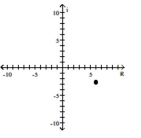
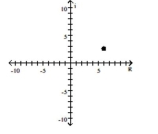
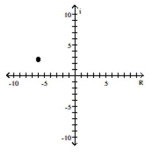
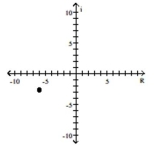
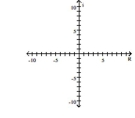
Plot the complex number in the complex plane. - 6+7i6+\sqrt{7} i  Plot the complex number in the complex plane. - 6+\sqrt{7} i     A)    B)   C)    D)    A)  Plot the complex number in the complex plane. - 6+\sqrt{7} i     A)    B)   C)    D)    B)  Plot the complex number in the complex plane. - 6+\sqrt{7} i     A)    B)   C)    D)    C)  Plot the complex number in the complex plane. - 6+\sqrt{7} i     A)    B)   C)    D)    D)  Plot the complex number in the complex plane. - 6+\sqrt{7} i     A)    B)   C)    D)
(Multiple Choice)
4.8/5
(80)

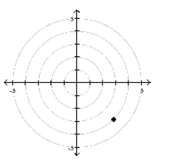
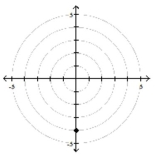
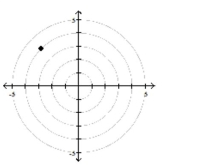
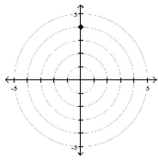
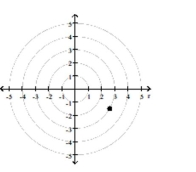
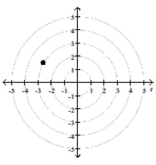
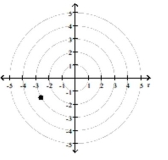
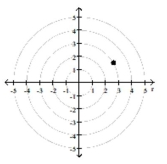
Plot the point given in polar coordinates. - (4,315∘)\left( 4,315 ^ { \circ } \right)  Plot the point given in polar coordinates. - \left( 4,315 ^ { \circ } \right)     A)    B)    C)    D)    A)  Plot the point given in polar coordinates. - \left( 4,315 ^ { \circ } \right)     A)    B)    C)    D)    B)  Plot the point given in polar coordinates. - \left( 4,315 ^ { \circ } \right)     A)    B)    C)    D)    C)  Plot the point given in polar coordinates. - \left( 4,315 ^ { \circ } \right)     A)    B)    C)    D)    D)  Plot the point given in polar coordinates. - \left( 4,315 ^ { \circ } \right)     A)    B)    C)    D)

(Multiple Choice)
4.9/5
(87)

Solve the problem. -If u = -9i - 2j and v = -3i + 7j, find u - v.

(Multiple Choice)
4.9/5
(79)

The rectangular coordinates of a point are given. Find polar coordinates for the point. - (−7,0)( - 7,0 )

(Multiple Choice)
4.9/5
(78)

The letters r and θ represent polar coordinates. Write the equation using rectangular coordinates (x, y). - r=1+2sin⁡θ\mathrm { r } = 1 + 2 \sin \theta

(Multiple Choice)
4.9/5
(66)

State whether the vectors are parallel, orthogonal, or neither. -v = 4i - 2j, w = 4i + 2j

(Multiple Choice)
4.9/5
(69)

Solve the problem. -Two forces of magnitude 25 pounds and 40 pounds act on an object. The force of 40 lb acts along the positive x-axis, and the force of 25 lb acts at an angle of 80° with the positive x-axis. Find the direction and magnitude Of the resultant force. Round the direction and magnitude to the nearest whole number.

(Multiple Choice)
4.9/5
(75)

The polar coordinates of a point are given. Find the rectangular coordinates of the point. -(400, 130°) Round the rectangular coordinates to two decimal places.

(Multiple Choice)
4.9/5
(74)

Plot the point given in polar coordinates. - (3,7π6)\left( 3 , \frac { 7 \pi } { 6 } \right)  Plot the point given in polar coordinates. - \left( 3 , \frac { 7 \pi } { 6 } \right)     A)    B)    C)    D)    A)  Plot the point given in polar coordinates. - \left( 3 , \frac { 7 \pi } { 6 } \right)     A)    B)    C)    D)    B)  Plot the point given in polar coordinates. - \left( 3 , \frac { 7 \pi } { 6 } \right)     A)    B)    C)    D)    C)  Plot the point given in polar coordinates. - \left( 3 , \frac { 7 \pi } { 6 } \right)     A)    B)    C)    D)    D)  Plot the point given in polar coordinates. - \left( 3 , \frac { 7 \pi } { 6 } \right)     A)    B)    C)    D)

(Multiple Choice)
4.8/5
(82)

Solve the problem. Leave your answer in polar form. - z=8 +i W=3 +i Find zw.

(Multiple Choice)
4.8/5
(89)

Find the direction angles of the vector. Round to the nearest degree, if necessary. - v=−6i−4j−12k\mathbf { v } = - 6 \mathbf { i } - 4 \mathbf { j } - 12 \mathbf { k }

(Multiple Choice)
4.8/5
(75)

Use the given vectors to find the indicated expression. -v = -4i - 3j + 2k, w = -5i - 5j + 4k, u = 4i + 4j - 4k Find w · (v × u).

(Multiple Choice)
4.8/5
(74)

Test the equation for symmetry with respect to the given axis, line, or pole. - r2=sin⁡(2θ); the pole \mathrm { r } ^ { 2 } = \sin ( 2 \theta ) \text {; the pole }

(Multiple Choice)
4.7/5
(94)

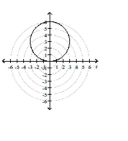
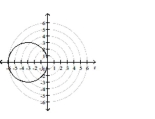
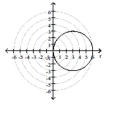
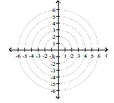
Transform the polar equation to an equation in rectangular coordinates. Then identify and graph the equation. - r=6sin⁡θr = 6 \sin \theta  Transform the polar equation to an equation in rectangular coordinates. Then identify and graph the equation. - r = 6 \sin \theta     A)     x^{2}+(y-3)^{2}=9 ;   circle, radius 3 center at   (0,3)   in rectangular coordinates  B)     (x+3)^{2}+y^{2}=9 \text {; circle, radius 3 }   center at   (-3,0)   in rectangular coordinates  C)     (x-3)^{2}+y^{2}=9  ; circle, radius 3 , center at   (3,0)   in rectangular coordinates  D)     \mathrm{x}^{2}+(\mathrm{y}+3)^{2}=9  ; circle, radius 3 center at   (0,-3)   in rectangular coordinates A)  Transform the polar equation to an equation in rectangular coordinates. Then identify and graph the equation. - r = 6 \sin \theta     A)     x^{2}+(y-3)^{2}=9 ;   circle, radius 3 center at   (0,3)   in rectangular coordinates  B)     (x+3)^{2}+y^{2}=9 \text {; circle, radius 3 }   center at   (-3,0)   in rectangular coordinates  C)     (x-3)^{2}+y^{2}=9  ; circle, radius 3 , center at   (3,0)   in rectangular coordinates  D)     \mathrm{x}^{2}+(\mathrm{y}+3)^{2}=9  ; circle, radius 3 center at   (0,-3)   in rectangular coordinates x2+(y−3)2=9; x^{2}+(y-3)^{2}=9 ; circle, radius 3 center at (0,3) (0,3) in rectangular coordinates B)  Transform the polar equation to an equation in rectangular coordinates. Then identify and graph the equation. - r = 6 \sin \theta     A)     x^{2}+(y-3)^{2}=9 ;   circle, radius 3 center at   (0,3)   in rectangular coordinates  B)     (x+3)^{2}+y^{2}=9 \text {; circle, radius 3 }   center at   (-3,0)   in rectangular coordinates  C)     (x-3)^{2}+y^{2}=9  ; circle, radius 3 , center at   (3,0)   in rectangular coordinates  D)     \mathrm{x}^{2}+(\mathrm{y}+3)^{2}=9  ; circle, radius 3 center at   (0,-3)   in rectangular coordinates (x+3)2+y2=9; circle, radius 3 (x+3)^{2}+y^{2}=9 \text {; circle, radius 3 } center at (−3,0) (-3,0) in rectangular coordinates C)  Transform the polar equation to an equation in rectangular coordinates. Then identify and graph the equation. - r = 6 \sin \theta     A)     x^{2}+(y-3)^{2}=9 ;   circle, radius 3 center at   (0,3)   in rectangular coordinates  B)     (x+3)^{2}+y^{2}=9 \text {; circle, radius 3 }   center at   (-3,0)   in rectangular coordinates  C)     (x-3)^{2}+y^{2}=9  ; circle, radius 3 , center at   (3,0)   in rectangular coordinates  D)     \mathrm{x}^{2}+(\mathrm{y}+3)^{2}=9  ; circle, radius 3 center at   (0,-3)   in rectangular coordinates (x−3)2+y2=9 (x-3)^{2}+y^{2}=9 ; circle, radius 3 , center at (3,0) (3,0) in rectangular coordinates D)  Transform the polar equation to an equation in rectangular coordinates. Then identify and graph the equation. - r = 6 \sin \theta     A)     x^{2}+(y-3)^{2}=9 ;   circle, radius 3 center at   (0,3)   in rectangular coordinates  B)     (x+3)^{2}+y^{2}=9 \text {; circle, radius 3 }   center at   (-3,0)   in rectangular coordinates  C)     (x-3)^{2}+y^{2}=9  ; circle, radius 3 , center at   (3,0)   in rectangular coordinates  D)     \mathrm{x}^{2}+(\mathrm{y}+3)^{2}=9  ; circle, radius 3 center at   (0,-3)   in rectangular coordinates x2+(y+3)2=9 \mathrm{x}^{2}+(\mathrm{y}+3)^{2}=9 ; circle, radius 3 center at (0,−3) (0,-3) in rectangular coordinates
(Multiple Choice)
4.9/5
(67)
Showing 221 - 240 of 270
close modal

Filters

  • Essay(0)
  • Multiple Choice(0)
  • Short Answer(0)
  • True False(0)
  • Matching(0)