



 Chat with AI
Exam 1: Thinking Critically

Exam 1: Thinking Critically195 Questions
Exam 2: Approaches to Problem Solving149 Questions
Exam 3: Numbers in the Real World290 Questions
Exam 4: Managing Money262 Questions
Exam 5: Statistical Reasoning230 Questions
Exam 6: Putting Statistics to Work258 Questions
Exam 7: Probability: Living With the Odds261 Questions
Exam 8: Exponential Astonishment103 Questions
Exam 9: Modeling Our World85 Questions
Exam 10: Modeling With Geometry127 Questions
Exam 11: Mathematics and the Arts62 Questions
Select questions type


Evaluate the validity of the chain of conditionals.
-Premise: If I pay my bills on time, then my credit will be good. Premise: If my credit is good, then I will become a movie star.
Conclusion: If I pay my bills on time, then I will become a movie star.
(Multiple Choice)
5.0/5  (83)
(83) Draw a Venn diagram to determine whether the argument is valid.
-Premise: All snakes have fangs.
Premise: Teri's pet does not have fangs.
Conclusion: Teri's pet is not a snake.
(Essay)
4.8/5 (84)
(84) Determine whether the statement is true or false.
-If , then Canada is in North America.
(True/False)
4.9/5 (78)
(78) Decide whether the statement makes sense. Explain your reasoning.
-The answer to the question is a whole number but it is not an integer.
(Essay)
4.7/5 (85)
(85) The statement connects two individual propositions with the word and. State whether the entire statement is true or false,and explain why.
-George Washington was the first president of the United States of America and France is in
Europe.
(True/False)
4.9/5 (79)
(79) Rephrase the statement as a conditional proposition with the form "if p, then q."
-All chocolate is good.
(Multiple Choice)
4.9/5 (71)
(71) The argument given or described involves some kind of fallacy. Identify the fallacy.
-When confronted with questions from the press about alleged scandals, a congressman replies that the allegations against him should be ignored since his accuser is part of a vast right-wing
Conspiracy.
(Multiple Choice)
4.8/5 (89)
(89) Choose the first set in the list natural numbers, whole numbers, integers, rational numbers, and real numbers thatdescribes the following number.
--70
(Multiple Choice)
4.8/5 (71)
(71) Decide whether the statement makes sense. Explain your reasoning.
-If you have $5, then you will buy a hot dog; and, contrapositively, if you don't have $5,
then you won't buy a hot dog. (Hint: focus on whether the word "contrapositively" is used
correctly.)
(Essay)
4.7/5 (85)
(85) The statement contains a double or multiple negation. Analyze the statement, explaining what it means.
-The following Venn diagram describes the cars on a used car lot. Use it to determine how many Fords are on the lot. 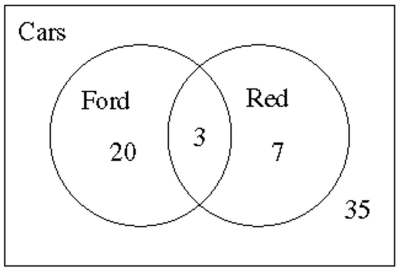
(Multiple Choice)
4.9/5 (77)
(77) Draw a Venn diagram for the given sets. In words, explain why you drew one set as a subset of the other, disjoint sets, oroverlapping sets.
-motor vehicles and cars
(Essay)
4.8/5 (81)
(81) Decide whether the argument is inductive or deductive.
-Linda's last four children were girls. Therefore, the next one will be a girl.
(Multiple Choice)
4.9/5 (74)
(74) Decide whether the argument is inductive or deductive.
-For any positive number p
(Multiple Choice)
4.8/5 (74)
(74) Two statements are listed in which p, q, and r represent propositions. Are the two statements logically equivalent?
-not (p and q); (not p)or q
(True/False)
4.8/5 (70)
(70) Provide an appropriate response.
-Consider the following ballot initiative:
"Shall there be an amendment to the state constitution to prohibit the state legislature from
adopting any law which inhibits the freedom of religious expression?"
Explain the meaning of a "no" vote.
(Essay)
4.9/5 (79)
(79) Draw a Venn diagram with three overlapping circles for the three given sets. Label the contents of every region. If aregion has no members, state that fact clearly.
-salty things, sweet things, tangy things
(Essay)
4.8/5 (87)
(87) Determine the truth of the premises, discuss the strength of the argument, and assess the truth of the conclusion.
-Premise: Calvin Coolidge was over 35 years old when he became President of the United
States.
Premise: Bill Clinton was over 35 years old when he became President of the United States.
Premise: Ronald Reagan was over 35 when he became President of the United States.
Conclusion: Every United States politician is at least 35 years old.
(Essay)
4.8/5 (82)
(82) The argument contains an example of the fallacy named in parentheses. Explain how the fallacy occurs in the argument.
-(Hasty Generalization)Isabelle had vegetarian food for lunch every day last week, so she
must be a vegetarian.
(Essay)
4.7/5 (76)
(76) Create a simple three-line argument for the given form. Choose your example so that it illustrates clearly whether or notthe argument is valid.
-Affirming the conclusion
(Essay)
4.9/5 (81)
(81) Draw a Venn diagram to determine whether the argument is valid.
-Premise: No surfers speak French.
Premise: Pierre speaks French.
Conclusion: Pierre is not a surfer.
(Essay)
4.9/5 (85)
(85) 
Filters
- Essay(0)
- Multiple Choice(0)
- Short Answer(0)
- True False(0)
- Matching(0)